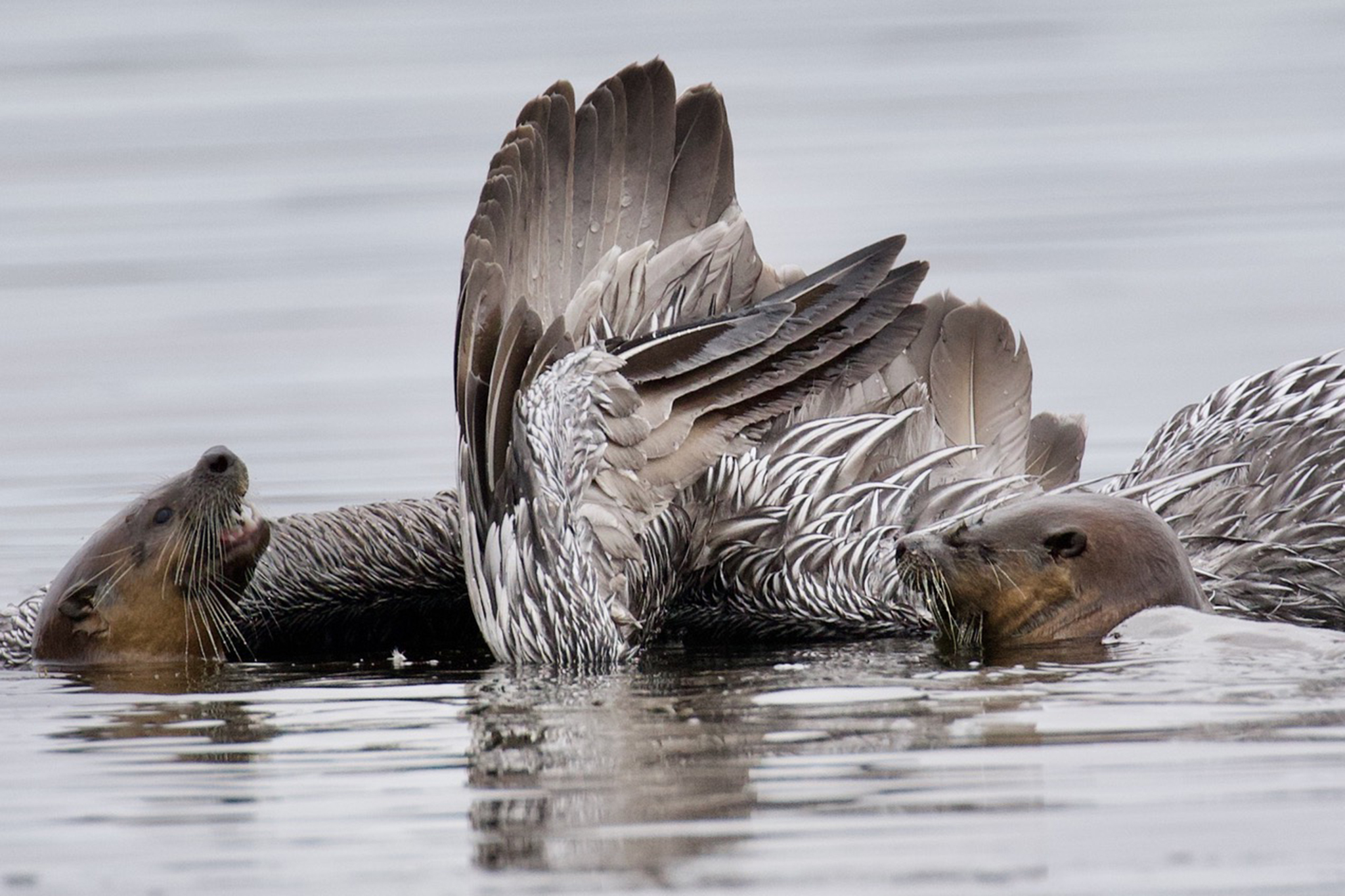
River otters are hunting and drowning pelicans in a Bay Area lagoon
Early one morning in 2018, Megan Isadore was observing wildlife at Abbotts Lagoon, along the northwestern edge of Point Reyes National Seashore, when she noticed something splashing in the water. At first, the co-founder of the River Otter Ecology Project thought it could have been anything — the area is home to a wide variety of species including thousands of waterfowl and shorebirds, as well as mammals such as weasels and bobcats.
Read more Body found in SF Bay on Saturday identified as another boat capsizing victim

Isadore saw it was a brown pelican, which wasn’t unusual. The diving waterbirds liked to spend the nonbreeding season resting at the site. But this one’s wings were flapping in a way that struck her as abnormal. “I could see it struggling, but I couldn’t figure out why,” she told SFGATE over the phone.
The movement all but stopped as the bird’s head was pulled underwater by an unseen force. Then, the head of a river otter popped to the surface, chewing.
“I realized the otter had grabbed the pelican, killed it by drowning it, and was starting to eat it,” Isadore said. “I was with a couple of other people who were somewhat horrified.”
She had never observed the hunting behavior herself before. Over the next couple of years, Isadore regularly checked her camera traps, which she had been previously using to monitor river otters in the area as part of her nonprofit’s mission to preserve the health of local watersheds. She found an increasing number of pelican carcasses littering the shoreline, and it fascinated her.
A shocking pattern
Typically, river otters seek out prey closer to their own size: cormorants, surf scoters, gulls and ducks, or smaller creatures like crustaceans and amphibians. “They’re very fierce and hungry little animals,” Isadore said. “They’ll get whatever’s plentiful and easiest to catch.”
But she learned it was the first time in decades that a river otter had been observed drowning a brown pelican, a species Isadore said otherwise has few known predators. The last reported instance of the behavior was in 2006, at Rodeo Lagoon in the Marin Headlands, with another one-off instance in 1998 at Lake Tolowa in Del Norte County. It has never been documented outside of California.
Questions raced through Isadore’s mind. Both river otters and brown pelicans are recovering species that have rebounded from low numbers historically caused by pollution, habitat loss and lack of hunting regulations. Were the otters killing enough pelicans to cause a problem for the population at large? Would the pelicans begin to leave the area in response to their peers’ killer instincts? And how did the behavior emerge in Point Reyes in the first place?
Isadore and her partner Terence Carroll, also a co-founder of the River Otter Ecology Project, decided to conduct on-the-ground research to learn more.
Counting the casualties
The resulting paper, published in April 2025 in the IUCN/SSC Otter Specialist Group Bulletin, is the result of an intensive monitoring project taking place from the beginning of June to November 2023, when the last of the pelicans had left for the season. Isadore said she and Carroll went out every week or so, circling the lower lagoon to track pelican carcasses. They labeled each one with biodegradable marker to avoid counting the same bird twice. Then, they photographed the specimens before collecting the measurements of their wings and beaks.
“We wanted to figure out whether the pelicans we were finding were young or fully adult,” Isadore explained.
The couple counted an average of 300 live pelicans resting on the lagoon at any given point, and 73 carcasses over the course of one season. The number of dead pelicans was significant — “more than we’d ever seen before,” Isadore said — but not enough to affect the population. Many of them had been dragged to the shoreline of the lagoon, and most appeared to be younger birds, according to Carroll.
Still, their findings only tell part of the story. Did one otter successfully drown a pelican and start teaching others to hunt in the same way? How did the behavior extend from one otter to another? Isadore still isn’t sure.
“The most exciting question to me is why did it take this long to spread from Rodeo Lagoon to Abbotts Lagoon?” Isadore said. It wouldn’t be out of the question for river otters from Rodeo Lagoon to make the 50-mile journey to Abbotts Lagoon. “But it’s a long haul and seems unlikely,” Isadore said.
The behavior also appears to be driven by different factors. At Rodeo Lagoon in the mid-aughts, researchers hypothesized that excessive algae growth had reduced fish stocks, forcing river otters to consume pelicans as an alternative food source. But similar conditions related to eutrophication — or overenrichment of nutrients in the water — are not present at Abbotts Lagoon, meaning the behavior likely represents a different relationship between predator and prey.
“If pelicans are a consistent diet preference, rather than an episodic replacement food source, the ecosystem effects of these nutrient subsidies are likely to be magnified and longer-lasting,” the paper says.
A ruthless hunter
Despite their water-puppyish appearance, Isadore described river otters as opportunistic hunters that would certainly go after an unsuspecting pelican if given the chance. The animals may be affectionate and playful within their family groups but also have a surprising reputation for violence: Their aggressive mating behaviors can lead to severe if not fatal bite wounds. They sometimes hold other otters’ pups underwater until they receive a food ransom. A Vox article published in 2014 called them the “necrophiliac, serial-killing fur monsters of the sea.”
Read more California man’s Hawaii voyage became a monthlong fight for survival
While the pelican drownings are “a novel phenomenon,” Isadore said river otters have been known to drown other birds, too. “It’s quite brutal,” she said. “They can gang up on them and kill them and literally rip them to pieces.”
“I, thankfully, have not observed that,” she added.
But it’s part of the circle of life — and could simply be a reflection of two flourishing populations living side by side. River otters are mammals with high energy needs and have to eat large quantities of food in order to stay warm while hunting in cold water, Isadore explained. According to the paper, the semiaquatic weasels have a demonstrated ability to employ repetitive use of successful foraging routes, which may explain the consistency of the pelican hunting behavior.
“Pelicans are big and have a lot of meat on them,” Isadore said. “It’s a lot of bang for their buck.”
A changing ecosystem
Isadore and Carroll hope to someday pursue a longer study allowing them to research other long-term impacts of the hunting behavior. She’s noticed that pelicans, which previously exhibited no fear of river otters, have started to flush and fly away when they approach. In the paper, she called these observations the “first known reports of avoidance behavior” between both species.
Other research has shown the carcasses the river otters leave behind provide scraps for coyotes wandering along the coastline, as well as birds of prey like turkey vultures. Otters are too small to eat an entire pelican at once, so they cache the remains and leave them in the water for later, and scavengers seek them out.
Isadore is curious to learn how big of a role brown pelicans play in river otter diets, information she could determine through DNA metabarcoding. She’s also interested in the broader effects the predation could have on the local ecosystem.
“This is behavior that’s different, new and not like anything we’ve seen before,” Isadore said. “But, as you know, it’s difficult to get funding for any kind of science right now.”
Over the past few months, she’s only seen a few pelican carcasses along the shoreline — not nearly as many as before. Still, Isadore acknowledged, it’s early in the season, and she plans to lead docent walks through the lagoon this summer, where she will continue to keep an eye on the birds.
Dave Press, integrated resources program manager and wildlife ecologist at Point Reyes National Seashore, told SFGATE the National Park Service was aware of the predatory feeding behavior, but without a regular monitoring presence at the lagoon, he could not speak to the frequency with which it was occurring. Press said the localized behavior has been known to occur between river otters and cormorants and surf scoters, with the otters attacking the birds from below as they rested on the water.
Daniel Dietrich, a wildlife photographer and nature guide who visits the lagoon multiple times a week, told SFGATE that while the behavior was “incredible a few years ago at its peak,” the pelicans have “not been in the lagoon in any numbers even close to what [there] used to be.” A video he recently shared on Instagram sparked conversation around the hunting behavior again — for many, it was the first time they had witnessed the gruesome spectacle. The post showed footage he captured in 2023 of otters taking down not one, but two pelicans.
Dietrich said it was the first time the behavior had ever been caught on camera. It’s not clear if or when it will be observed again.

BECOME A FRIEND. GET OUR AD-FREE APP.
“I think that it has largely stopped is an amazing part of the story,” he said in an email. “Could the pelicans truly have learned this over the few years it was happening so frequently? How did they ‘tell’ each other?”
Dietrich said he still sees the birds in other parts of Point Reyes like Chimney Rock, Drakes Beach and even the coast along Abbotts Lagoon. But they don’t venture further anymore.
“They just give it a miss, or they circle and then keep going,” he said. “It is amazing.”
— California Forever dealt huge blow as $3 billion contract goes to Texas
— Bay Area city braces for biggest housing boom in decades
— Free parking at abandoned San Francisco Walgreens is over
— Wild pigs are tearing up this Bay Area neighborhood
Get SFGATE’s top stories sent to your inbox by signing up for The Daily newsletter here.
Read more 2 firefighters injured in uncontained blaze near Yosemite National Park