How a wealthy Bay Area town killed a train station to prevent housing
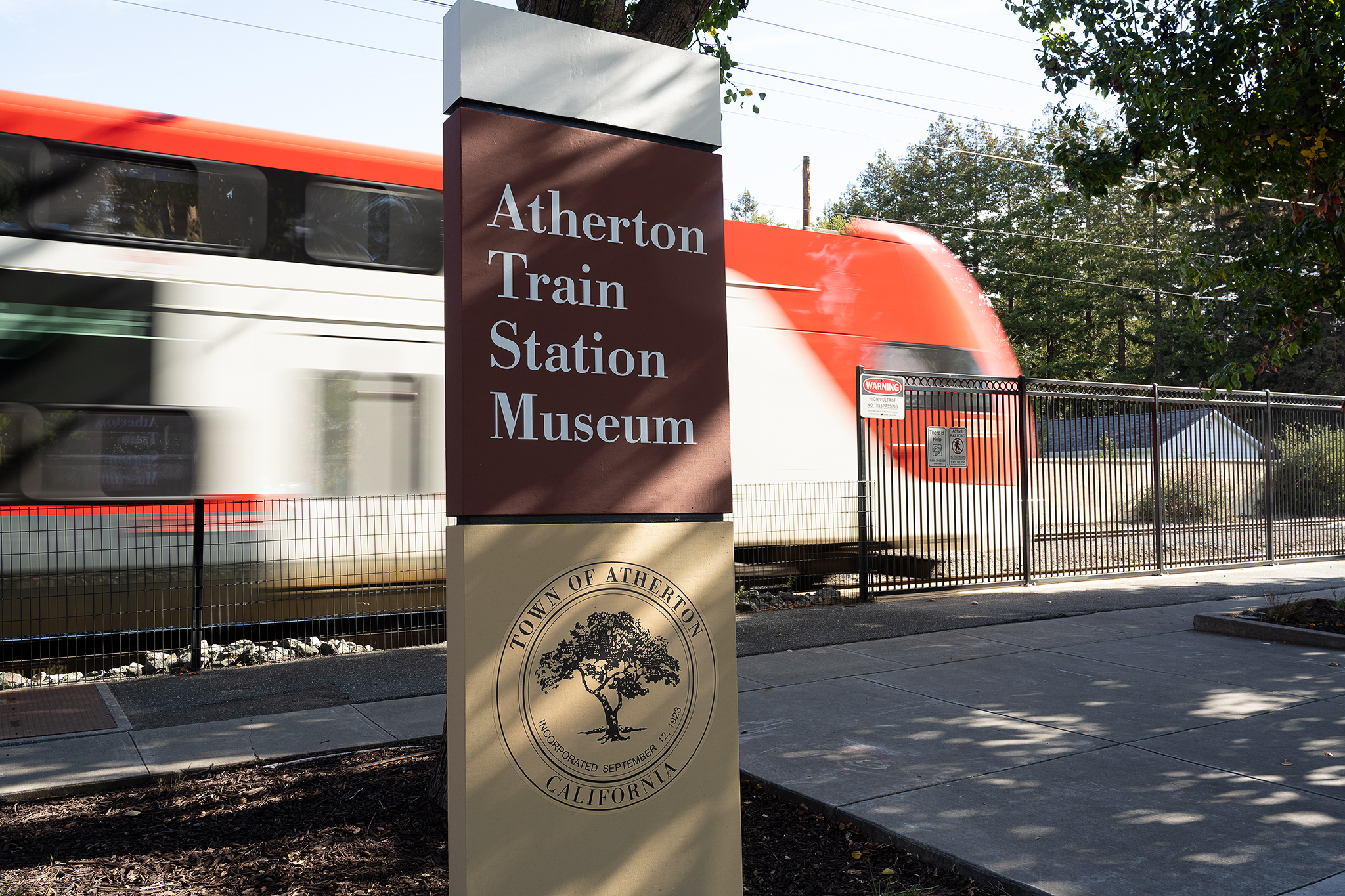
The most expensive ZIP code in the United States doesn’t have any restaurants or stores. On Sunday, however, the Bay Area town opened its first tourist attraction: the Atherton Train Station Museum.
Read more SF man operating self-driving Tesla hits, kills pedestrian on I-80, CHP says

A crowd of about 200 people turned out for the grand opening, which featured a DJ and food truck. Mayor Stacy Holland thanked the museum’s developers for “choo-choo-choosing to invest in Atherton’s heritage.”
It was an inherently awkward tribute.
Years ago, Atherton and California transit veered onto separate tracks. First, the town sued to stop Caltrain’s transition to electric trains. Atherton residents were afraid that it paved the way for high-speed rail, which could disrupt their way of life. Later, the station itself became a threat to Atherton’s single-family zoning, as housing advocates proposed fast-tracking denser development near public transportation hubs.
Atherton once went to war against the railroad, and the history is thorny. Some locals insist that the train had run its course, only serving riders on the weekend. Housing advocates see it as a front line in the Bay Area’s affordability crisis.
This week, the town enshrined a station that it worked so hard to mothball. Inside the 680-square-foot tombstone to lost transit, a diorama depicts the Atherton stop across five eras, but steers clear of any drama.
“We absolutely avoided getting into political controversy with the museum,” said Vice Mayor Rick DeGolia, who co-led the museum’s planning. Instead, he said they focused on the “important story” of rail on the Peninsula.
Trains roared by the depot during the grand opening, but they didn’t slow down. According to Caltrain spokesperson Dan Lieberman, Atherton is the only town on the transit line without a stop.
One-track mind
Atherton’s claim to fame is that it’s expensive to live there. In 2023, an empty lot sold for $25 million. This year, it was officially the priciest ZIP code in the United States, according to real estate data firm PropertyShark, a title it’s held many times before. The median sale price for a home is $10.7 million.
Businesses are banned — no restaurants, theaters or grocery stores — and the town’s sole bar is inside the private Menlo Circus Club, once billed as “the only country club in America designed exclusively for children.”
Bill Widmer, a councilmember and former mayor, said that outsiders have long characterized Atherton residents as “people who are arrogant, just because they’re fortunate.”
Some believe that Atherton deserves that reputation. Housing advocates label them one of the most stubborn cities in California toward housing density, despite their direct proximity to some of the region’s largest private employers.
“They’re just some really good villains,” said Leora Tanjuatco Ross, California director for the housing advocacy nonprofit YIMBY Action. “We couldn’t ask for better villains.”
Few aspects of Atherton better symbolize the divide between local control and outside influence than the train tracks.
In 2015, Caltrain was preparing to electrify its line, a project partly funded with high-speed rail money and designed to share tracks with future bullet trains. Atherton filed a lawsuit to hit the brakes.
“With respect to high-speed rail, our position remains immutable,” Atherton’s town staff wrote to the city council in 2015. “The impacts in Atherton are
significant and we will stand in front of that train until our concerns are addressed.”
Atherton argued that rail electrification was a Trojan horse for high-speed rail, a doomsday development they believed would drown the town in traffic at rail crossings and jam up ambulances. The suit alleged that Caltrain hadn’t and that the environmental review failed to analyze noise impacts, among many other issues.
Around that time, Rosemary Maulbetsch — a member of Atherton’s rail committee — rallied residents to a letter-writing campaign focused on how trees would be impacted. At the Atherton Train Station Museum, she’s remembered with a memorial plaque for her efforts.
Read more Plane crash shuts down I-80 near Google, Switch data centers
Caltrain’s response was blunt. “We’re incredibly disappointed that Atherton has chosen to go this route,” agency spokesperson Jayme Ackemann said at the time. “There are 17 communities along this [railroad]. We have managed to work with the 16 others to make sure there are no problems.”
Atherton eventually . It joined a second suit, this one against a state law steering high-speed rail bond money toward electrification. That lost on appeal in 2021.
The town’s efforts to derail trains weren’t in vain. Atherton’s litigious nature was cited by a 2024 state Senate as a reason to change California law. The Legislature passed a bill exempting future zero-emission rail projects from the California Environmental Quality Act, the environmental review law the town had sued under, which the analysis said was meant “to prevent future similar lawsuits.”
Although Atherton lost in court, the damage was done. Adina Levin, co-founder of transit advocacy nonprofit Seamless Bay Area, measured the cost of Atherton’s rail lawsuits in years, and potentially hundreds of millions in expanded costs.
“Caltrain sought a grant from the Federal Transit Administration, but they wouldn’t confirm the grants until the lawsuit was resolved,” Levin said. “The 19-month delay meant Caltrain wasn’t able to get the funding in the Obama administration. Then the Trump administration held up the funding … so that overall added up to a delay of three years.”
Radioactive rail
Atherton originally grew up around the station, as its new museum details, but the relationship with Caltrain became fraught in recent years. “We can’t eliminate the tracks and they can’t eliminate the town,” DeGolia said in 2017.
In 2005, Caltrain scaled back service to a weekend-only schedule, despite the fact Jim Janz, a councilmember at the time, said that there were over 300 riders a day. After the cuts, he said ridership plummeted to 115 people. “Caltrain has destroyed ridership at our station,” Janz said that year. A breakup felt inevitable.
Their next battle wouldn’t be about the trains, however. It would be about the station itself, when years later, it became apparent that the depot could force the town into approving apartment buildings.
Atherton’s little train depot went from quaint to radioactive.
San Francisco state Sen. Scott Wiener introduced Senate Bill 50 at the end of 2018, which would have allowed developers to build denser housing near transit stops, single-family zoning be damned. In Atherton, the proposal landed less like legislation, and more like a declaration of war.
“The people that lived around the station were saying, ‘Yeah, let’s get rid of the station,’” Widmer said. “‘Let’s get rid of the stop, because we don’t want to be included in that housing density stuff.’ A lot of the residents were suddenly in favor of closing the station.”
Having the highest price per property for a ZIP code in the United States created “an enormous target” on Atherton’s back, DeGolia said. He defended the town for merely protecting its values.
“Atherton is opposed to the transformation of single-family neighborhoods because all that we have, except for the eight schools that exist, are single-family residences,” DeGolia said. “There’s a great need in Atherton for affordable housing, and the only way to get there is with ADUs and with apartments at the schools. You’re not going to get there by some developer coming in and building an apartment building.”
Though SB 50 died on the Senate floor, the train depot became a looming threat. The fate of Atherton’s train station was sealed in 2020. That January, Caltrain proposed closing it for good, citing the need for $30 million in fixes and upgrades, few riders and “the lower density, residential character” of the neighborhood. Within a week, the town agreed.
Atherton chose its single-family zoning over transit. Its leaders don’t regret it.
“If the Atherton train station were open, [new density laws] would apply to hundreds of properties in Atherton, like it applies to hundreds of properties in Menlo Park,” DeGolia said. “Given that the station closed, we don’t have to face that. To avoid transforming those neighborhoods immediately around the train station into six-story apartment buildings, that’s a benefit to Atherton.”
— Plane crash shuts down I-80 near Google, Switch data centers
— How a wealthy Bay Area town killed a train station to prevent housing
— $725M mega-hotel breaks ground on I-5 between LA and SF
— How Wang Chung’s became the go-to karaoke spot in Hawaii
Read more Ex-fast food manager stole $232K, spent nearly all of it at Bay Area casino
For more travel news and features, sign up for our TravelSkills newsletter here.