New report shows what happened in deadly Castle Peak avalanche
Blackbird Mountain Guides released a preliminary report Sunday from an independent investigation into the Feb. 17 avalanche that killed nine people near Castle Peak on Donner Summit.
Read more Section of Highway 1 closed as Timber Fire in Big Sur spreads

The internal report includes findings that help explain unanswered questions about the horrific avalanche, including more information about the guides’ decision-making processes in the days and hours leading up to the avalanche and the route the group ultimately took.
The document does not, however, explain why the skiers and snowboarders chose to leave the Frog Lake huts in a severe blizzard, instead of staying inside to wait out the storm.
The nine victims were part of a group of 15 skiers and snowboarders, including four guides from Blackbird Mountain Guides and 11 clients who’d signed up for a multiday backcountry trip to the Frog Lake huts. Eight of the 11 clients were a group of women, many from the Bay Area, who were friends.
The victims included six clients and three guides employed by Blackbird: Niki Choo, Mike Henry and Andrew Alissandratos.
“Niki, Mike and Andrew were really good people — they loved this job and they loved their clients,” Blackbird Mountain Guides wrote in a statement emailed to SFGATE on Monday. All three were highly trained guides with extensive training and certifications through the American Mountain Guides Association and the American Avalanche Association. They were also experienced with the terrain at the Frog Lake huts and the weather patterns in the Sierra Nevada, the company noted.
The report is compiled by Don Sharaf, an avalanche expert with 35 years of experience in fieldwork, avalanche education and consulting. It is based on “statements and data from many sources,” including oral interviews from survivors and rescuers, as well as written statements, maps, GPS tracks, photos, weather data, client questionnaires and summaries from morning guide meetings.
According to the report, the guides met on the morning of Sunday, Feb. 15 — the first day of the trip to the Frog Lake huts — and discussed a break in the storm that was forecast for Tuesday morning, Feb. 17. The forecast predicted heavy snowfall through Monday evening and then again in the afternoon on Tuesday, with a lull Tuesday morning that could be a weather window for their departure from the huts.
On Monday afternoon, Alissandratos, a senior guide, spoke with Zeb Blais, founder of Blackbird Mountain Guides, by phone about the group’s departure plans for the following morning. On that call, they discussed the snowpack conditions. Alissandratos was the most familiar with the terrain, having led many trips to the Frog Lake huts before. He had dug pits in the snow, including one on the northern aspect of Red Dot Pass. Digging a pit is a way to see what’s lurking beneath the surface of the snow and enables backcountry skiers to see if there are weak layers and to do tests that can help better detect the avalanche risk. “Alissandratos reported the results of the snowpack tests above, including no propagation in the extended column test (ECTN), and no other avalanches observed Sunday or Monday,” the report states.
The clients had asked to ski an extra lap on Tuesday morning before leaving, according to the report, but the guides decided against it. “The weather forecast was such that they should leave as soon as possible following breakfast and packing,” the report states. “The predicted Tuesday morning weather window was going to shut quickly.”
Deciding on a route to leave was not straightforward. Considering one route, the group would have to thread a line between public and private property marked with no trespassing signs. “The 7C property has aggressively pursued trespassers in past years and knowledgeable parties avoid crossing that property boundary,” the report states. The guides also decided against a longer, flatter route to the east out of “consideration for the group’s endurance and safety in deep snow and low visibility.”
In the end, they chose a route near Red Dot Pass that would take them through avalanche terrain under Perry’s Peak. They discussed what would be the safest route and talked about crossing a creek and traversing along “the far side of the meadow” to create a wide buffer between Perry’s Peak and their route.
However, Strava tracks from Choo, an apprentice ski guide, show the skiers were thwarted by the creek. In normal conditions, snow bridges the creek, making it possible to cross. But Choo’s Strava track shows they approached the creek two or three times, yet the creek was seemingly unpassable, pushing them onto the route that led to the avalanche runout zone.
The report addresses another big question, which is why they weren’t spaced farther apart. When traveling in avalanche terrain, it’s common practice to travel one at a time or to put distance between people. But it seems the group was disoriented and didn’t realize that they were in an avalanche path. “The tight tree spacing, trees between the group and the start zone above, and the similarity to the terrain that they had just been crossing does not make the path easily recognizable,” the report states. “Navigating by a digital map on a phone can be impossible in blizzard conditions.”
“On day 3 of the trip the storm intensity ramped up and trail-breaking and route-finding was made very difficult by high precipitation intensity and strong to extreme wind speeds,” the report says.
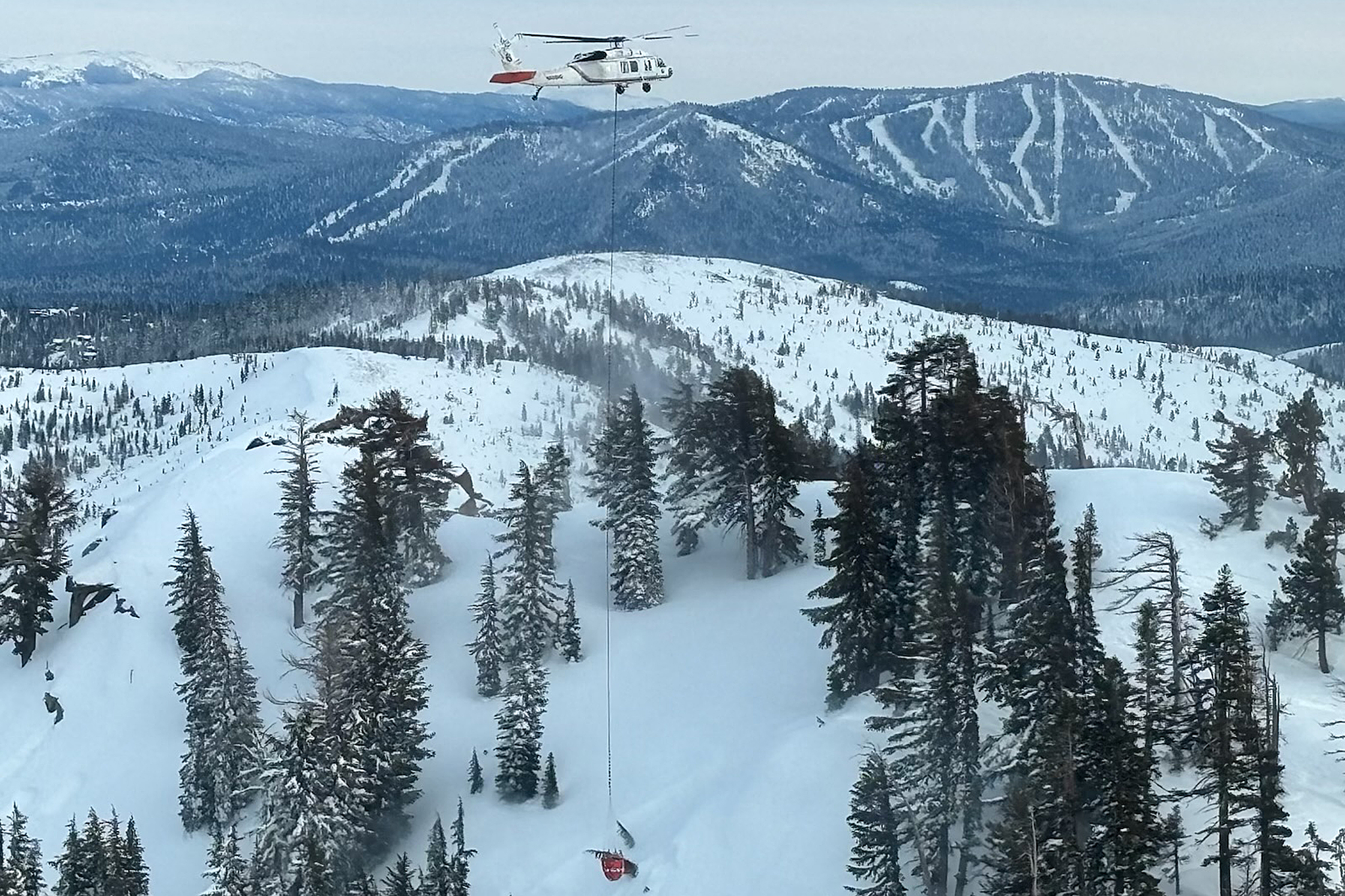
They were traveling across low-angle, forested terrain on the northwest side of Perry’s Peak, in a “broad, flat-bottomed drainage,” when the avalanche struck around 11 a.m.
Read more How to catch the summer’s brightest meteor shower over the Bay Area
The report estimates 2 to 3 feet of snow had fallen from the storm by 11 a.m. on Tuesday, when the avalanche occurred. It’s still not known how the avalanche was triggered, whether it released naturally or was spurred by the proximity of the skiers traveling below.
“None of the survivors report hearing or feeling a ‘whumpf’ or collapse prior to the avalanche,” the report states.
The avalanche slid from about 390 feet above the group and likely buried them close to where they were traveling. The victims were found buried about 30 to 50 feet from the toe of the avalanche.
Thirteen people were caught in the slide, with 11 people “completely buried.” One survivor was fully buried except that his hand and ski pole were close enough to the surface that he was able to clear an airway. Another client had managed to take cover below a tree and was partially buried up to his chest.
The two people who were not caught in the slide — a guide and a client — quickly skied up to the burial site and immediately launched a rescue.
The surviving guide activated the search function on his beacon — a device used to track and find people who are buried beneath the snow — but the beacon was overwhelmed by too many signals from the people buried beneath him.
“There were so many signals that his beacon would not lock onto any of them and allow him to fine search efficiently,” the report states.
The guide took out his probe, a long stick used to puncture the snow to find people who are buried, and immediately found someone. Ultimately, four survivors were rescued from the avalanche debris, including the two people who were partially buried.
Nine people, including Alissandratos and Choo, died in the avalanche debris from asphyxiation, according to coroner’s reports on the victims that SFGATE obtained through a public records request.

BECOME A FRIEND. GET OUR AD-FREE APP.
“There is nothing easy about any part of this. Nine deeply loved people are gone, three of them our own guides. There is still much that remains unknown, but this is the most complete information available so far and we hope the release of this information can help the community begin to heal together,” Blackbird Mountain Guides said in a statement.
Blackbird commissioned the report in April and released the findings on Sunday along with a supplemental document to provide “additional context and technical clarification,” the company said in a statement. The company provided copies of the report to the Nevada County sheriff and the families of the victims before releasing it to the public.
SFGATE called the Nevada County sheriff’s public information officer for comment on Blackbird’s investigation but did not receive a response before publication. Last month, the sheriff declined to release documents related to the avalanche, stating the investigation is ongoing. The New York Times reported on Saturday the avalanche incident is being reviewed by the district attorney.
— The Beach Boys’ Mike Love is selling his ‘majestic’ Tahoe mansion for $43M
— 4 golden mussels found on a boat bound for Tahoe. It could have been a disaster.
— These longtime Tahoe friends are following the World Cup in a souped-up school bus
Read more MLB’s worst teams in 2026 are still pretty bad, but at least they are reasonably bad
For weekly updates, interviews and profiles from a Tahoe insider, sign up for our Tahoe newsletter here.