San Francisco’s worst dinner date ended with a murder confession
Kovita Cox heard strange sounds through the ceiling.

First came the voice of a younger woman yelling about her missing pet, from the flat above hers at 826 Ashbury St. “What did you do with my dog?” she cried. “It’s the only one that loves me.”
Read more Suspect detained after shots fired on Sacramento State campus
There were screams and moans, followed by what sounded like a prolonged struggle. Cox heard someone making repeated trips to the bathroom and flushing the toilet. Then came the sawing.
When Cox asked the building’s manager, Jean Marie Toman, what on earth she had been doing up there, Toman said she had sawed two legs off a table.
The noises stopped, and life inside the Cole Valley house carried on. It was not until a few weeks later, on March 3, 1964, when a San Mateo County sheriff’s deputy peered into two scorched suitcases beside Highway 1 near San Gregorio, that Cox learned what she had actually heard that day.
Inside the suitcases were the dismembered remains of 21-year-old Elinor Ann “Elly” Kahn. Her head, both legs and one arm had been severed from her torso and forced into the luggage and set on fire.
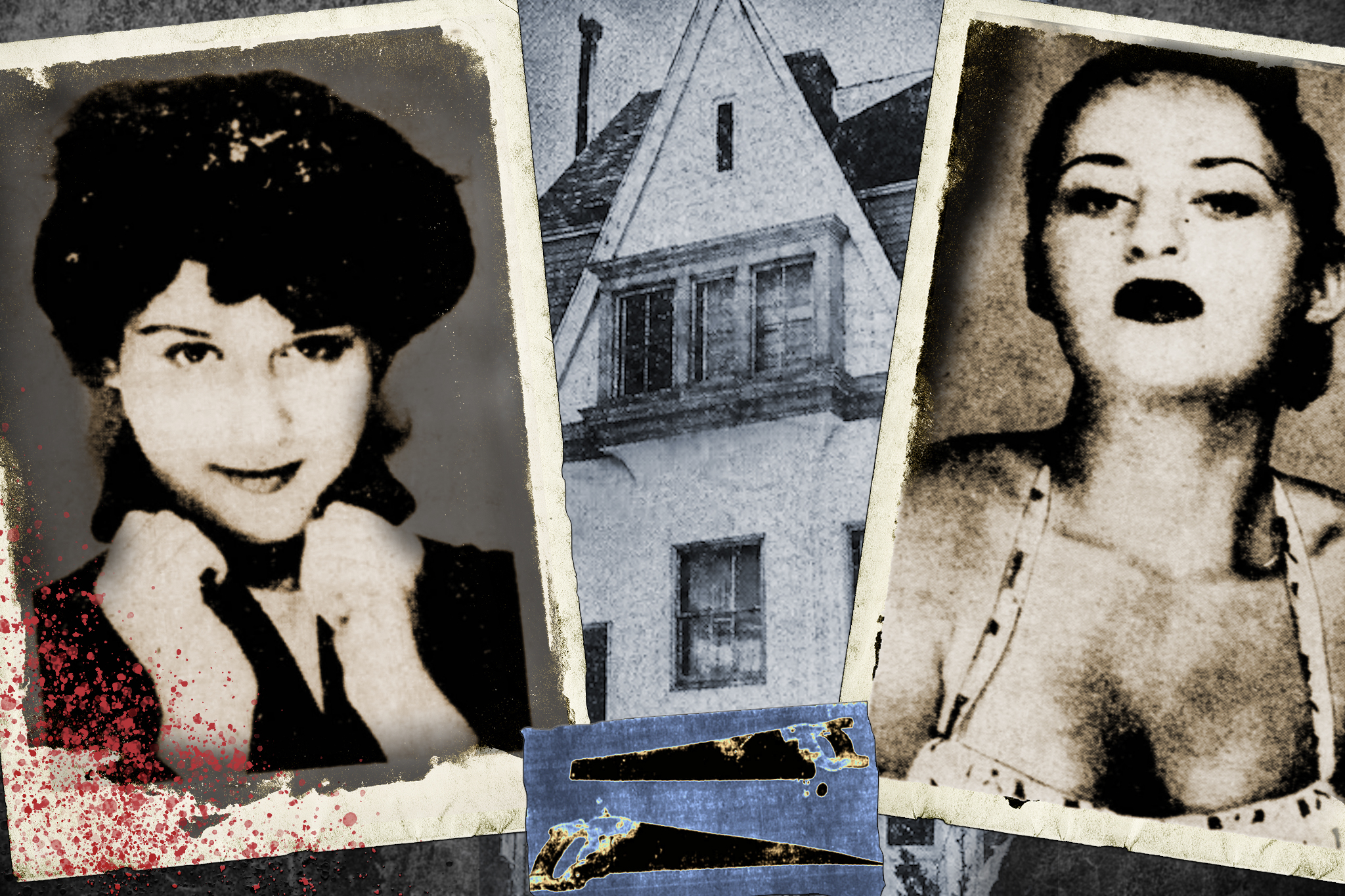
The killing exploded across San Francisco’s front pages for days and would become known as the Cole Valley Suitcase Murder. The story had dismemberment, a missing dog named Judy, a landlady on the run and a nightmarish date that ended in a murder confession. There were also two beautiful women.
The Examiner announced “The Death of a Beauty” and, the next day, “Two Beauties and Death.” Kahn was variously called a “strikingly beautiful brunette” and a “comely 21-year-old girl,” though soon was referred to more simply as “the torso girl.” Police described Toman, then 36, as an “attractive brunette” with a “shapely figure.” The coverage of a young woman’s grisly demise repeatedly paused to assure readers that everyone involved was good looking.
Police suspected Toman of killing her tenant after speaking with a local writer named Arnold Kottwitz. Kottwitz had recently noticed Toman with a bundle of clothes at a Haight-Ashbury laundromat and a meet-cute ensued. The writer, who lived at 1200 Haight St., saw her there several more times before deciding to invite her to his apartment for dinner.
One Friday night, he opened some wine and cooked a chicken for two. Toman arrived visibly nervous, and Kottwitz poured her a glass of wine in hopes of improving her mood. Instead, she began crying and talking about suicide.
“I have to face the music,” he recalled her saying. “There’s no way out but the bridge.”
Kottwitz said he slapped her and told her she was not going anywhere while she was talking that way. After he calmed her down, Toman abruptly began talking about “Elly.”
As she sipped her wine and picked distractedly at the chicken, Toman said she had “killed, dismembered and disposed of a girl” who stayed at her rooming house. According to Kottwitz, she said Kahn had become hysterical and began taking narcotics during a violent quarrel. Toman claimed she tied Kahn to a chair and gagged her to silence the girl’s screams, accidentally strangling her in the process.
She told Kottwitz that she kept the body in the apartment for several days, then used a saw to dismember it and packed the remains into two suitcases. She drove south along Highway 1 to a lonely gully near San Gregorio, doused the cases with kerosene and set them alight. The chicken went largely untouched.
“I fretted about it all weekend,” Kottwitz said. “All those ghastly details.” On Monday, he called the police.
Officers questioned Toman at the Ashbury Street house, where she flatly denied telling her date anything of the kind. She said Kahn had simply gone out of town. Despite finding bloodstains and two rusty-toothed saws in the flat, police went on their way after talking to Toman, and didn’t arrest her.
The next day, a deputy found the partly burned luggage near Highway 1. By then, Toman had disappeared. Police in five states were alerted that a murderous woman was on the run.
Elly Kahn had a short, complicated life. Bob Daniels, a former boyfriend who spoke to a reporter at his Richmond District home over a glass of bourbon, said she spent part of her childhood in San Francisco, attended Presidio Junior High and lived for a time at the Homewood Terrace orphanage. Daniels remembered taking her to a dance when she was 12. “She was a knockout,” he said.
In 1955, Kahn moved with her mother and younger brother to Long Beach, where she completed school and enrolled at Long Beach State College. She later returned to San Francisco. She qualified as a real estate salesperson, worked as a pharmacy clerk and took night classes, hoping to become a veterinarian. Friends said she loved animals, especially Judy, her black cocker spaniel.
Read more A fire, labor dispute and complaint of maggots: Growing scrutiny of an LAX caterer
Kahn also struggled with drugs and her mental health, facts the newspapers treated with little mercy. Months before her death, her father, Harry Kahn, sought psychiatric care for her and said he wanted her kept in treatment until she had “licked her pill addiction.”
One friend offered a kinder assessment of Kahn’s troubles. “She just wanted to be left alone, to live her own life,” the friend said.
By early 1964, Kahn was staying at the Ashbury Street house managed by Toman, a twice-divorced mother of six who had herself undergone psychiatric treatment. The address was one block from the house that would later become famous as the Grateful Dead’s home, and two blocks from the corner of Haight and Ashbury, which was still several years away from becoming the center of the Summer of Love.
In the first days of coverage, some reporters concluded that the fatal dispute may have begun with Judy, Kahn’s cocker spaniel. For reasons that were never made clear, Toman had arranged for the dog to be taken to a Potrero Avenue kennel on Jan. 31, perhaps because she did not want it in the house. When she tried to retrieve Judy after closing time on Feb. 6, an attendant told her to return the following day. Toman came back with another woman and collected the spaniel. Around that time, tenants heard Kahn demanding to know what Toman had done with her dog. Judy was never reported seen again, prompting speculation that the animal’s disappearance had triggered the final quarrel between the women.
As police searched for Toman, an anonymous woman called the Hall of Justice switchboard with a remarkably precise tip: Officers should look in Room 501 of the Ambassador Hotel at 55 Mason St. Police found Toman there, in the Tenderloin, and arrested her.
According to the story Toman later told psychiatrists and attorneys, the conflict with Kahn arose not over the dog, but over the victim’s father. Toman said she had been having an illicit romance with Kahn’s father and had posed nude for photographs he took. She believed Elly had the pictures, or could retrieve them, and was keeping her at the house until she handed them over. Decades before “revenge porn” entered the language — and half a century before California specifically outlawed it — the fear that intimate photographs might be used against her had become an alleged motive in a murder case.
Investigators ultimately settled on Feb. 7 as the approximate date of Kahn’s death, the same night Cox remembered the screaming and moaning upstairs, the flushing toilet and the sound of the saw.
At the Hall of Justice, Toman was sullen and sometimes angry. When a sergeant told her in a fatherly way, “Everything will be alright, honey,” she snapped back, “Don’t honey me!” While being led from a holding cell, Toman lunged at a KPIX cameraman and tried to claw his face.
She fired her attorney after he proposed the unusual, seemingly contradictory strategy of entering two pleas: not guilty and not guilty by reason of insanity. Her new public defender ultimately pursued the insanity defense.
The trial that August was brief. Toman waived her right to a jury trial, and much of the case was presented through an earlier grand jury transcript. A psychiatrist testified that Toman was mentally ill and incapable of legal responsibility; her thinking too distorted for the killing to have been a deliberate plan.
Toman repeatedly interrupted the proceedings, pounded the table and insisted she was sane. The judge found that Toman had committed second-degree murder but was legally insane at the time. He ordered her committed to Mendocino State Hospital. Later, back in her cell and furious that reporters wanted to know how she felt, she exploded.
“I am sane. I am not mentally ill,” Toman said. “I don’t want the whole God-damned creep world to know my feelings.”
Three years later, a hospital psychiatrist told a Mendocino County judge that Toman had been rehabilitated and was ready to take her place in society. San Francisco prosecutors opposed her release, and the judge ordered two more psychiatric examinations.

BECOME A FRIEND. GET OUR AD-FREE APP.
Toman did eventually return to ordinary life, apparently moving to Santa Barbara County, where members of her immediate family had settled. By 1989, she had spent eight and a half years at the Carrillo, a retirement residence in Santa Barbara, and appeared in a newspaper advertisement praising the “security, peace of mind, and lots of new friends” she had found there. Her mother’s obituary still placed her in Santa Barbara in 2003, nearly 40 years after the killing. What became of her after that remains unclear, but it appears she was indeed rehabilitated, and never arrested again.
The house on Ashbury remains. Built in 1910, the narrow, three-story building last sold in 2022 for $2.1 million, and looks remarkably similar to the old newspaper photographs. The same windows face Ashbury Street, the same steps wind up to the door.
In 1964, even while the city was transfixed by the horrors inside 826 Ashbury St., the room did not stay off the market for long. The day after Toman’s arrest, a passerby noticed a “Rooms For Rent” sign in the home’s window. Herb Caen reported that among the available flats was “the one they shared,” where “murder most foul was done.”
— Rare disease found among the children of an idyllic Calif. suburb
— Ex-Cal softball player alleges coach coerced her into sexual relationship
— Northern Calif. supervisor candidate dies while door-knocking
— Ex-child actor claims she was repeatedly raped during Disney filming
Read more Bo Bichette hits 3-run homer in 8th inning as Mets rally past Giants 4-2
Sign up for SFGATE’s breaking news email