Lake Powell, America’s second-largest reservoir, may collapse without new water
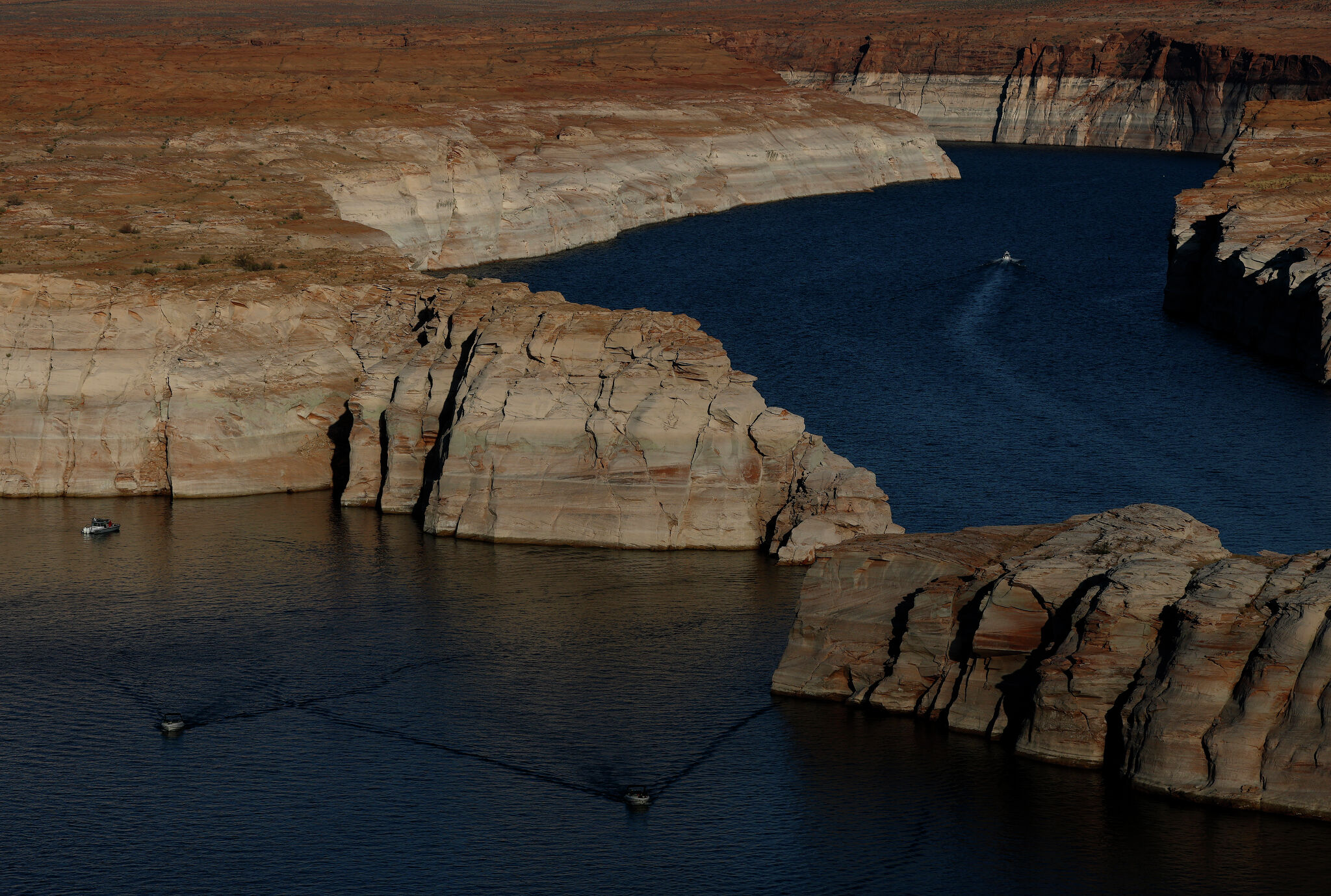
One of the country’s largest reservoirs hit a record-low surface elevation over the weekend, prompting concerns about critical water and electricity supply for several states, including California.
Read more Jet Skier rescued after missing for 12 hours in Long Beach

Lake Powell, located on the Arizona-Utah border, dropped to a surface-level elevation of 3,519.91 feet on Saturday, surpassing its previous record low of 3,519.92 feet, set in April 2023. And on Sunday, the reservoir dropped even lower, to 3,519.8 feet, according to data from the U.S. Bureau of Reclamation.
Lake Powell is now only about 30 feet away from the level where the Glen Canyon Dam, which is at the southern end of the reservoir just inside Arizona, could no longer generate hydropower, or electricity made from moving water. According to an April news release from the bureau, water from the Glen Canyon Dam would have to flow through four tunnels called “river outlet works” if Lake Powell reaches anything below 3,490 feet.
Releasing water only through the river outlet works, which bypass the hydroelectric turbines, would cause “instability in regional power and water supplies, and a reduction in power generation,” according to the bureau. If the water level drops below 3,370 feet, Lake Powell hits its dead pool, and water won’t be able to move through the dam.
An ongoing drought, limited snowpack from last winter and decades of overuse have caused Lake Powell’s water levels to drop sharply. The reservoir and the Colorado River that feeds it provide water to more than 40 million people, according to the bureau.
Seven states receive water from the Colorado River Basin: Arizona, Colorado, California, Nevada, New Mexico, Utah and Wyoming. The states that are most affected by the alarming water level drop are California, Nevada, Arizona and New Mexico, Newsha Ajami, a hydrologist and environmental policy expert with Stanford University, told SFGATE.
Bay Area residents rely less on water from the Colorado River, but the crisis still creates a problem for the state because the water system is all “interconnected,” Ajami said. Many Southern California communities depend on water that comes from Colorado and the Sierra Nevada, but if the supply comes up short, the region will be left with water that comes from the Bay Area, Ajami said.
“This is a huge crisis where people depend on this water, and it’s sort of happening right in front of us,” she said. “It has been a slow-moving disaster.”
Some of the water from the Colorado River is also used for producing crops that come into California, Ajami said.
Read more Mining claims appeared less than a day after Trump shrank 2 Utah national monuments
“If the supply chain is impacted, we are impacted collectively because we all depend on a very interconnected level food system,” she said.
Lake Mead, another major Colorado River reservoir and the largest in the country, has also reached record-low levels this month, raising concerns about toxic algae, less power generation at Hoover Dam, boating hazards, and dwindling water supplies across the region. The reservoir, which is located at the Arizona-Nevada border near Las Vegas, hit its lowest ever water level of 1,040.4 feet on Aug. 7, according to the Associated Press.
Lake Mead is close to hitting its own dead pool at around 900 feet, and water would not be able to flow downstream, disrupting water for Native American tribes and major cities including Los Angeles, the New York Times reported. As of Monday afternoon, the reservoir is at 1,039.86 feet, according to data from the U.S. Bureau of Reclamation.
Jack Schmidt, a scientist and the director of the Center for Colorado River Studies at Utah State University, told ABC News that the crisis is “completely new territory.”

BECOME A FRIEND. GET OUR AD-FREE APP.
“If you add the two of these reservoirs together, the last time the joint contents were this low was in 1957, before there even was a Lake Powell,” he told the news outlet. “These are truly unprecedented.”
Similarly, Ajami said it will be critical for officials and communities to allocate more resources to the river, dams and other important infrastructure.
“A lot of our water infrastructure is out of sight, out of mind,” Ajami said. “A lot of people don’t really know if they depend on this water, how critical it is to their livelihood and how dependent they are on this system.”
— Blue Apron, meal kit powerhouse once valued at $2B, descends into chaos
— Without new water, America’s second-largest reservoir may collapse
— Rapid erosion reveals decades-old infrastructure at Calif. beach
— Boys ages 12, 13 and 16 charged in California killing
Read more Hawaii Island loses 911 service in Hurricane Lala’s wake
Sign up for SFGATE’s breaking news email