Bulldozers are ripping apart Big Bend National Park. Conservationists are furious.
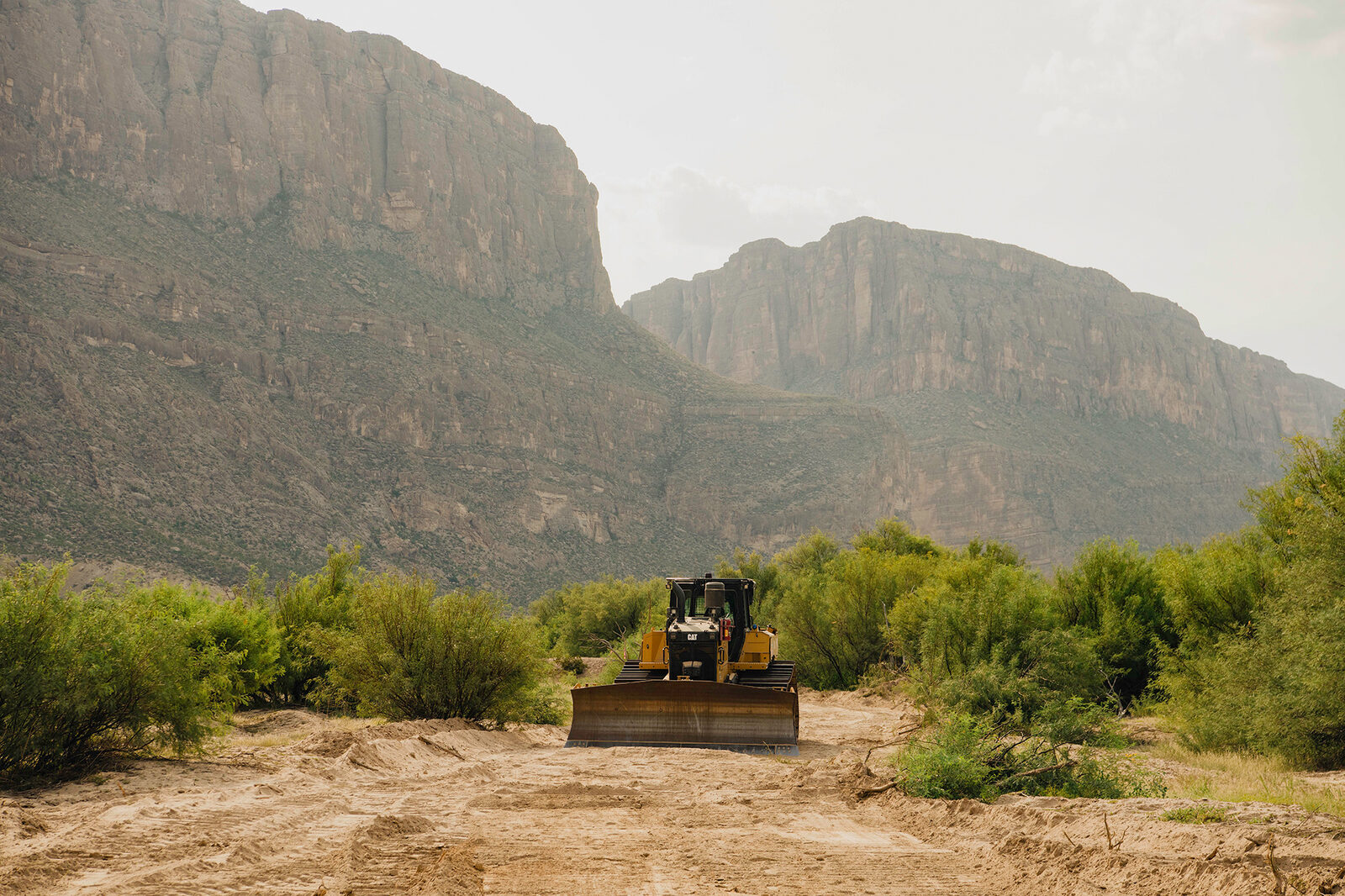
Heavy construction equipment has appeared inside Big Bend National Park in southern Texas as contractors for Customs and Border Protection begin a land assessment. The work is a precursor to a massive border security project that opponents say will profoundly reshape the character of one of the state’s most pristine landscapes.
Read more Rafael Devers, Willy Adames hit home runs, Jung Hoo Lee adds 2-run single as Giants beat Tigers 5-2

As onlookers stood by, bulldozers crashed through native cottonwoods and willows growing alongside the Rio Grande, scattering birds and pig-like javelinas. Raymond Skiles, a former wildlife biologist and wilderness coordinator who worked in the park until 2018, posted on social media that the event would go down as “a day of infamy.”
“The needless border wall’s rip and tear across the fabric of this national treasure began yesterday,” he said in a Facebook post, adding that “in the desert, there is no more valuable habitat than where the trees grow. … This is what they chose to destroy first.”
The purpose of the work, sources told SFGATE, remains unclear even as it moves forward. For months, plans for border security within Big Bend have been shifting, with officials at times making references to a wall before settling on a combination of vehicle barriers, smart technology, and several hundred miles of service roads.
“I’ve been told that even the park superintendent doesn’t know what’s happening there,” Bob Krumenaker, a former Big Bend superintendent who now heads the advocacy group Keep Big Bend Wild, told SFGATE.
In a phone call with SFGATE, CBP spokesperson John Mennell said that the current demolition does not mark the official start of the agency’s Big Bend 4 project — a $1.7 billion dollar effort to improve border security in the region — and disputed that the dozers are clearing a new road.
“You don’t just scrape out a road,” Mennell said. “What they’re doing is looking at the soil, figuring out how deep you have to dig in order to put the vehicle barriers in, assessing what kind of base you have to use to put in the roads. All the things you have to do so that the engineers can go back and actually do the design.”
News | After 117 dead dogs found, Calif. rescue owner speaks out
Culture | Calif. radio station lays off entire on-air staff
Crime | Influencer shot dead in Mexico while livestreaming
Local | Prank SF billboard gets thousands of responses
Read our stories ad-free on the new SFGATE app.
The work at Big Bend and other public lands along the country’s northern and southern borders is legal based on a 2005 law called the Real ID Act, passed in the wake of the 9/11 terrorist attacks. The law grants the secretary of Homeland Security — a political appointee, rather than an official elected by voters — the power to waive nearly 50 laws, including the National Environmental Policy Act, Endangered Species Act, the Clean Water and Air acts and the Antiquities Act, for activities “necessary for improvement of barriers at borders.”
Over the past year, the Real ID Act has been used to justify the construction of many hundreds of miles of border roads and walls, even when doing so led to the destruction of Indigenous burial grounds in Organ Pipe Cactus National Monument and a massive, 1,000-year-old fish-shaped etching in Cabeza Prieta National Wildlife Refuge, both in Arizona. The act’s power is now being challenged by the Tohono O’odham Nation, after the Trump administration pledged to build a section of wall through their land in violation of their rights.
Read more Cole, Yankees hold off Braves 5-4 in matchup of Cy Young winners
Until recently, tampering with Big Bend National Park in the name of national security was seen as unnecessary, because the remote region isn’t known for high levels of migrant entry. CBP Commissioner Rodney Scott has repeatedly referenced this fact, referring to the landscape as one that “serves as a natural deterrent.” But beginning in late 2025, sections of wall began appearing on CBP’s SmartWall website. Plans changed several times without formal announcements, though the modifications were often noticed by private citizens and advocacy groups.
While CBP did not elaborate on long-term plans for the park, it did confirm that at this time, the agency is not planning to build walls in Big Bend or a neighboring state park. “CBP is planning for approximately 200 miles of patrol roads and detection technology along with approximately 17 miles of non-contiguous areas of vehicle barriers in strategic locations,” Mennell shared in a written statement.
Roads and vehicle barriers are not without impact, however. The current demolition is being carried out on a floodplain that is home to a threatened species, the western yellow-billed cuckoo. If its path continues along the same trajectory, it would seemingly pass through the park’s Cottonwood Campground and beyond to the Castolon Historic District, which includes old adobe buildings from early Mexican settlers and an Army cavalry camp.
In addition, CBP has previously mentioned plans to build a road up and over nearby Mariscal Mountain. Such a road would need to rise about 1,700 feet from the river valley floor, and Krumenaker told SFGATE that erosion would almost certainly redirect the flow of the Rio Grande, in violation of the 1970 Boundary Treaty with Mexico. CBP has said that building the road would not require blasting, but according to Krumenaker, “no credible person who knows the terrain thinks there’s any way they could build that road without blasting.”

BECOME A FRIEND. GET OUR AD-FREE APP.
With so few details from CBP, it’s hard, Krumenaker told SFAGTE, not to let his mind run wild with worst-case scenarios.
“If they really think this is the right thing to do, they certainly have the authority to do it, so why not level with the public?” he said. “It seems to me they could get a whole bunch of appreciation from people if they would say, ‘Yes, we heard you. We are going to try to make this a more reasonable solution.’ But instead, they are completely obscuring everything they’re doing.”
— A man went over Yosemite’s Nevada Fall. A stranger tried to save him.
— Time is running out to visit Olympic National Park’s best coastal hike
— Kids were allegedly poisoned in Yellowstone. The park says it isn’t responsible.
We love national parks just as much as you do, so we have a newsletter that covers them from top to bottom. Sign up here.
Read more Jackson Jobe has sparkling debut to help the Tigers rout the Giants 8-0