SF youth clinic to close after Trump bill causes $306M cuts from city budget
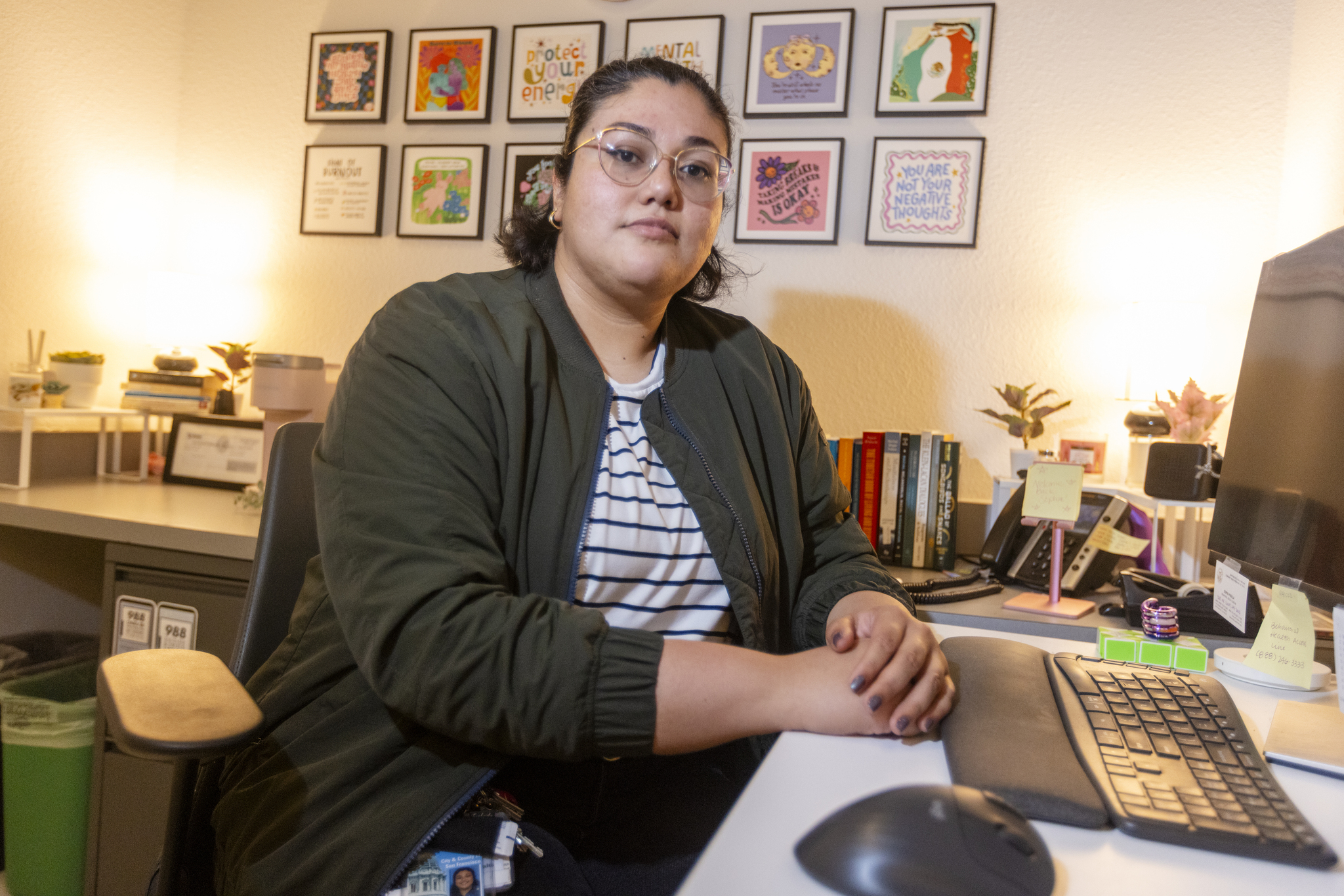
The San Francisco office of Sophia Padilla is downright cozy. There’s a framed poster celebrating the famed parrots of Telegraph Hill in the corner, and dim lighting creates a warm glow. The goal is to help her patients feel more comfortable as they get mental health care for potentially the first time.
Read more Federal government set to spray ‘devastating’ herbicide in Tahoe Basin

Padilla is a licensed family therapy counselor working with the “small but mighty” team at the Michael Baxter Clinic, located in the basement of the Larkin Youth Center in the Tenderloin. The clinic provides medical testing, basic medical treatment and counseling for some of the most vulnerable children and young adults in San Francisco, who are often living on the streets.
The clinic is supposed to act as a one-stop shop for the at-risk people coming in. They can get both medical and mental health care all in one spot, and potentially all in a single day.
Back in Padilla’s office, a small bin of plastic fidget bracelets sits next to the upholstered chair facing her desk.
It’s “hard to know what to do with your hands when you’re being vulnerable,” she explains.
But soon the bin, along with the rest of the resources provided by the staff, will be gone. The Michael Baxter Youth Clinic is slated to close later this year as the San Francisco Department of Public Health is grappling with a in funds due to President Donald Trump’s “Big Beautiful” budget bill, passed last summer, which slashed Medicaid spending as well as other federal financial support.
‘Complete shock’
The federal cuts to Medicaid — administered as Medi-Cal in California — mean there will be a loss of $306 million over two years for the city, according to a budget outlook by the agency in April. The budget presentation points out the Medi-Cal cuts equal one quarter of the funding that SFDPH gets from the San Francisco General Fund. Mayor Daniel Lurie has ordered an increase in general funds to help cover the shortfall, but also asked SFDPH to cut $40 million from its budget. In addition to the three clinic closures, SFDPH is taking other cost-cutting measures, including eliminating the managed alcohol program, moving clinical staff out of administrative roles and reducing middle management.
So, in early April, the team at the Michael Baxter Youth Clinic was told that they, along with the staff at the Cole Street Youth Clinic in the Haight and the South East Mission Geriatrics clinic near Holly Park, would be reassigned and the clinics would be closed.
Padilla said the team at Michael Baxter was in “complete shock.”
While the Department of Public Health said all patients would be directed to other clinics, Padilla and her team are skeptical their at-risk patients will make the trek to another part of the city for specialized care. For her younger patients, she worries they won’t get the treatment they need at clinics focused on adults.
“Therapeutic relationships are built over time, and when they get cut off really abruptly, that can be, you know, really sad, really hard, really stressful for the patient,” Padilla said. She said she usually works with her patients over time, conducting eight to 12 sessions for “solutions-based” therapy.
In an emailed statement to SFGATE from the general media line, the Department of Public Health said the clinics being closed are “very low-volume” and that staff will be reassigned to clinics with higher patient demands.
“Every decision in SFDPH’s proposed budget was made with one goal: preserving the public health system San Franciscans depend on and ensuring patients continue to receive the care they need, where they need it,” the department said in the statement.
Padilla isn’t convinced.
“Without this clinic they would have to go honestly, really, really far to the south end of the city, to the Mission,” she said.
“Or,” she worries, “they would go nowhere at all,” and then end up in the emergency room.
A ‘big beautiful’ cut in funding
In an April meeting for the San Francisco Health Commission, Daniel Tsai, the head of the San Francisco Public Health Department, discussed the three clinic closures along with other reductions in services. Cuts had to be made somewhere, Tsai said. While in total 120 full-time positions will be cut, he said, the majority are vacancies that will remain unfilled or include staff that will be reassigned. Only 10 full-time staff members would be laid off.
“It’s a very difficult time,” Tsai told the health commission, which is the governing body that oversees SFDPH. Members are appointed by the mayor and serve four-year terms. “I can promise you that neither myself nor anybody on the DPH team has been enjoying our lives much recently, with very difficult decisions we have been needing to work through. ”
In slides Tsai presented, the number of unique clients listed for Michael Baxter was just 355 for all of 2025, averaging to about nine clients seen per day. Similarly low numbers were shown for South East Mission Geriatrics clinic and Cole Street Youth Clinic.
Lisa Cadillo, a medical assistant at Michael Baxter for over 10 years, was sitting in the audience during the presentation waiting for the public comment to start. She had carefully written remarks to meet the one minute allotted time for each speaker.
But after Tsai’s presentation, Cadillo was so angry she started speaking off the cuff when she finally reached the microphone.
“We do the important work to protect the future in San Francisco. … The numbers that you have seen today do not reflect on what we do and what we have seen. Those numbers are a lie,” she said. “We provide a safe space for everyone to come as they are and feel heard and supported.”
Read more How Katie Porter’s strongest asset came to haunt her California governor run
A ding signaled she had run out of time, but Cadillo continued.
“We used to be primary care, but that was removed by management,” she said, in front of a crowd that had started to cheer her on. “Our kids will not transition to other clinics. They will age out of services and will not go anywhere else. Our kids will die if these clinics do not stay open.”
‘You don’t need a conspiracy’
At a subsequent May 18 hearing for the San Francisco Health Commission, Padilla put together a presentation showing there were 3,000 total appointments for 2025 at her clinic. It’s a number that Padilla says highlights how the staff manages to gain trust with their young and vulnerable clients.
“Because of the relationships we’re able to build with youth, we get to continue to see them, even as they graduate from programs, as they go to school, as they get their own housing and jobs,” Padilla said. “They’re still coming here for their STI testings to tell us how they’re doing, and so we’re grateful to be here when youth are most vulnerable, and we get to see them through becoming successful.”
Other staff at Michael Baxter also bristle at the idea that the clinic is underutilized. Instead, they say, they are underresourced and understaffed.
Spencer Miller, a registered nurse at the clinic, said he’s frustrated because he is medically licensed to provide more medical care at the clinic than is currently allowed to provide by SFDPH. Miller said he primarily provides triage, vaccines and testing for sexually transmitted infections, but all other medical care must be provided by a physician or nurse practitioner, according to SFDPH, who is only on site intermittently.
“You don’t need a conspiracy to have bad management,” he told SFGATE.
Cadillo told SFGATE while the number of unique patients at nine per day seems small, it doesn’t include the number of people who want to be seen. She said she often has at least five patients on a daily wait list, people who want to come get primary care but can’t, as Michael Baxter hasn’t had a full-time medical provider in years.
In 2024, the number of days a nurse practitioner was on site per week was cut down from five times to three, according to information compiled by Padilla.
Cadillo has known for a while that she wanted to work with teenagers, after she suffered abuse and was thrown out of her home when she was a teen. She’s so beloved by the patients that she’s been dubbed “Auntie Lisa.”
“We could be so highly utilized if you gave us the resources,” Cadillo told SFGATE. In the meantime, she said, she tries to help the young patients in the best way she can. As she takes their vitals and sits with them as they wait for test results, she tells them, “I can give you auntie advice,” if not a physician’s diagnosis.
‘A second family’
At the May 18 health commission hearing, SFDPH officials highlighted the attempts to ease the effects of the shutdowns, talking up plans to launch a new pilot for a virtual care model and to spend months progressively ramping down the clinics slated for closure.
But the attendees were not convinced, often shouting that not enough is being done to fund these programs and help vulnerable patients. Members of the health commission also did not appear fully convinced and asked pointed questions to SFDPH leaders about how clinic patients, among them seniors and people without internet, will be helped by telehealth appointments.
In a lengthy public comment section, dozens of speakers, including both clinic clients and staff, decried the cuts, asking why such a wealthy city needed to cut services for the most vulnerable residents. Among them was 22-year-old Alyana Perez, who said the clinic was a lifeline when she went to it as a homeless teenager at age 18.
“They are very patient, but also just very professional on what they’re doing, and they’re just like they’re like a second family to me,” she told SFGATE.

The Bay Area’s best free newsletter.
By signing up, you agree to our Terms Of Use and acknowledge that your information will be used as described in our Privacy Policy.
At the hearing, Perez spoke in defense of the clinic and especially her “Auntie” Lisa Cadillo.
“This clinic really has changed my life,” she told the commission. “… I was in a very abusive household before I graduated from high school, struggling with homelessness, struggling with no job. I went to the clinic, and Lisa has saved my life by giving me another chance to build my self-esteem up, and also I’m speaking [for] other clinics too, because if you take these clinics away, like I said from last time, it really will kill a lot of people.”
Yet barring a last-minute reprieve from Lurie’s upcoming budget, which is expected to be presented on June 1, the Michael Baxter Youth Clinic, Cole Street Youth Clinic, and South East Mission Geriatrics will shut down permanently in October.
— Man killed woman, then went on Bay Area road rage spree, officials say
— Uproar as video of Bay Area police officer punching teen goes viral
— Woman’s tip leads to man suspected of multiple Bay Area arson fires
— Man, 36, drowns in Donner Lake over Memorial Day weekend
Read more Traffic clear along I-15 on Calif.-Nevada border after prior gridlock
Sign up for daily SFGATE breaking news alerts here.