Federal government set to spray ‘devastating’ herbicide in Tahoe Basin
The U.S. Forest Service is moving ahead with plans to spray the controversial herbicide glyphosate, the main ingredient in Roundup, on thousands of acres devastated by the Caldor Fire, including in the Lake Tahoe Basin. The plans have sparked growing public opposition and have come under scrutiny from local residents, wellness and organic food advocates and environmentalists after an investigation published by Mother Jones this spring showed the federal government is spraying the herbicide at “record levels” across California forests.
Read more How Katie Porter’s strongest asset came to haunt her California governor run

Glyphosate is an effective, if potent, weed killer, approved by the U.S. Environmental Protection Agency, and it’s been widely used by the agricultural industry since Monsanto began selling it as Roundup in 1974. The extensive use of glyphosate on crops has long been controversial: It is known to destroy habitat for monarch butterflies and bees. And in 2015, the World Health Organization’s cancer research division said that glyphosate is “probably carcinogenic to humans.” That opened the door for more than 100,000 lawsuits to be filed against Monsanto by people who had been diagnosed with cancer including non-Hodgkin’s lymphoma after using Roundup. Now, the Supreme Court is weighing a case about whether Monsanto is liable for not including a cancer warning on its product.
The agricultural industry isn’t the only industry spraying the chemical. The Mother Jones investigation analyzed millions of spraying reports and discovered that the Forest Service sprayed 266,000 pounds of glyphosate in California forests in 2023, the most recent year that the data was available, which is about five times the amount used two decades ago.
In 2011, the Forest Service conducted a analyzing glyphosate’s impact on human health and ecological risk. “The preponderance of the available data, however, clearly indicates that the mammalian toxicity of glyphosate is low,” the report states. Yet, the report relied on research that was heavily influenced by Monsanto, according to a trove of emails and court records reviewed by Mother Jones.
“Monsanto poisoned the well of public understanding of science,” Naomi Oreskes said in the Mother Jones story. Oreskes is the co-author of the 2010 book “Merchants of Doubt,” which revealed a corporate strategy to influence research on tobacco and climate change.
Despite the controversy and uncertainty that surround glyphosate, the Forest Service continues to use it on landscape-scale reforestation projects.
Plans have been approved to spray the chemical on more than 46,000 acres in the Caldor Fire burn scar, including between 2,400 and 3,600 acres in the Lake Tahoe Basin.
Local officials emphasize that the vast majority of spraying is happening outside of the Tahoe Basin in the Eldorado National Forest. A video released last week by Mother Jones is creating “more distrust and confusion” about the boundaries of the Tahoe Basin and the impact of the herbicides on Tahoe’s watershed, said Jeff Cowen, a spokesperson for the Tahoe Regional Planning Agency, in an email to SFGATE.
“It seems like the lack of understanding of the different watersheds and project plans, separate National Forest Units, and a concrete understanding of agency roles in the Tahoe Basin isn’t giving people a good basis from which to express their concerns,” Cowen wrote.
The Caldor Fire restoration plans attracted little attention before Mother Jones published its investigation. The Lake Tahoe Basin Management Unit quietly approved its environmental assessment in March, which received just 16 comments from the public.
Now, thousands of people are speaking up. As of Tuesday morning, more than 14,000 people have signed a petition protesting the Forest Service’s use of glyphosate in the Tahoe region.
Glyphosate “has been linked to serious environmental harm, including the decline of crucial pollinators like bees, contamination of water sources, and risks to human health,” the petition states. “Its use in the Tahoe Basin could have devastating effects on our local wildlife, flora, and the crystal-clear waters that have earned Tahoe its nickname, ‘The Jewel of the Sierra.’”
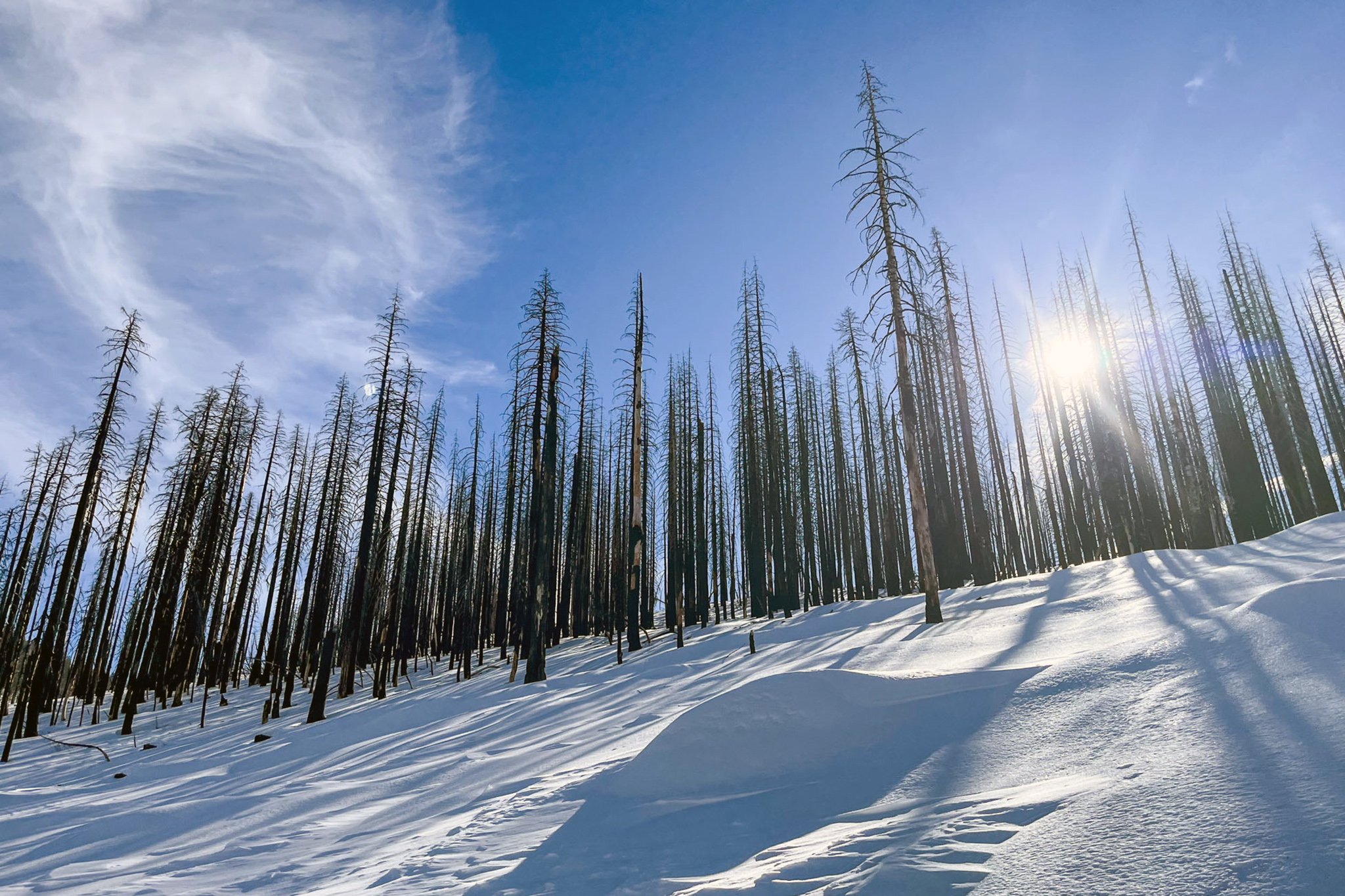
The Caldor Fire burned more than 221,000 acres in 2021. Large swaths of forest burned with so much intensity that the seed bank was destroyed, and the trees are unlikely to grow back for decades unless humans intervene, according to the Forest Service. The restoration plans are a road map to remove torched, dead trees and plant new seedlings of native trees.
The Forest Service uses glyphosate to remove weeds and shrubs and prepare planting sites for the new trees. The agency said herbicides help give seedlings their best chance at survival by reducing competition for nutrients and water. As the trees grow and become established, herbicides may continue to be used to eliminate nearby shrubs and weeds.
Spraying has already begun in the Eldorado National Forest, just outside of the Tahoe Basin. The Forest Service expects to spray herbicides on about 2,000 acres every year for the next five to 10 years, according to an emailed statement that the agency sent to SFGATE.
Maps from last year document where the agency sprayed glyphosate, including around the base area of the Sierra-at-Tahoe ski resort. This spring, the Forest Service plans to use it near campgrounds, hiking trails and off-highway vehicle roads. Mostly, glyphosate and other herbicides will be sprayed with backpacks and wands. However, the Forest Service is looking into using booms mounted on trucks and all-terrain vehicles to spray roadsides in the Eldorado National Forest.
Read more Traffic clear along I-15 on Calif.-Nevada border after prior gridlock
The timing is less clear in the Tahoe Basin. SFGATE asked when spraying would begin in the Tahoe Basin, and the Forest Service responded vaguely, writing in an email that “spraying is associated with seedling planting and growth” and that site prep for new seedlings has not been proposed for this year or next year. “No specific date has been determined beyond those years,” the Forest Service wrote.
Critics are demanding more answers. “I would love to get a phone call back and know what their plans are,” said Tobi Tyler, the vice chair of the Sierra Club’s Tahoe Area Group.
The exact location of where glyphosate will be sprayed in the Tahoe Basin remains to be determined, the Forest Service said. The overall boundaries of the restoration project surround neighborhoods in Meyers and South Lake Tahoe and are near the headwaters of the Upper Truckee River, Lake Tahoe’s largest tributary. But first thing’s first: The Forest Service needs to clear out the dead trees before field reconnaissance can begin.
Herbicides will be used “selectively,” the Forest Service said, and the public will be notified where spraying has occurred. “The majority of herbicide use is expected to be in areas where hand treatment is necessary, which are generally further from existing roads,” the agency wrote.
No herbicides will enter Lake Tahoe, a federally protected Outstanding National Resource Water under the Clean Water Act, the Forest Service said.
Tyler of the Sierra Club, a retired water quality expert, doesn’t buy it: “It will get into the water, the streams,” she said.
“They say it breaks down. Well, it could definitely go into the air or the water before it breaks down. And what does it break down into? The bottom line is the discharge,” Tyler continued, adding that “all the water that falls in the basin all goes to Lake Tahoe, eventually.”
Keep Tahoe Blue is also looking for more answers. The watchdog environmental nonprofit asked the Forest Service for more transparency, especially around where the herbicides will be applied, site-specific safeguard, why they’re necessary and how glyphosate will be monitored to ensure Lake Tahoe’s protection. “The lack of publicly available information — beyond the broad strokes included in the project’s Environmental Assessment — has understandably raised concern and questions from groups like ours and the broader community,” the nonprofit said in a statement emailed to SFGATE.
The Forest Service doesn’t need approval to use herbicides for a forest health project in the Tahoe Basin. The project was fast-tracked under a memorandum of understanding between the Forest Service and the Tahoe Regional Planning Agency that exempts fuel reduction and forest health work from TRPA review and permitting, said Cowen, the TRPA spokesperson.
The TRPA strongly discourages the use of herbicides in the Tahoe Basin, it but doesn’t prohibit them, he added.
“The Forest Service is a key partner,” Cowen wrote in a text message to SFGATE, noting this collaboration has led to more than 100,000 acres of successful forest thinning work, which saved Meyers and South Lake Tahoe during the Caldor Fire. “We work closely with them and all member organizations of the Tahoe Fire and Fuels Team to ensure our environmental standards and shared goals are met with every project.”
Meanwhile, opposition to glyphosate is growing quickly. A nurse in El Dorado County commented on the petition, stating that she cares for patients who were exposed to glyphosate and have suffered from “blood cancers, leukemia, non-Hodgkin lymphoma and other serious illnesses.”

The Bay Area’s best free newsletter.
By signing up, you agree to our Terms Of Use and acknowledge that your information will be used as described in our Privacy Policy.
“My stepmother worked professionally with glyphosate products for many years as a gardener and later developed non-Hodgkin lymphoma,” another commenter said.
“Spraying glyphosate in the Lake Tahoe Basin risks contaminating one of the clearest alpine watersheds in the world,” another person wrote on the petition.
Read more Gavin Newsom intervenes amid historic tech layoffs
This story has been updated.
— A once-in-a-generation Tahoe estate goes on the market for $47.5M
— Tahoe is losing a major power source amid Google, Apple data center expansion
— Popular Tahoe beach plagued by overcrowding to get new, bigger parking lot
For weekly updates, interviews and profiles from a Tahoe insider, sign up for our Tahoe newsletter here.