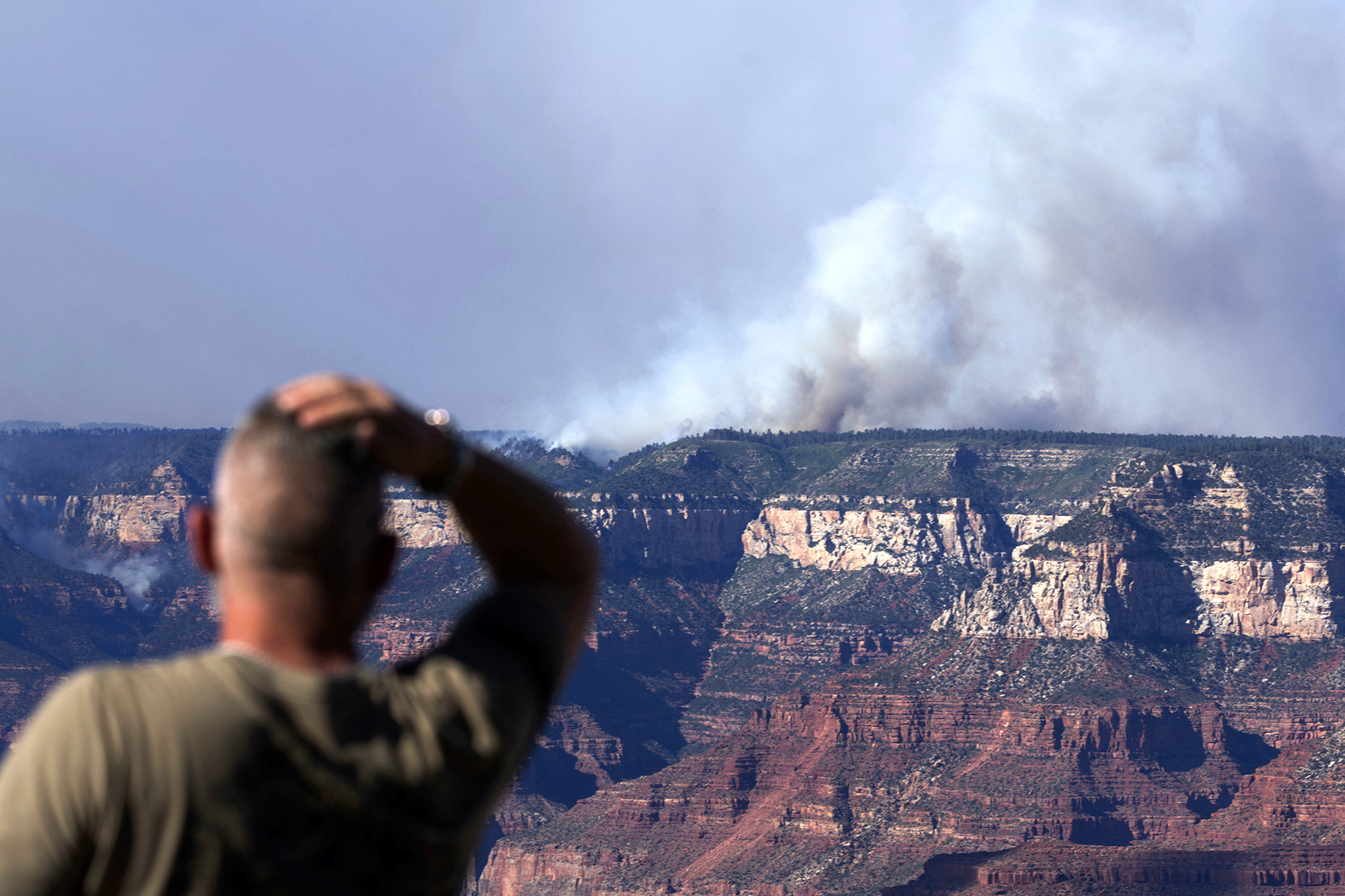
The untold story of Dragon Bravo’s devastating impact on Grand Canyon workers
There was nothing to worry about, Bethann Ryan was told on the day her home in Grand Canyon National Park was incinerated.
Read more Huntington Beach has been a MAGA stronghold. Chris Kluwe has other plans.

It was Friday, July 11, 2025, and the Dragon Bravo wildfire had already been burning for a week after a lightning strike ignited a tree 4 miles from the North Rim. Park visitors had been evacuated the day before, but Ryan — who worked the park’s entrance gates — was told it was only due to visibility concerns related to smoke from another nearby fire.
She remembers standing at the community center talking to neighbors when her husband Bill, then a Park Service electrician who worked year-round on the North Rim, approached. “Beth, get your stuff,” she recounted Bill saying, her voice quavering over the phone. “The plumes are overhead, and I don’t like this, and no one’s telling me anything. I want you out of here.”
The couple grabbed some belongings, but left an estimated $22,000 of their possessions behind: furniture, appliances, tools, memorabilia from volunteer work in Honduras, a lifetime of family photos. That evening, when they arrived in Page, Arizona, they learned from a co-worker that their cabin and everything in it was gone.
“It has no mercy,” Ryan said of wildfire in the American West.
Three months later, Dragon Bravo was finally brought under control. By then, it had burned nearly 150,000 acres and reduced more than 100 structures to ash, including five employee homes, according to Ryan, and the North Rim visitor center and the historic Grand Canyon Lodge. News stories memorializing the lodge abounded, as did calls for a thorough investigation into what went wrong.
But now, a year later, there are still no clear answers. And while the North Rim’s landscape is in the midst of recovery, with aspens and wildflowers poking through the charred ground, residents who lost their homes, their jobs and their peace of mind have been slower to heal. The Ryans have not been compensated for their losses, and although the Trump administration has committed to rebuilding the lodge, almost nothing has been said publicly about the destruction of the North Rim community.
The Park Service did not respond to SFGATE’s emailed questions about the Dragon Bravo evacuation, its handling of traumatized employees or whether those who lost their homes would be compensated. That doesn’t surprise Ryan.
“There has never been one mention from the National Park Service or [Interior Secretary] Doug Burgum of what the people lost,” she said. “… There’s such a low level of decency toward employees throughout the National Park Service, and it really has to stop.”
A community destroyed
Before the fire, the North Rim was a sanctuary at 8,000 feet. Atop a forested plateau replete with ponderosa pine and aspen trees, the region attracted visitors and workers seeking a more secluded Grand Canyon experience. The community of “parkies” — employees who live and work in national parks — had grown tight over the years.
The North Rim’s 219 housing units included a mix of cabins, apartments, single-family homes and RVs, and most were occupied only from mid-May to mid-October, when the North Rim is open to visitors. Last summer, before the fire, around 25 Park Service volunteers and seasonal workers were living in that housing, along with 25 year-round employees. Another 275 residents were employees of Aramark, the North Rim’s concessioner that managed the Grand Canyon Lodge, along with dining, retail and transportation services.
In addition to the park’s two main employers, there were also smaller outfitters, such as the mule trek company Canyon Trail Rides. According to the company’s former canyon expedition photographer Sheah Tippets, in the day before the fire leveled much of the North Rim, a party atmosphere reigned. Guests had been evacuated, she said, and the guides were all hanging out and having fun. Most communications about the fire were arriving via “word of mouth” rather than official sources, she told SFGATE.
On the afternoon of July 11, as strong winds carried Dragon Bravo beyond its containment lines and sent it blazing toward the North Rim community, Aramark’s HR manager Heather Hudson was grabbing food at an employee buffet in the lodge. She had been monitoring the fire on the Watch Duty app, and for the whole week, superiors had been saying in meetings that Dragon Bravo was not a threat, she told SFGATE.
So she was caught off-guard when she saw on her phone that the three-tiered Watch Duty warning level had jumped from “ready” to “go,” breezing over “set.” As part of her job, Hudson said, she suddenly had to account for the evacuation of 187 employees.
She felt it was important to prevent panic, and began calmly explaining to employees at the buffet that they needed to box it up and start packing. But then another manager burst into the lodge. “He’s like, ‘Everybody get the f—k out! We gotta go!’” she said.
As employees departed, Hudson took inventory of who was in each vehicle and checked them off a list. The scene was chaotic, she recalls, because “people’s whole lives were there.” When almost everyone was gone, Hudson told the safety manager she was going to get her French bulldog named Little, and her stuff. “He looked at me as if, like, I was bailing out on the team,” she said. “And I was like, um, I’m an HR manager. I’m not a first responder.”
When she arrived at her cabin, a pink ribbon was tied to the door to indicate it was checked and cleared. She entered her cabin anyway, retrieving Little and scrambling to pack crucial items, but forgetting her thyroid medication. On her way out, she asked a law enforcement ranger: “Can you be fully transparent with me please? Are we leaving forever? Are we about to burn?”
Local| Landline service could end for good across California
News | Calif. woman, 31, killed by alligator on Florida hike
Politics |Paul Pelosi in hit-and-run in Napa Valley, authorities say
Crime | Youth pastor accused of pushing wife off Zion cliff found dead
Get SFGATE’s top stories straight to your inbox by signing up for The Daily newsletter.
Hudson says the ranger told her the problem was smoke, not fire. It didn’t seem true, though, and she knew she’d have no service while evacuating. Hudson reentered her cabin.
“I literally called my mom and said goodbye, because I didn’t know what was going to happen,” she told SFGATE, crying. “… And that was the hardest call of my life.”
Several hours later, Hudson and the rest of the employees arrived safely in Lake Powell. But the ordeal was far from over. For days, Hudson helped hourly employees figure out what came next, particularly those from other countries on J-1 visas, who had little money and nowhere to go. Then, a week after the evacuation, Aramark called the managers in and laid them off, Hudson said. “They just dropped us like hot potatoes,” she said. “… Today’s your last day. Good luck.”
Aramark spokesperson Sheena Weinstein disputed Hudson’s characterization of the evacuation and the company’s treatment of employees. “During the Dragon Bravo wildfire, we worked closely with and were widely praised by National Park Service officials and emergency responders as we helped ensure the safe evacuation of all those affected at the North Rim,” she wrote, providing a letter of commendation from the Park Service.
Although there was no workplace left for employees to return to, Weinstein said, employees were paid through peak season, provided temporary housing at no cost, and given access to counseling and support services, with Aramark offering assistance in new job placements across the organization and other national park concessioners.
According to Weinstein, the company recognizes “the significant personal impact this event has had on our employees” and remains “committed to supporting affected team members.” But that hasn’t been the case for Hudson, who says she was written a severance check and sent on her way. She had once been in a horrific car accident and had worked as a contractor in Kuwait during the Iraq War, but she had “never encountered anything as traumatizing as this,” she said, referring to her experience of Dragon Bravo.
Hudson remains deeply frustrated not only by her dismissal, but also by the inadequate fire response of the National Park Service.
“Why would you allow a controlled burn 2 miles from the Grand Canyon North Rim where people live?” she said.
Dragon Bravo’s response under review
Hudson is one of many people asking that question. Long before the flames were extinguished, voices from across the political spectrum, as well as members of the public, were calling for answers. Over the past year, federal, state and independent investigators have looked into the handling of the blaze in separate inquiries, but the results have not yet been made public, much to the frustration of those who lived through the fire.
Read more US Air Force’s largest aircraft used to remove $5B in illegal drugs from Calif.
In the interim, blame has been thrown around over the chaotic evacuation and the decisions that allowed the fire to grow out of control. An independent investigation by the Arizona Republic found that the National Park Service ignored its own fire management plans, while state officials criticized the delayed response and alleged that the Department of the Interior downplayed the threat. Interior Secretary Doug Burgum later said the choice to “confine and contain” the fire — that is, let it burn under supervision — rather than immediately suppress it, was a mistake.
“Sometimes we’ve had land managers that feel like they’ve been underfunded in terms of fuel load management, and so they’ll let a fire burn . . . thinking like, ‘Oh, I can manage some of my fuel load,’” he said during a Senate hearing in April, later adding that “in retrospect, an approach of suppression versus containment might have saved hundreds of millions of dollars of historic properties.”
Incident commander John Truett of the U.S. Forest Service, as well as other first responders, defended their actions, however, noting that decisions are made based on the best available evidence at the time. Weather forecasts in the fire’s first days indicated that the summer monsoon season would arrive soon, and the ground was damp from recent rains. Because Dragon Bravo did not appear to be an immediate threat, some of its resources were diverted to the higher priority White Sage Fire, according to a Park Service employee who was granted anonymity under Hearst’s ethics policy because they fear losing their job.
It took an unexpected change in wind direction to push Dragon Bravo out of its containment boundaries and toward the park’s northern rim, according to the employee. Over the next 24 hours, the fire’s footprint grew tenfold, and after that, it was too much to stay on top of, let alone coordinate an orderly evacuation.
The employee was among those caught off guard when the fire blew up July 11. What they experienced that night can only be described, inadequately, as a hellscape: Columns of flame hundreds of feet high, air so acrid as to be unbreathable and fist-sized chunks of debris raining down onto nearby buildings. Those built with larger timbers exploded as embers found their way into fissures in the wood, igniting them from the inside. Eventually, fighting the flames became pointless. The area’s plastic water pipes had long since melted, leaving small geysers of water spouting within each ruin.
“Once it was that out of control, everything went so fast,” the employee told SFGATE. “Anything with the wooden roof — the entire administrative area, the Park Service housing, the offices — everything caught fire right about the same time, and there was nothing we could do.”
What remains of the North Rim
Today, many of the people who lived through Dragon Bravo are still struggling to make sense of what happened and rebuild their lives.
Hudson, Aramark’s HR manager, was unemployed for seven months until she found another HR job in San Antonio, Texas. Tippetts, who called her photographer position at Canyon Trail Rides a dream job, is now working the register at the campground’s general store. Ryan has since left the Park Service. After losing an estimated $22,000 in personal belongings, she fell into a depression and moved to Kentucky with her husband, who also left his Park Service job of over six years.
Their daughters created a GoFundMe to assist with their parents’ recovery, and the Ryans submitted a tort claim on Dec. 17, 2025, which Ryan shared with SFGATE. She also shared the response from Grand Canyon’s “tort claim coordinator” saying that Park Service attorneys have six months to review the claim. On June 17, Ryan emailed again asking for an update, but says there has been no response.
“It is nothing short of a nightmare,” Ryan told SFGATE.
Others who have continued to work at the North Rim say they have been experiencing symptoms consistent with post-traumatic stress disorder.
The anonymous employee told SFGATE that after the fire, they started having nightmares and dreaded falling asleep. They became increasingly angry and withdrawn until eventually, close interpersonal relationships disintegrated. To this day, they panic when the wind picks up, and current wildfire conditions across the West aren’t helping. On June 26, a new blaze sparked to life below the North Rim, similarly started by a lightning strike.
“Every day I’m going through what happened and I’m living every moment of it,” they said. “I can’t let it go.”
The situation has been made worse, they said, by how the National Park Service has forced its staff to remain silent about what happened. While seasonal and permanent employees displaced and traumatized by the fire have been given access to counseling and, in some cases, new housing and job options, they have also been forbidden from discussing the fire publicly.
“Everyone vilifies us and we’re barred from defending ourselves,” the employee said. “No one wants to accept blame for what happened, and so it’s easiest to say the wrong decisions were made on the ground. As if anyone who wasn’t there — who doesn’t have a long history of fighting fire in the West — could understand what it’s like to make those calls.”
For many employees, the decision about whether to return has been a difficult one. But not for backcountry information technician Cindy Donaldson.
What originally drew Donaldson to the North Rim was its quietude, and the chance to live among the plateau’s timeless forests. Donaldson and her husband made a home for themselves beneath those trees, living for the past five years in a cabin in the park’s administrative complex. “It was enough time to have accumulated a lot of memories,” Donaldson said. “And we lost it all in an instant.”
Like the Ryans, the Donaldsons learned from a co-worker rather than a superior that their house had been destroyed. And while they had managed to grab a few personal items, the vast majority of their belongings had been left behind. It was heartbreaking. Still, they knew right away that if given the chance, they would definitely go back.
When Donaldson first returned to the North Rim in September, she found that it wasn’t just her home that was gone. The forest, too, looked different. The burn scar is a mosaic, with some areas completely stripped, and others burned less severely.
As Donaldson drove back in, she was struck by the devastation along the narrow, winding entry road. But once inside the park, she was relieved to see swathes of forest still standing. Near the campground, where Donaldson sometimes staffs the backcountry information booth, the trees continue to cast their shade, as they have done for centuries.

The Bay Area’s best free newsletter.
By signing up, you agree to our Terms Of Use and acknowledge that your information will be used as described in our Privacy Policy.
The rhythms of her daily life have changed dramatically, however. Employees are no longer allowed to remain on the North Rim full time, and instead must travel back and forth during their off days. Some commute from the South Rim, as Donaldson does, or live out of their cars when not working. The cabins that remain after Dragon Bravo are still usable, but are today a harder sell. They sit scattered among rubble, and the entire sector still has no running water or sewage.
The area surrounding Donaldson’s former home remains closed, and all she’s been able to glimpse is the metal roof resting atop the cabin’s old foundation.
“Everything above the ground and below the roof burned away,” she said. “… There’s really no hope of recovering anything.”
— A man went over Yosemite’s Nevada Fall. A stranger tried to save him.
— Time is running out to visit Olympic National Park’s best coastal hike
— Kids were allegedly poisoned in Yellowstone. The park says it isn’t responsible.
We love national parks just as much as you do, so we have a newsletter that covers them from top to bottom. Sign up here.
Read more Justin Verlander plans to retire after this season, capping a career with 3 Cy Young Awards