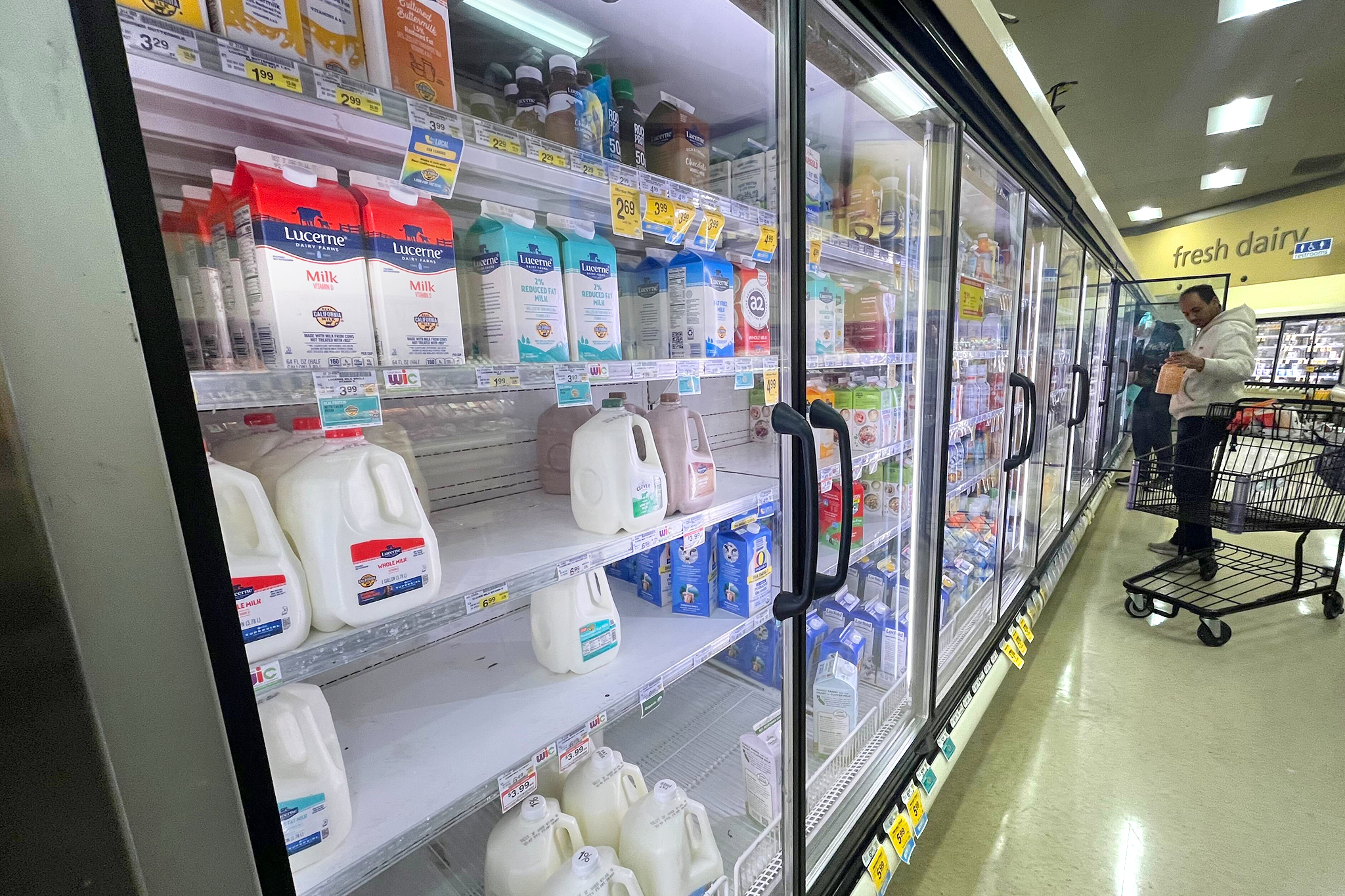
California’s dairy industry panics over August recycling deadline
California’s new recycling law is leaving dairy manufacturers panicked that the legislation’s fees and mandates could be devastating to their business and could send Californian’s grocery bills even higher.
Read more California HOA to pay $2.5M to resolve coastal access dispute

The 2022 law is designed to increase recycling participation and reduce landfill waste in California by making companies responsible for what happens to their products after they’re thrown away. That includes charging companies an impact fee for each product they sell and phasing out materials that cannot be adequately reused, recycled or composted.
CalRecycle is now implementing the first phases of the law, named Senate Bill 54, with companies expecting bills as early as next month.
The dairy industry is particularly concerned because its products are required to use packaging that does not currently meet the law’s targets. Katie Davey, the executive director of the Dairy Institute of California, said companies are facing impact fees as high as $15 million and will be forced to either charge customers more or shut down entirely.
“Our members are very sensitive about the price of their product,” Davey said. “They take a lot of pride in it, and they are at level 10, code-red alert and deeply concerned about what SB 54 is going to do to the price of their dairy products.”
Proponents say that the current system allows manufacturers and packaged goods companies to create excessive waste without paying for it, off-loading those costs to taxpayers as millions of tons of waste ends up in California landfills every year. State Sen. Ben Allen, who proposed the law, said in a June news release that the law actually protects consumers by forcing companies to pay for their waste.
“Rather than forcing taxpayers and ratepayers to shoulder these costs, we are ensuring companies that profit from this mass pollution help pay for its cleanup,” Allen said.
SB 54 attempts to solve California’s trash problem by levying fees on most packaged goods — everything from packaged strawberries to cosmetics — with the hope of spurring new innovation in sustainable packaging and incentivizing companies to use easier-to-recycle goods and reduce packaging.
However, there’s little doubt that the law will also force Californians to pay more for everyday goods. Davey said her group’s analysis has found that SB 54 will increase grocery costs for consumers by $1,300 on average a year. CalRecycle’s estimate, based on data from the state’s Department of Finance, is far lower, predicting an increased cost between $57 to $190 a year.
California is not the first state to implement this type of waste system. Oregon passed a similar program in 2021, while Europe has used similar policies since the early 1990s. One study commissioned by the state of Oregon found that these types of programs have not increased prices substantially.
CalRecycle has said that the program actually delivers 2.5 times as many benefits as costs by reducing waste, improving recycling and lowering the cost that local governments face for dealing with waste.
Yet, the dairy industry is adamant that California’s law as it’s currently designed will be catastrophic for the industry. Danielle Quist, the vice president of regulatory affairs and counsel at the International Dairy Foods Association, said the law’s source reduction requirements, which require companies to reduce their overall use of plastics by 25% over the next decade, will be “extremely challenging” for manufacturers.
Read more Giants overcome McCarthy’s 2nd inside-the-park homer this year, beat Rockies 3-1
Quist said packaged cheese, which currently comes in flexible plastic film that is not recyclable, would be entirely outlawed by the law come 2032 when all packaging needs to be recyclable, yet there’s currently no alternative.
“You may not be able to sell cheese. Cheese has to be in a flexible film,” Quist said. She later added: “Dairy packaging is there to protect consumers, and it’s there for food safety reasons, and the requirements of this law do not take into account the food safety needs.”
Some dairy manufacturers are already using safe and completely reusable glass containers; Petaluma’s Straus Family Creamery has more than 2.7 million glass milk jugs returned every year for reuse, according to its website. But Davey said that glass jars are currently a tiny portion of the overall market and that it’s not possible to serve all of California’s milk in glass containers. She also said that changing a single bottle line would cost manufacturers $40 million.
“At that price point, people are going to close their facilities and they’re moving out of California, and then we’ve lost good union manufacturing jobs and it’s really heartbreaking,” Davey said.
The law is currently facing multiple lawsuits, including one from 17 Republican-led states arguing in federal court that the law’s requirements are onerous and should be struck down. Environmental groups have also filed a lawsuit, arguing that the law was weakened during implementation. The law currently remains in effect but could be delayed or struck down by these court cases.

The Bay Area’s best free newsletter.
By signing up, you agree to our Terms Of Use and acknowledge that your information will be used as described in our Privacy Policy.
The dairy industry is now urging CalRecycle to accept some of the requirements for common dairy packaging by as much as five years, but even if that is approved, costs will still increase, according to Davey.
“It’s going to get really expensive here in California,” Davey said, “and as a Californian for my whole life, it already is expensive.”
— Bay Area restaurant goes viral for its policy on unruly children
— A Menlo Park restaurant is closing after over 20 years. The owner blames Meta.
— A California chain steakhouse giant is getting the slow axe
— Major burger chain to debut in Hawaii
For all things fascinating in Bay Area food, sign up for our Eat the Bay newsletter here.
Read more LA’s most convenient airport is about to get better with new terminal