Albertsons is infuriating Bay Area shoppers over vacant grocery stores
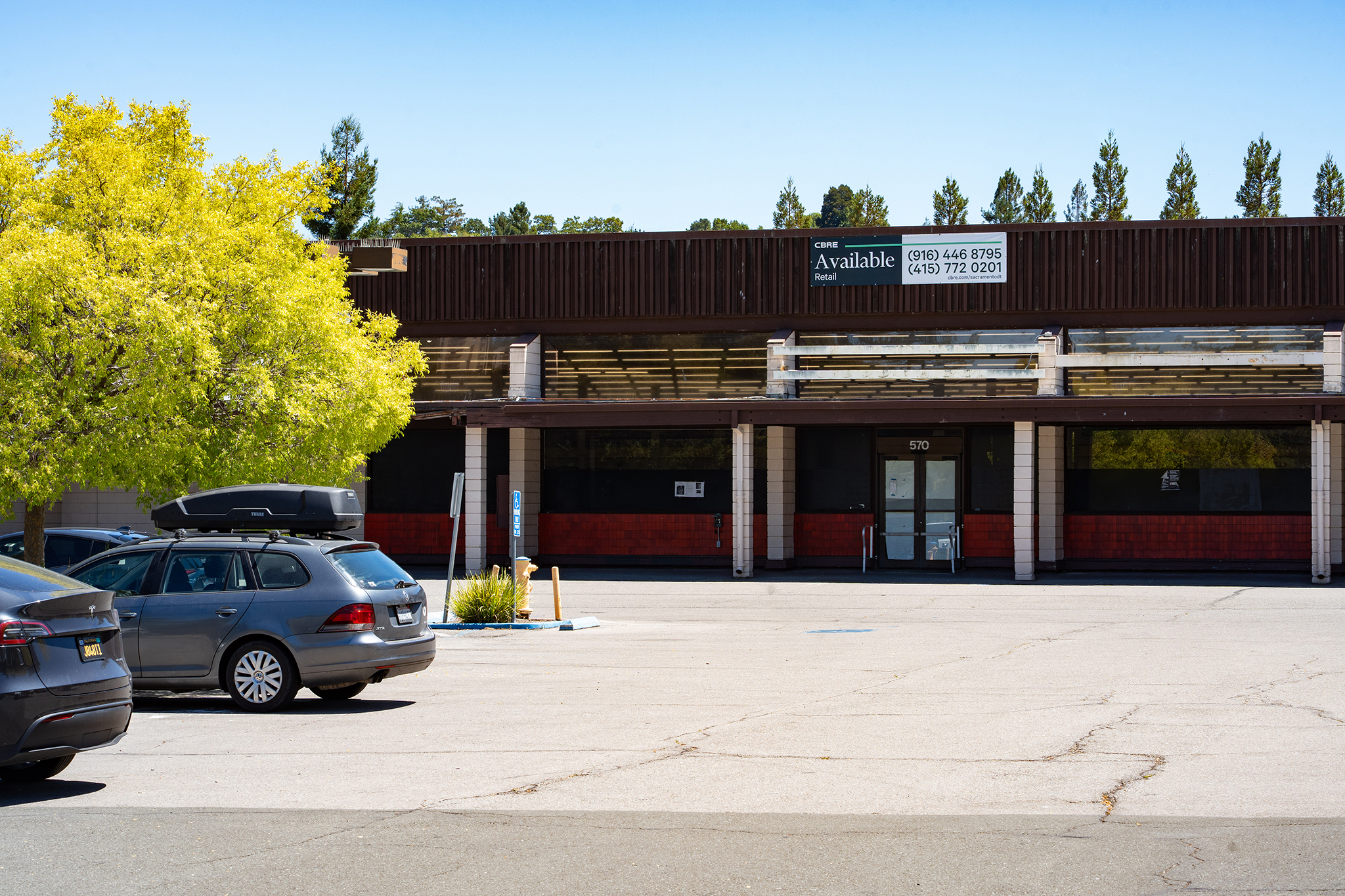
In the heart of downtown Larkspur, a tiny shopping center has become the grave site of a former Lucky Supermarket. The building, with its barren storefront and sealed doors, has haunted the neighborhood since 2023, yet there are currently no plans to open another grocery store in its place.
Read more Calif. company still focus of cyclosporiasis outbreak investigation, FDA says

Tina McArthur, a Larkspur resident and board president of the historic Lark Theater, blames the building’s owner: Albertsons Companies.
“I think it’s terrible that they just left their building like that,” McArthur said. “The lights are still on. … I really don’t think they care one bit.”
The Lucky store is not an outlier. Albertsons — the parent company of Safeway, Vons and other major supermarkets — owns dozens of vacant surplus properties across the U.S., including at least sevenvacant California stores listed for sale. An SFGATE investigation found that Albertsons appears to have a history of usingits vast real estate portfolio to block the opening of competing grocers through restrictive land covenants or by keeping its properties vacant. In some cases, Albertsons has introduced controversial development plans on its properties that could raze existing supermarkets like Trader Joe’s in Oakland’s Rockridge neighborhood and Safeway in San Rafael without replacing those markets.
Albertsons could leave even more vacant properties on the market as the grocery company plans to shutter an unknown number of underperforming stores in California, and beyond, after its failed merger with the Kroger Company.

Albertsons Vacant Buildings
Grocery companies that keep properties vacant or add covenants to prevent future stores contribute to limited food access in communities, according to Christopher Leslie, a law professor at the University of California, Irvine.
Kent Streeb, a spokesperson for Albertsons, said in an email that the company is working to fill vacant stores.
“For over 100 years, Safeway has demonstrated its commitment to serving communities across Northern California and currently runs 283 stores,” Streeb said. “Our goal is to operate successful stores, and we actively seek to fill vacant properties with tenants to serve local residents. In addition, we regularly make significant food donations and financial contributions towards hunger relief in neighboring communities.”
One Bay Area lawmaker is now trying to block grocery store owners like Albertsons from keeping locations vacant. San Francisco Supervisor Bilal Mahmood recently proposed a law that would tax any grocery store company for creating “zombie stores” by leaving neglected stores empty.
A ‘food desert by design’
Larkspur, a Marin County town about 10 miles north of the Golden Gate Bridge, has always prided itself on its walkability, but since the Lucky closure, locals now need to drive to find the next closest food markets, which aren’t always affordable, Larkspur City Manager Dan Schwarz said.
“We’re talking about stores that … have a slightly higher price point than Lucky would if somebody’s looking for that classic broad economic spectrum shopping experience,” Schwarz said. “I think that’s probably another piece of some of our community’s frustration is they don’t necessarily want to shop at a store that’s above their comfort level for their daily needs.”
The U.S. Agriculture Department defines a food desert in part as a town where residents live more than 1 mile from a supermarket, or more than 10 miles in rural communities. In the case of Albertsons, the grocery company could be creating a “food desert by design,” Leslie told SFGATE.
This can happen when companies exercise land covenants, which are legally binding rules set on a property to control how the land is used. According to Leslie, major and regional grocery chains like Albertsons have placed strict covenants since at least the mid-20th century. Walmart has also used these restrictions, which can last up to 50 years.
“Supermarkets do this because it eliminates competitors from opening grocery stores, which forces consumers with cars to drive to the major supermarkets’ other locations … in the suburbs,” Leslie said.
When major grocery stores close and place a restrictive covenant on the property, locals tend to drive farther to the next affordable grocery store. People without cars will likely pay even more by shopping at nearby independent grocery stores or bodegas, if available, because those markets charge more than big chain grocery stores, he said.
This very same dynamic could soon play out across the bay from Larkspur to Oakland.
The race for housing
Albertsons’ impacts on grocery availability in the Bay Area are likely to only increase as the grocery conglomerate flexes its muscle into property development. Align Real Estate and Albertsons are developing housing projects at Safeway locations throughout the Bay Area, including plans to build almost 3,500 units of housing across San Francisco’s Marina, Bernal Heights, Outer Richmond and Fillmore districts. The proposed residential housing project that could demolish the Safeway in San Rafael is not part of the Align Real Estate portfolio and is instead managed by Mill Creek Residential.
Albertsons may also be blockingprospective grocery companies from temporarily opening in the former Safeway store in San Francisco’s Fillmore District, which is expected to be closed for years as the company redevelops the property, according to the San Francisco Standard. The Standard reported thatGrocery Outlet, Smart & Final and Sprouts Farmers Market have all considered short-term leases at the Safeway site, which closed in February 2025, but Mahmood told the Standard that Safeway has stalled those talks, which he said shows the company was “never intending to actually put a grocery store in there.”
Streeb, the Safeway spokesperson, refuted Mahmood’s framing of those negotiations. He said in an email that Safeway offered the space to the other grocery chains on a “rent-free basis” before construction but that they declined “citing the cost to open and the challenges of operating during construction.”
Local| Bay Area city braces for biggest housing boom in decades
News | ‘She was amazing’: 18-year-old dies after falling at Calif. dam
Crime| She was alone in a remote Bay Area farmhouse. A killer found her.
Get SFGATE’s top stories straight to your inbox by signing up for The Daily newsletter.
Albertsons’ plan to redevelop one of its properties at 5727 College Ave. in Oakland into a 31-story senior living facility is particularly controversial. Trader Joe’s is currently a tenant at the property,but initial plans for the development include bulldozing the beloved grocery storewithout allowing Trader Joe’s or any other market to move into the new building.
Matt Easton, a Ph.D. candidate in political science at UC Berkeley, told SFGATE that he was disappointed when he learned that his preferred grocer may close. The Trader Joe’s has made it easier for Easton to buy affordable groceries while on a student stipend. If the city approves the project, it could dramatically change his routine.
“I just don’t want to lose my Trader Joe’s,” Easton said. “The convenience and ability for me to go grocery shopping without having to rely on my car is such a selling point.”
He added: “I’ll have to reframe my budget a little bit more because honestly, if I start shopping at Whole Foods, I’m going to be eating a lot less food.”
Read more Royals All-Star shortstop Bobby Witt Jr. leaves win over Giants with back tightness
Safeway has not filed its final application for the redevelopment, and there appears to be some movement toward including a grocery store in the plans. Oakland City Councilmember Zac Unger has said the city is “actively working” with Albertsons and its development partner to make space for Trader Joe’s in the future development.
Streeb, the Safeway spokesperson, said the parties are working with each other but did not comment further on the plans.
“In Oakland, Safeway has leased this location to Trader Joe’s for nearly two decades,” Streeb said. “We continue to support grocery at this site. In response to the community and its leaders, we continue to work with the buyer to allow for grocery operations that make sense for their business.”
Star Lightner, a board member of the Rockridge Community Planning Council, told SFGATE that the organization supports new housing but is worried that removing the Trader Joe’s would eliminate the most affordable grocery store in the area. Its closure would push locals to nearby Safeways or a Market Hall Foods, but those options are more expensive, Lightner said.
“Trader Joe’s is really the affordable option, and it’s very central,” Lightner said. “People can jump off BART and go straight to Trader Joe’s on their way home.”
It’s unclear why Albertsons has proposed housing without including a grocery store. The multibillion-dollar company and Align Real Estate did not return SFGATE’s request for comment. One clue could be the location of the conglomerate’s other existing stores: There are two Albertsons-owned Safeway stores within a mile of the Oakland Trader Joe’s it plans to close. Is Albertsons closing competing grocery stores near its own properties to encourage locals to shop at its own brands? Leslie wasn’t sure. But he said the grocery company’s sudden shift to housing seemed unusual.
“It seems odd that a major supermarket is building housing developments without grocery stores,” Leslie said. “Building housing developments is progress. But blocking future residents from being able to walk to a neighborhood supermarket is housing that comes at an unnecessarily high cost.”
Removing the Trader Joe’s without replacing it could also impact foot traffic and hurt the neighborhood, Lightner said. She said that there’s a three- to four-block stretch of retail business that includes Zachary’s Chicago Pizza and Ain’t Normal Cafe that keeps the corridor busy. Without a grocery store in place, that could change.
The Rockridge Community Planning Council met with Align Real Estate at the end of June to discuss its concerns over the proposed project and plans to continue conversations this month, Lightner said.
Albertsons’ tight grip on land
Grocery store conglomerates like Albertsons can keep properties vacant long after they sell buildings, as one abandoned Rite Aid property in Eureka shows.
Before its closure last summer, the Humboldt County Rite Aid was allowed to sell up to 30% worth of grocery store items in the neighborhood due to a 50-year covenant established by Safeway in 1999, according to the Humboldt County Assessor. And while the property sale occurred decades before Albertsons purchased Safeway in 2015, the deed restriction continues to impact the city of Eureka today.
Locals and Eureka City Council members want to reopen the vacant site as a full grocery store, according to Eureka City Manager Miles Slattery, but the decades-old covenant has halted those plans.
According to Leslie, grocery companies can implementstrict covenants because they’re not illegal in most jurisdictions. Still, some lawmakers have already taken steps to curb these restrictions. Last October, Seattle unanimously approved legislation that banned restricted covenants on grocery stores and pharmacies following a wave of grocery store closures in the city. California Assemblymember in March that would also prohibit grocery stores from using covenants.
While the long-term effects of covenants aren’t fully understood, scholars have theorized that covenants can violate antitrust law, which is designed to enforce fair competition between companies, Leslie said.
Last September, Eureka City Council members proposed a city-run grocery store at the former Rite Aid, but talks have since fizzled because it is “cost-prohibitive” amid a million-dollar deficit, Slattery said. He added that the city previously spoke to the property owners Slack and Winzler Properties Inc. and learned that they had hired a lawyer to renegotiate the land restriction, given the great interest grocery chains have had on this site. Lisa Slack, an owner of Slack and Winzler Properties Inc., declined to comment for this story.
‘Not a good situation’
In recent years, the city of Larkspur has held discussions with Albertsons to convert the former Lucky supermarket space into housing. According to Schwarz, Albertsons submitted a letter asking for the property to be all housing, which concerned city officials who then requested that the company include a grocery space in its proposal. After that, Albertsons went “radio silent,” Schwarz said. The property has since gone back for sale.
There’s still a strong desire to see the downtown property reopen. Schwarz said that some locals have even pushed city officials to penalize Albertsons for leaving its property vacant like other Bay Area cities have. A few years ago, San Francisco passed a law that fines landlords if they keep their properties vacant for more than 182 days. But Schwarz was cautious about implementing a similar law in a smaller city like Larkspur because it could have bigger impacts.
“Some of these tools might help encourage Albertsons to do something, but then we have to apply it to different storefronts,” Schwarz said. “Maybe it’s a local owner that is well-intentioned, and there’s a good explanation for why they’re needing more time. So it’s just about unintended consequences if you start pulling out the big hammer.”

The Bay Area’s best free newsletter.
By signing up, you agree to our Terms Of Use and acknowledge that your information will be used as described in our Privacy Policy.
For now, McArthur and other locals in Larkspur will need to wait to see what becomes of the abandoned Lucky store. For her part, McArthur said that replacing the space with housing would not solve the city’s issue, which is not having a grocery store.
“The loss of Lucky’s is a real tragedy for our citizens,” McArthur said. “It’s not a good situation.”
— Every summer, this 63-year-old Calif. drive-in gets mobbed for its peach shakes
— Once famous only for its lab, Bay Area town booms with great eats, shops
— Canada’s cult-favorite supermarket arrives in the Bay Area. It’s a showstopper.
— Sprawling Bay Area food hall with Michelin cred is hidden in an office building
For all things fascinating in Bay Area food, sign up for our Eat the Bay newsletter here.
Read more Loftin’s squeeze bunt in the ninth gives the Royals a 4-3 victory over the Giants