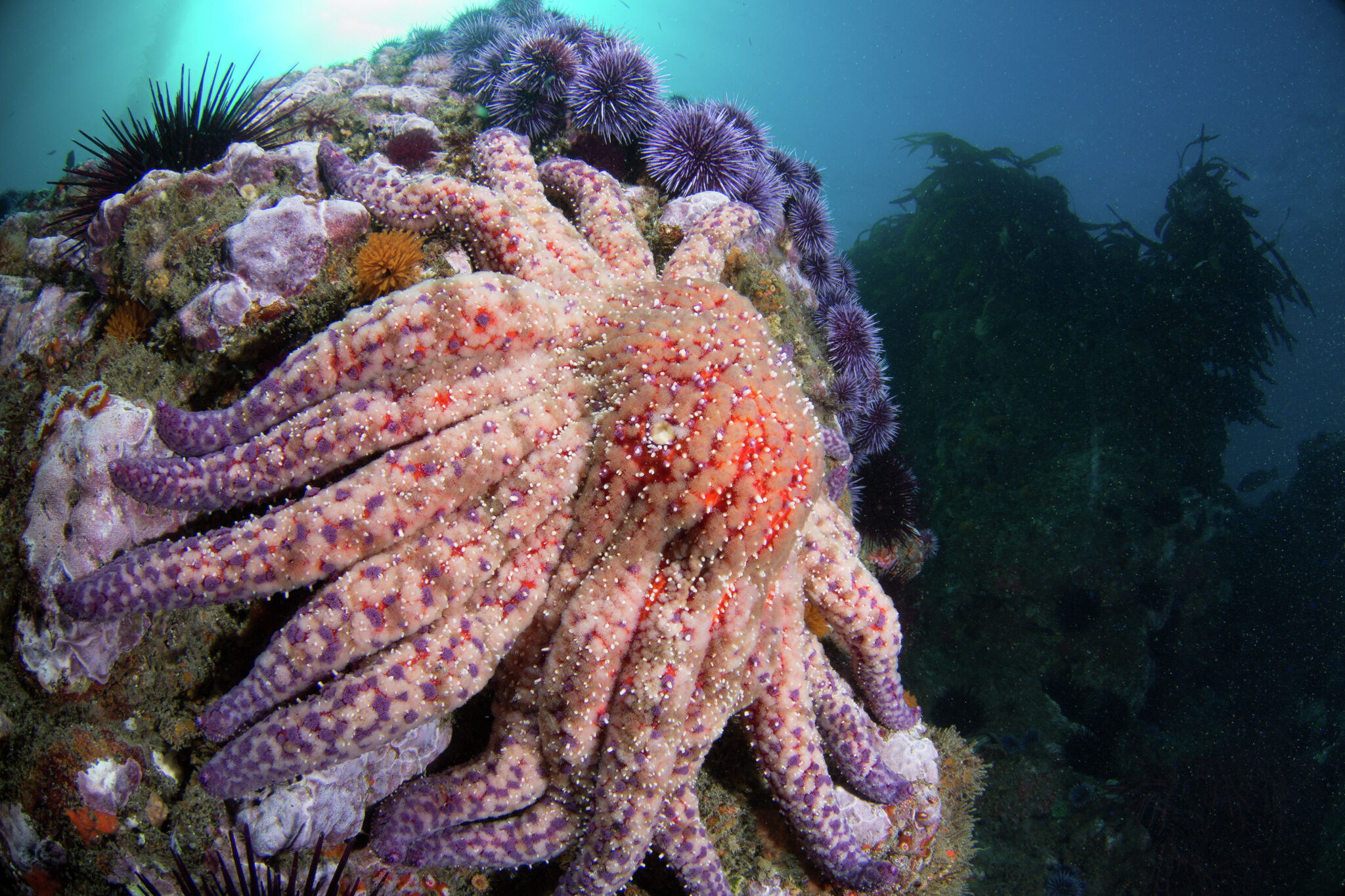
California lost these iconic sea creatures years ago. A family just reappeared.
As an infamous marine heat wave ramped up more than a decade ago, sunflower sea stars fell sick and all but disappeared from California waters.
Read more MLB Commish: Giants botched Pride Night cap guidance, leaving players unclear on opt-out

But scientists refused to stop searching for the keystone species, Pycnopodiahelianthoides, one of the world’s largest sea stars, known for hunting California’s rocky reefs with up to 24 arms. The loss of the big stars shifted California’s marine ecosystems wildly, including by allowing prey like purple sea urchins to gobble up collapsing kelp forests.
Last summer, a large group of research partners — including the Kashia Band of Pomo Indians, Greater Farallones and Cordell Bank national marine sanctuaries, the Nature Conservancy and Sonoma State University — gathered on the Sonoma Couny coast near Sea Ranch, investigating a cove where a diver had stumbled upon one wild sunflower sea star. They found 18.
“For those who’d seen them prior to wasting disease, it must have been akin to seeing an old friend, but I felt more like a stunned paleontologist seeing a dinosaur,” Tyler Mears, a specialist for the Greater Farallones Kelp Restoration Project who was one of the scuba divers in the underwater search, said in a statement.
Although there have been a few rare sightings in California since the massive die-off that started in 2013, the Sea Ranch discovery marks the largest group of sunflower sea stars spotted in state waters yet.
The research team did not share the find with the public until now. Yet, according to Rietta Hohman, the kelp restoration project manager for Greater Farallones Association, researchers have raced to learn more about the survivors over the past year.
“What was so exciting about the Sonoma County site was there were larger, not just little, individuals at a density that could be meaningful for reproduction,” Lauren Schiebelhut, an affiliate with University of California, Merced, who is analyzing genetic samples from the 18 stars, told SFGATE. “If you just have an isolated star, then it’s not doing much for the population.”
Schiebelhut hopes to have some findings by the end of this summer that build upon a breakthrough study published last year, which revealed that a bacteria called Vibrio pectenicida had caused the sea star to waste away.
“Ultimately, we’re interested in how these new stars fit into the conservation landscape,” Schiebelhut said. “So where are they coming from? What do they look like? What do the pathogen dynamics look like?”
The ongoing efforts to monitor and restore sunflower sea stars in California are extensive, including initiatives to introduce disease-resistant stars cultured in the lab to the ocean.
Read more California union warns of mass exodus with Newsom’s return to office order
But time is of the essence. Marine biologists believe there’s a link between the wasting disease and warming ocean temperatures. Right now, a historic heat wave has been cooking the Pacific for months, and the forecast very strong El Niño could warm temperatures even more.
“The warmer ocean temperatures could negatively impact pycnopodia, and that’s why we’re all trying to get plenty of data and trying to document where they are,” Schiebelhut added. “There could be serious consequences, given it’s documented that the sharp decline for pycnopodia was right on top of some temperature extremes. Those warm waters negatively impact them presumably because of the pathogen, but there could also be other factors that increase their susceptibility to wasting associated with temperature.”
Peter Raimondi, a marine biology professor at UC Santa Cruz, recalled seeing the rapid effects of the disease while taking one of his classes diving in Monterey Bay in 2013. At first, everything looked normal.

The Bay Area’s best free newsletter.
By signing up, you agree to our Terms Of Use and acknowledge that your information will be used as described in our Privacy Policy.
“But during the second week, the pycnopodia were in fragments, with pieces of them like arms walking around on the bottom, while the intact ones were dying in place,” he told SFGATE. “By the third week, there wasn’t another one. Sequentially after that we would see other species hit, but the pycnopodia were the first. They’re the most fragile.”
In terms of what’s at stake with rising ocean temperatures for the entire marine ecosystem, Raimondi said that the fate of the sunflower stars plays less of a role now for the kelp forests, since there are so few. He’s most concerned about bull kelp, which has not rebounded as much as giant kelp.
“If there’s a really strong heat wave, it’s very likely that giant kelp will go down again by a lot of acres,” he said. “But the consequences could actually be way worse for the bull kelp because it then becomes so exceedingly rare that recovery becomes less and less of a possibility.”
— AI data centers appear to be creating their own microclimates
— After ‘unprecedented’ results, SF researchers get closer to HIV cure
— Gray whales are out of luck in San Francisco Bay
— California faces first sign of a new drought
Read more Man dies after being ejected from boat on Shasta Lake
Sign up for daily SFGATE breaking news alerts here.