How a $3.8B project made an ‘eyesore’ of a Calif. airport cool again
In a city as beautiful as San Diego, with perfect weather nearly year-round, San Diego International Airport’s Terminal 1 was an eyesore — even to airport officials.
Read more The Giants trade struggling catcher Patrick Bailey to the Guardians. Bo Naylor optioned to Columbus

“We were all kind of hiding our faces when we had to come pick up our friends and family from the old Terminal 1,” Angela Shafer-Payne, San Diego Airport Authority vice president and chief development officer, told SFGATE.
When the terminal was built in 1967, it was designed to handle 2 million travelers per year. But by 2005, through a cramped, understaffed facility with only four security checkpoints and an insufficient number of baggage carousels. At times when the airport was at its most crowded — the terminal served Southwest, the airport’s largest carrier — it would have to let in only a few passengers at a time. Something had to be done, and the problems were so significant that airport officials realized they had to demolish and replace the old Terminal 1 rather than try to give it a facelift with a less invasive renovation.
“There was nothing that was redeeming that we could redeem in that building,” Shafer-Payne said. “It needed to go from all aspects.”
After five years of construction, a new Terminal 1 opened in September, and airport officials are hoping the $3.8 billion project helps San Diego Airport fly into a future of better amenities, more passengers and a flight network that extends far internationally. And thanks to the airport’s new SAN Pass program, anyone can explore a new terminal that feels quintessentially San Diego even when they’re not flying.
Don’t let Google decide who you trust.
“Let’s make sure that when people come into the airport, whether they’re arriving to San Diego or whether they’re departing, that it gives a sense of San Diego,” Shafer-Payne said.
The case for a new terminal
San Diego Airport’s convenient location on San Diego Bay next to downtown and Balboa Park also has its drawbacks. Crammed between the bay, Interstate 5 and a Marine Corps base, the airport has no room to expand. Previously, the city had considered moving the airport altogether. But when residents rejected a plan to move the airport to Miramar in 2006, officials knew they’d need to work with the limited space they already had.
“Right now, there’s absolutely no conversation going on in the community about replacing this airport or adding a second airport,” Shafer-Payne said. “We’re just focused on how we can make this airport be the best that it can be.”
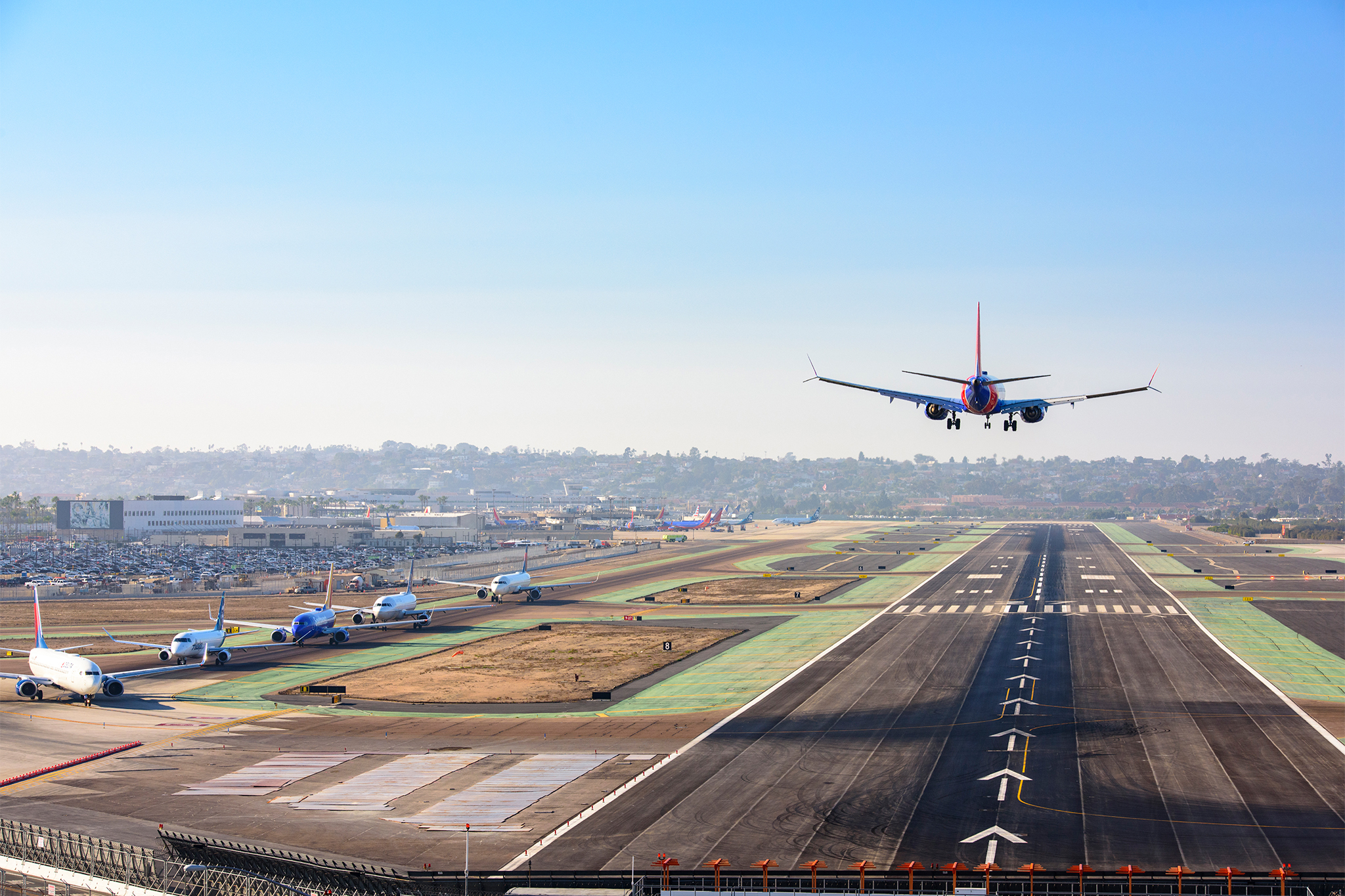
In 2025, San Diego Airport hit a record high, with its two terminals collectively recording 25 million passengers. But as the busiest single-runway airport in the United States, it has a limited capacity for the number of flights it can accommodate, plus a curfew to curb noise that prohibits flights between 11:30 p.m. and 6:30 a.m. Those constraints made the need for a new Terminal 1 even more apparent.
“We needed to build a new building,” Shafer-Payne said. “It was the fact that the building itself, because it was built so many years ago; it did not have adequate restrooms, concessions, gate hold room areas.”
Fifteen years in the making, the first portion of Terminal 1 opened in September. The first phase of the project includes 19 gates. But by the end of the second phase in 2028, the new terminal will have 30 gates, making more room for some of the 17 passenger airlines that service more than 85 destinations each year.
Food | SF bakery finds unusual solution to neighbors complaining about its long lines
Local
Travel | The California town that rose and died in 2 years
Get SFGATE’s top stories sent to your inbox by signing up for The Daily newsletter here.
What is the SAN Pass?
The SAN Pass program, which launched in November, allows visitors to enjoy San Diego Airport without a plane ticket. It’s a chance for visitors to treat an airport’s terminals like a mall — something many airports resemble these days — meet friends and loved ones inside the terminal when they land, or walk them to their gate.
The days of strict security checkpoints where boarding passes are required to pass through — a byproduct of the Sept. 11 attacks — are slowly melting away. And San Diego is not alone. More than two dozen airports across the U.S. now have similar programs, including Seattle-Tacoma, Oakland San Francisco Bay Airport and San Francisco International Airport, which just launched its program on April 28.
To get a SAN Pass, prospective visitors must fill out the application from up to a week before they plan to arrive to the day of their visit. Applicants need to have Transportation Security Administration-approved identification, such as a Real ID or a passport, and choose which of the two terminals they’d like to visit (at present, the terminals are not connected behind security). Approved visitors will receive their SAN Pass after midnight on the morning of their visit.
Visitors should arrive at the airport between 4 a.m. and 9 p.m. and head straight to security with the same TSA-approved ID they used for the application and a PDF copy of their SAN Pass saved on their phone (passes should not be printed). Sorry, TSA PreCheck and Clear members, the passes are accepted only in the standard screening lanes.
Only 100 passes are available per day, on a first-come, first-served basis, airport spokesperson Nicole Hall told SFGATE in an email. The program has been a hit so far, she said, with an average of 1,500 passes issued per month and more than 8,500 since its inception. I applied for my SAN Pass seven days before my visit. When I woke up the next morning, I received an email with an attached QR code similar to the codes I use with mobile boarding passes.
At Terminal 1, I headed straight for the security line, which had only a 12-minute wait. When I got to the front, the officer at first seemed a bit confused that I wasn’t flying. She didn’t scan the QR code for my pass; instead, she gave it a quick once-over and made sure the name on the pass matched my passport before waving me through. Call it San Diego charm, but the TSA officers were friendly while doing their job. After my backpack made its way through the metal detector and the always uncomfortable experience of starfishing in the full body scanner was over, I made it inside.
A walk through the new terminal
The contrast between the old and new is sweeping. While the old Terminal 1 was uncomfortably dark, the new Terminal 1 is flooded with light. Floor-to-ceiling windows take advantage of the nearly always sunny San Diego landscape. And there’s a certain calm in the comfortable, stylish window-facing seating that’s perfect for reading a book or watching planes.
Shafer-Payne says the goal was to think long term and create a terminal that will meet the airport’s needs for the long haul.
“We needed to modernize this facility, and we needed to bring it up to current airport standards for hold rooms, for restrooms, all of that,” she said. “But beyond that, we said we also recognized that we were building a building that wasn’t going to serve passengers just for the next 10 years; it was likely going to serve passengers for the next 50 years.”
Read more Rafael Devers goes deep and Robbie Ray pitches the Giants to a 5-2 win over the Pirates
On a Friday afternoon, the terminal was bustling with people, but wide hallways make it easy to take a stroll and enjoy the art all around the airport. Wood carvings and glass art effortlessly hang from the ceiling. Shafer-Payne said they decided to bring artists into the fold before they even had renderings of the building.
“We didn’t want to design a building and then at the last minute say, ‘OK, now where can we place art?” she said. “So really, on a parallel track with the design, we were bringing artists on board.”
Built for San Diego
While walking around, I noticed several nods to San Diego culture meant to provide a lasting imprint on anyone arriving in or departing from the city. From the artwork on the walls to the restaurants, concession stands and even an outdoor patio, designers had embeded San Diego landmarks and history throughout the airport.
The Liberty Station gift shop and the Arts District Market pay homage to the historic Naval Training Station, built in 1921. The former training grounds are now known as Liberty Station, home to several businesses, including one of my favorite coffee shops to work from, Moniker Coffee Co., and an international food market that’s perfect for grabbing dinner and a drink before heading to the airport.
The terminal’s food stalls feature local favorites. Better Buzz Coffee, which started as a coffee cart in Mira Mesa, operates a stall just past airport security where travelers can get its well-caffeinated coffee, energy drinks and pastries. The Taco Stand, which first brought its Tijuana-style Mexican food to La Jolla in 2013, operates a stall in the food court alongside Ambrogio15, a northern Italian restaurant with roots in Pacific Beach. Shafer-Payne said that, like the artists, the vendors were chosen early and have been on board since the conception phase.
“We wanted it to give a sense of San Diego — a sense of place — whether you’re arriving or departing,” she said.
But the focal point of the food court is Novecientos Grados by the San Diego County-born Tony Hawk, a 5,000-square-foot Mexican restaurant with an outdoor patio. Skateboard ramps serve as decor above the bar, and vibrant colors wash over the interior. The restaurant immediately caught my eye for lunch because of its unexpected mash-up of celebrity chef Claudette Zepeda and a skateboarding icon. It’s a dedication to San Diego’s roots in skateboarding culture and Old Town’s Mexican heritage.
Shafer-Payne said Hawk and Zepeda were intimately involved with the project.
“I think sometimes somebody puts a name on a place, and nobody ever sees them,” she said. “Tony was very engaged in the design.”
I ordered a steak quesadilla and a spicy margarita, both of which were delicious for airport food. The kitchen was generous with the amount of cheese, and the salsa had a nice kick. But the best part of the dining experience was sitting outside, enjoying the San Diego sun and glimpses of the aircraft.
“We said we need a place where if you’re flying through San Diego Airport, you can go outside,” Shafer-Payne said. “It all worked out that where the food court ended up being designed, that was on the south side of the building, which gave you just this magnificent view of downtown San Diego and the Coronado Bridge.”
Perhaps the most hyperlocal spotlight is the Snapshot San Diego exhibit. Tucked away in the left corner of the terminal, it’s an homage to several of the city’s museums and local groups. The Escondido History Center and Coronado Historical Association are just a couple of the groups highlighted. Handcrafted dolls from the Japanese Friendship Garden and Museum and historic weaving tools from the Visions Museum of Textile Art hang proudly on display. The exhibit is a nice reprieve from the hustle and bustle of a busy airport.
While the new Terminal 1 buildout is beautiful, what I found most fascinating during my visit was how much more I noticed about the airport when I wasn’t rushing to catch a flight. Airports are a transitional space. Even on a longer layover, I’m hyperfocused on making my next flight. But this time, it was almost peaceful.
What’s next for SAN
San Diego has seen steady growth since numbers declined in 2020 due to the COVID-19 pandemic. Still, in 2025, the airport officially surpassed pre-pandemic numbers, with 25.32 million travelers passing through. Los Angeles International Airport was still about 15 million visitors behind its pre-pandemic numbers at the end of 2025, ending the year with nearly 74 million passengers. SFO is a lot closer: 54 million passengers traveled through the airport last year — just 3 million below what the airport saw in 2019.
With only two terminals and the sole runway, the airport is not trying to compete with California’s largest airports, Shafer-Payne said. Instead of trying to oversaturate the market with routes, airport officials are focused on filling gaps in the route network. This past year, Alaska Airlines slashed several routes at SFO and expanded its presence at its San Diego hub. The airline launched new routes from San Diego to Dallas-Fort Worth International Airport, Oakland International Airport, Raleigh-Durham International Airport, Tulsa International Airport and Santa Barbara Municipal Airport.
Shafer-Payne said the airport’s current focus is expanding its international destinations. In 2025, the airport added 14 nonstop routes, including a new route on Copa Airlines to Panama City and another on KLM Airlines to Amsterdam.And this year, the airport added daily flights to Munich on Lufthansa and more flights to London Heathrow on British Airways. And despite a previous downturn in Canadian passengers, this summer, WestJet and Air Canada are adding more Canadian routes.
“I want to be clear, we’re never going to be anywhere near an LAX as San Francisco in terms of the international volume,” Shafer-Payne said. “But for us, we have really seen it was a double-digit growth in those international passengers, and we’re continuing to have conversations with international carriers for the future.”
Future infrastructure projects include building an airside connector between Terminal 1 and Terminal 2 and adding a second taxiway. The airport is also considering a complete teardown of the oldest section of Terminal 2.

“There’s a portion of Terminal 2 that was built in 1979, with a waffle-cut ceiling. They call it brutalist architecture,” Shafer-Payne said. “… We thought it didn’t look so bad until we got rid of [the] old Terminal 1. And now we realize, ‘Yeah, it’s in a state,’ and that’s where Alaska and American operate today.”
Shafer-Payne said the community response has been overwhelmingly positive to the new terminal and the overall changes at the airport over the past year. And while it took 15 years to get there, the community’s support and trust in the vision for a better airport experience has paid off.
“People are proud of the airport, and I don’t think anyone was saying they’re proud of the airport,” Shafer-Payne said. “… We have built a terminal that is worthy of this beautiful region.”
— One of California’s most beloved foods is based on a myth
— San Francisco solving dangerous street problem with speed cameras
— Tartine arrived in Korea 8 years ago. It changed how the country eats.
— Bay Area crash occurred hours after teens took drunk driving education
— The heavily congested Calif. highway now controlled by AI
Read more Infectious disease experts alarmed by Legionella infections at Bay Area hospital
For more travel news and features, sign up for our TravelSkills newsletter here.