In stunning vote, California’s reddest county chooses Bay Area Democrat
ADIN, Modoc County — On the afternoon before the primary election last week, Frank Castaneda, a shopkeeper in the remote agricultural town of Adin, was upset. Due to a newly redrawn congressional district map, the election was the first time voters in Modoc County were mushed in with their ideological opposite: voters in Marin County.
Read more 300-acre wildfire burning near Lake Berryessa sends smoke into Bay Area

“We lost our voice,” Castaneda told me by a window in his general store. “We’re a small community that’s now beholden to the people in the Bay Area.”
Castaneda and his wife, Mariana, took over the Adin Supply Company in April, leaving behind Southern California to embrace conservative values in the farthest northeast corner of the state. That morning, Castaneda said he poured coffee for ranchers who were up all night guarding cattle from the looming threat of wolves. The endangered species is just one wedge between environmentalists in the Bay Area and ranchers in Modoc County. It’s an urgent example to illustrate the stark division in politics between folks in rural and urban California.
Adin Supply Company is one of two prominent businesses in town (the other is a frosty stand) and serves as a hub for the 200 or so people living near the front door into Modoc County. It was the first stop on my tour of the county. Proposition 50 folded — or gerrymandered, depending on who’s speaking — Modoc into the same district as Marin, where I grew up. I wanted to talk to voters who live on the opposite end of the district, both geographically and politically.
I visited during election week and asked Modoc locals how they felt about their democratic voice being effectively marginalized.
“We don’t have as many people so there’s not as big of a voice,” said a rancher in Adin named Laurel Ybarra, before paraphrasing a much-derided doctrine that reshaped rural voting in America: “They say you don’t count rocks and trees,” she added.
Ybarra was referencing the landmark Supreme Court decision Reynolds v. Sims, which codified the electoral principle of “one person, one vote.” Due to the 1964 ruling, state legislative districts must be roughly equal in population, and ever since, the ruling has weakened rural voter power by favoring more populated urban areas.
Some folks in Modoc continue to reel from the 62-year-old ruling; Prop. 50 was merely the latest salvo in the ongoing clash between the city and the country.
“We have mining, timber and water — all the food is grown out here,” Ybarra said. “You like hamburgers? This is where they start out.”
Boogeyman from Marin
Open space and elbow room typically define Modoc, where about 8,500 people live among vast valleys molded by the splitting of the Sierra Nevada and Cascade mountain ranges. Their rugged fray forms the last frontier of California. Slightly smaller than Los Angeles County in square mileage, Modoc couldn’t exist further away from the state’s metropolitan areas in terms of politics.
Seventy percent of voters consistently turned out for Donald Trump over the previous , and, in response to Proposition 50 last fall, Modoc voters soundly rejected redrawing the congressional district map.
The near 80% disapproval was the polar opposite of opinion of those in Marin, who voted with an 80% approval of the new maps. After passing, the proposition looped the two counties together in a district map that resembles the outline of an old fur hat like the one Davy Crockett would have worn. Modoc at the forehead, Marin at the tail, anchoring the district with about 250,000 largely liberal residents that now effectively drown out conservatives in the north.
On Tuesday morning, I strolled through Alturas, the county seat and only city with more than a 1,000 residents. I walked its main street, which doubles as Highway 395. Polls were opening soon and I wanted to get a feel for how it compared to Marin.
Voters in both regions champion the outdoors, but in widely different ways. Modoc is a popular destination for hunters, but in Marin, you’re likely to trigger a freak-out if carrying a weapon. Green thumbs in Marin could relate to a problem besetting gardeners in Alturas as a population of mule deer evade mountain lions by eating their way through the small city.
The most visible contrast was on the roads; while Tesla is a popular vehicle in Marin, the full-sized pickup is the ubiquitous mode of transportation in Modoc.
At the Double-A Cafe, Jennifer Flournoy, a cattle rancher, spoke to how Prop. 50 was a somber defeat for representative democracy. “It’s very disheartening,” she said. “It makes us feel like our place here in California doesn’t matter as much.”
While the rural community cast some votes unscathed by outside influence — in races for county superintendent, district supervisors and the auditor-clerk — the impact from more populated areas stifled Modoc’s influence on statewide races for governor and Congress.
It didn’t help that Modoc voters were issued a particularly confusing ballot. They were previously located in the 1st Congressional District, alongside similar counties like Lassen and Plumas. Rep. Doug LaMalfa, reelected seven times since 2012, spoke on behalf of the district until he died in office earlier this year.
Modoc voters were asked to choose a successor for the remainder of LaMalfa’s term until January 2027 — however, they are no longer in the 1st Congressional District.
With the redistricting, Modoc no longer votes alongside its neighbors to the south in Lassen, Sierra and Plumas counties. Those counties remain in District 1, while Modoc was split off and pulled into District 2 along with Shasta and Siskiyou counties, where Marin resident and incumbent Democratic Rep. Jared Huffman was the front-runner headed into Tuesday.
He faced a crowded Republican field that included Robin Littau, a former member of the Coast Guard who said she plans to take over the Christian publication Joyful Living Local Magazine, and Tim Geist, a biopsychological researcher who has warned against artificial intelligence.
Huffman lives in San Rafael and could appear to some like the archetypal boogeyman for Modoc voters. Not only a staunch critic of Donald Trump, Huffman has a checkered history with agriculture, as it diminished in Point Reyes under his leadership.
In a letter to the editor in the Marin Independent Journal last month, Steve Kinsey, former West Marin supervisor and coastal commissioner, cast doubt on the congressman’s track record with agriculture. “Huffman lost my support when he appeared to betray his promise to keep our working landscapes in the Point Reyes National Seashore,” Kinsey wrote. “In my view, he helped shut down oyster farming there, then deceitfully helped to close down most of its multi-generational ranches.”
In Modoc, where cattle ranching is the dominant industry, Huffman’s name on the ballot could appear foreboding to some voters.
Read more Flesh-eating parasite found in US after Trump cut surveillance funding
A thankless democracy
Although polls opened at 7 a.m, a majority of the ballots were already submitted by mail. Similar to , voting by mail is popular. Over 1,300 ballots in Modoc County arrived via the U.S. Postal Service. If a town has fewer than 250 residents, voters have no choice but to mail in their ballot, as there’s no precinct.
More than a hundred people still voted in person on Tuesday across nine precincts scattered throughout the county, with three in Alturas.
Home to about 2,600 people, it’s the largest town in Modoc County and contains the only stoplight in the county: a blinking red light at the intersection of 395 and Highway 299. In early June, the faces of new graduates from Modoc High School appear on light posts to line main street like an open air yearbook.
Across from the library, a hand-drawn sign propped on a sun-scorched Ford truck asked “R-We Winning?” and referenced the war in Iran, gas prices, tariffs and abuse by Immigration and Customs Enforcement. The truck also had a banner for the progressive organization Indivisible, and from what I saw, it was the only public display promoting left-leaning politics in the entire county on Election Day.
At Alturas City Hall, a half-dozen volunteers patiently guided voters throughout the day. They told me they coordinated a potluck of snacks to sustain their energy through the 13 hours the polls remained open. Two women crocheted at a desk during the lulls.
Volunteers faced an unexpected setback when internet from Frontier Communications cut out for about an hour on Tuesday. Liz Gelardi, a spokesperson for the company, later told me that their engineering team found “a fiber cut” and immediately worked to restore service. Modoc has suffered for years from copper thieves.
The signal drop created an arduous confirmation process at the polls: Before receiving a ballot, poll workers first clarified with the election office to ensure the voter hadn’t already submitted one. A poll worker said it’s sometimes a problem since voters can forget.
Voter turnout was about 40%, stronger than the national average. Stephanie Wellemeyer, the Modoc County auditor-clerk, who was running unopposed for reelection on Tuesday, said the turnout number was higher than usual for a primary. She added that voting by mail has increased in recent years.
Hayes Pearce, a 19-year-old from Cedarville, said he abstained from voting. “I don’t have the luxury of political opinions,” he said, quoting a “Star Wars” film. Instead, Pearce said he instead focuses on his contracting business.
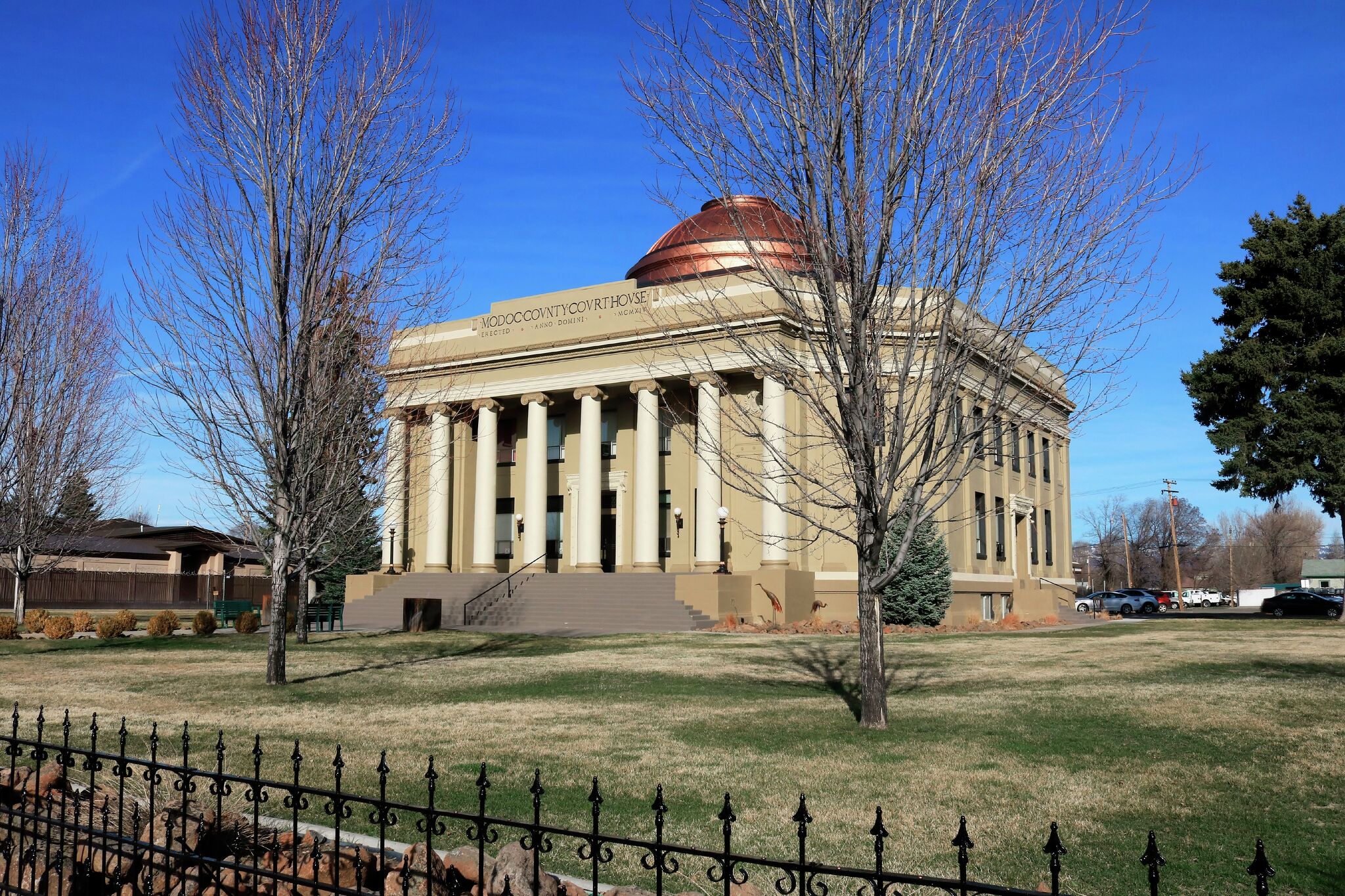
Polls closed at 8 p.m. and ballots were bound for the county courthouse, a stately, neoclassical building with a copper dome. In a windowless room in the basement, election officials began receiving the first bundles of ballots to count soon after polls closed. Some took bets for fun about which precinct would arrive first. The furthest one is in Newell, about an hour away. Wellemeyer’s parents volunteered to help deliver the votes by driving there and back.
A Dutch door opened at the top to allow journalists and observers to peer into the room where ballots were counted. Jay Jones, a retired public school teacher, was the only election observer. Since it’s a small community, the election officials were familiar with Jones and he’s watched over previous elections. The Trump administration actively promotes election observing, especially in California.
At one point, Jones grumbled about access, preferring to stand closer to the count, fearing that integrity was compromised.
Wellemeyer said running elections in Modoc has become more challenging in recent years. “When I first started, I used to get thanked. I still believe in that, even though that’s gone away,” she said. “Even if they think I’m a liar or a cheat, I stand by my morals.”
Around 11 p.m., Wellemeyer posted the unofficial final results. There were still a few hundred more votes to tally, including ballots that were damaged or had inconsistent signatures, but poll workers had processed nearly 80% of the votes.
The results showed a surprise twist in light of Prop. 50 in Modoc County: Rep. Huffman led the vote for representing District 2 with just over 18%, followed by Littau and Geist.
The Democratic incumbent from Marin told me he was “delighted” to nab the most votes but that he understood how the odds were in his favor. “The Republican vote was split among a whole bunch of different candidates, which is why I was the top vote getter in the primary,” he said in a voice message on Wednesday.
Huffman visited Modoc in January and said he has two more trips planned before the election in November. “I think showing up really matters,” he said. Asked about the pressing issues he’s heard from Modoc residents, Huffman noted housing — both the high cost and that there’s not enough of it. He was aware of the ongoing conflict with wolves. “We need to work on some better strategies for managing that conflict,” he said.

The Bay Area’s best free newsletter.
By signing up, you agree to our Terms Of Use and acknowledge that your information will be used as described in our Privacy Policy.
On Thursday after the election, I spoke with Ybarra in Adin by phone. After relocating to Modoc from the Central Valley in 2014, she told me she’s gradually grown disillusioned with politics. This was the first election since 1977 where she did not vote.
Ybarra explained she’s displeased with both parties and that Prop. 50 fueled a schism in the state.
“That’s where you get this urban and rural divide. Most of the news is urban-focused and when they talk about rural areas, they say how we’re a bunch of idiots and racists,” Ybarra said, adding later: “We already feel like the whole legislature doesn’t even know that we’re here. They don’t care and don’t even come out to the county to pretend to care.”
— Randsburg, a California tourist destination, loses its last lifeline: ‘This town is done’
— Legendary downtown Solvang building is suddenly razed
— Caltrain to run midnight train on a weekday next month for World Cup
— This deadly Santa Cruz natural wonder is smack in the middle of the city
— Get in, loser, Newsom says Chevron’s driving up gas prices
Read more Teen killed after car flew off SF overpass ID’d, planned to play college soccer
For more travel news and features, sign up for our TravelSkills newsletter here.