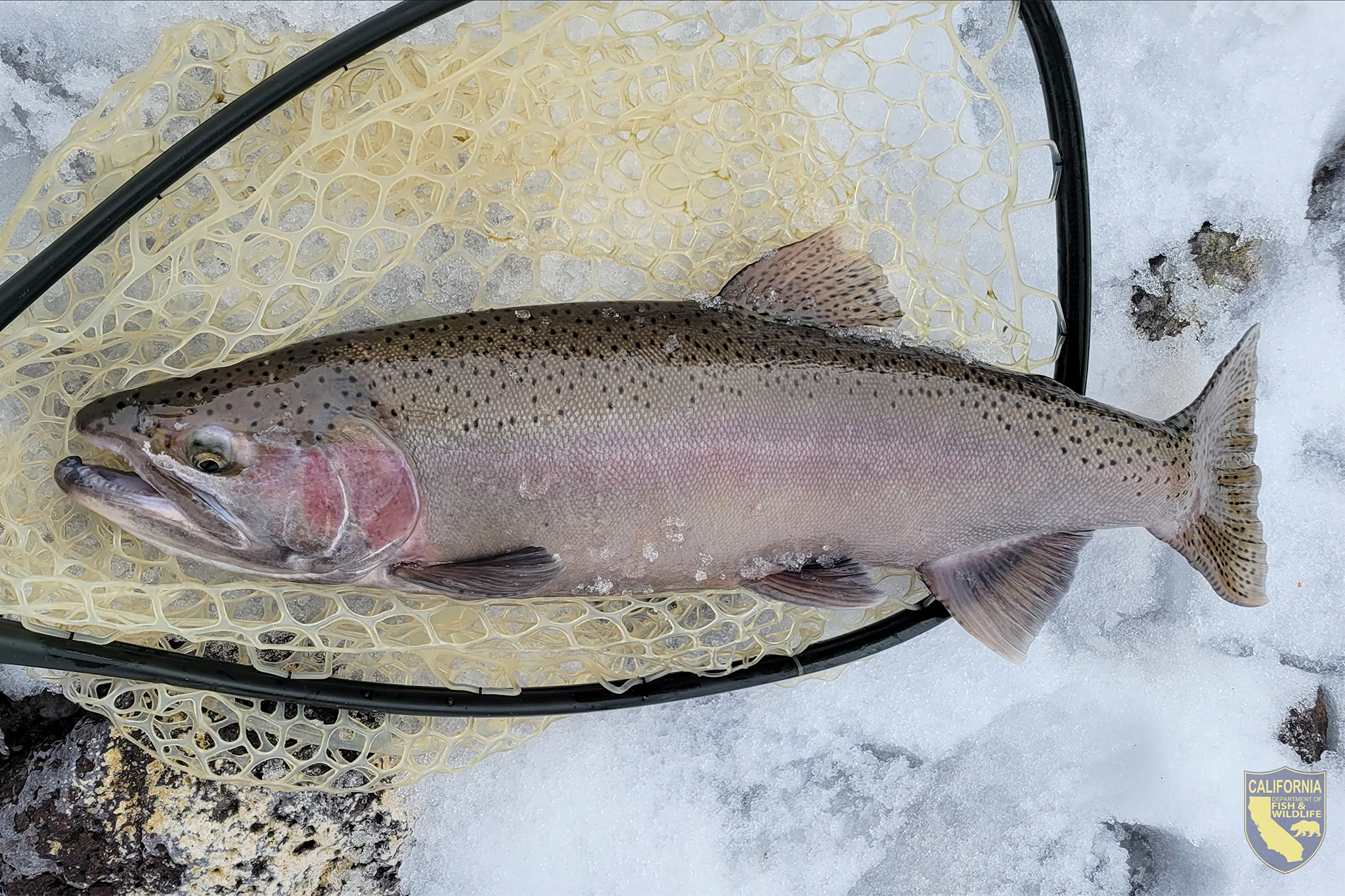
5,800 rainbow trout faced a ‘bleak’ death sentence. An emergency rescue saved them.
North of Susanville, on the edge of the Great Basin, Eagle Lake is a wild and beautiful body of water with an undulating shoreline. Sagebrush flats roll off to the north. Pine and fir trees border the southern edge of the lake. It’s the second largest freshwater lake that’s entirely within California, a closed basin with alkaline water, one main tributary and no outlet.
Read more ‘Aggressive’ turkeys trigger warning from Bay Area police

Out of that unique environment came a remarkable subspecies of colorful and resilient rainbow trout: the Eagle Lake rainbow trout. Among its attributes, it can survive in severe conditions and outlives other species of rainbow trout: The oldest on record is 11 years old, compared to the 4- to 6-year average lifespan.
The trout’s resilience and adaptability is one reason why it plays such a big role in the California Department of Fish and Wildlife’s hatchery operations. The department stocks Eagle Lake rainbow trout in waters across the state for recreational fishing. But Eagle Lake “is the only place in the world where they were originally found,” said Paul Divine, fisheries biologist for the California Department of Fish and Wildlife’s district in Lassen and Modoc counties.
Come spring, Eagle Lake rainbow trout migrate upstream on the lake’s main tributary, Pine Creek, to spawn. The problem is, Pine Creek can be a gamble. The arid creek only flows for a few months out of the year and quickly dries as the weather warms up.
“Pine Creek flows through some very wide, open valleys that are basically just sagebrush flats. There’s no trees or riparian vegetation. So it can warm up really rapidly,” Divine said.
This year saw a volatile combination of snowstorms in December and February, followed by rain and a record-setting heat wave. That meant thousands of fish had already begun their migration upstream Pine Creek and were at risk of getting stranded as the creek threatened to dry up faster than the fish could swim downstream to Eagle Lake.
A death sentence loomed for thousands of trout caught in a small section of Pine Creek that was less than a mile long. Bald eagles, ravens and turkey vultures circled in the sky, ready to feed on the fish. The outlook was “bleak,” Divine said. Something had to be done.
This spring, the California Department of Fish and Wildlife launched an emergency rescue operation to save 5,800 Eagle Lake rainbow trout from getting stranded in Pine Creek. It wasn’t the first time Eagle Lake rainbow trout have been stranded, but it was the largest rescue in more than a decade.
Over four days in March and April, 25 biologists, hatchery staff and volunteers climbed down to the banks of Pine Creek, equipped with waders and fishing nets. Their mission was to trap as many fish as possible and transport them in trucks equipped with water tanks so they could be released in Eagle Lake.
Heavy duty plastic bags were deployed: “Just put a little water in the bag, put a few fish in, swing it over your shoulder and carry them up the hill to a truck,” Divine said.
At other times, the operation was more complicated, especially in places where water was flowing and the fish could easily swim around the nets into deeper pools. In those instances, the rescuers used backpack electrofishing units that emit a small electrical current to the water and stun the fish, temporarily immobilizing them, giving rescuers a window to corral the fish in a large net and contain them in a holding pen.
Read more Impossibly rare tropical bird swooped over California. Experts fear a trend.
Some places along the creek were far from the road. Rescuers formed a line down the sagebrush-studded hillside, about 15 people long, and handed the fish one by one up the hill. “It was like a bucket brigade, just handing them off to get them up the hill,” Divine said.
Eagle Lake rainbow trout are a hardy species. Their precarious environment, especially when they are spawning in Pine Creek, has taken a toll in the past. In the 1930s and 1940s, their population numbers dipped to historic lows, and in 1959, wildlife officials built a weir to trap fish in Pine Creek, launching a hatchery for the Eagle Lake rainbow trout. “This program is believed to have saved the species from extinction,” a states. However, the reliance on “artificial propagation” has an unwanted impact on the gene pool. So in 2012, wildlife officials built a “fishway” that lets some trout pass through farther upstream to spawn naturally.
Extreme weather conditions, driven in large part by climate change, are making life even more unpredictable for the Eagle Lake rainbow trout.
“We’re seeing more extremes, extreme dry or extreme wet,” Divine said.
In wet years, the trout can swim far upstream and spawn naturally, with plenty of time for adult and juvenile fish to make their way back to the lake.

The Bay Area’s best free newsletter.
By signing up, you agree to our Terms Of Use and acknowledge that your information will be used as described in our Privacy Policy.
Divine has also seen dry years when the creek never ran because there was no snow and minimal rain. In those years, very few trout make it upstream to spawn.
Winters like this year’s, however, are the biggest challenge. There was enough snowpack for the creek to run and lots of fish had begun their annual migration, but then temperatures warmed up fast, putting those fish in a bad spot.
The good news is that, with so many adult fish saved, their long lifespans are a built-in buffer for challenging years. They may have time to make up for missed seasons: “With the fish being long-lived and adult sized, returning all those fish back to the lake, there’s a good chance they’ll have an opportunity again some other time in future years to spawn again,” Divine said.
— With days to go, poll shows candidate for Calif. governor pulling away
— DHS says it’s ‘drawing up plans’ to ban international arrivals at SFO
— Berkeley police probe rare homicide after woman found dead in home
— Last-minute deal saves Calif. megadevelopment from going dry
Read more Meta lays off more than 2,000 from Menlo Park headquarters
Sign up for daily SFGATE breaking news alerts here.