Bay Area crash occurred hours after teens took drunk driving education
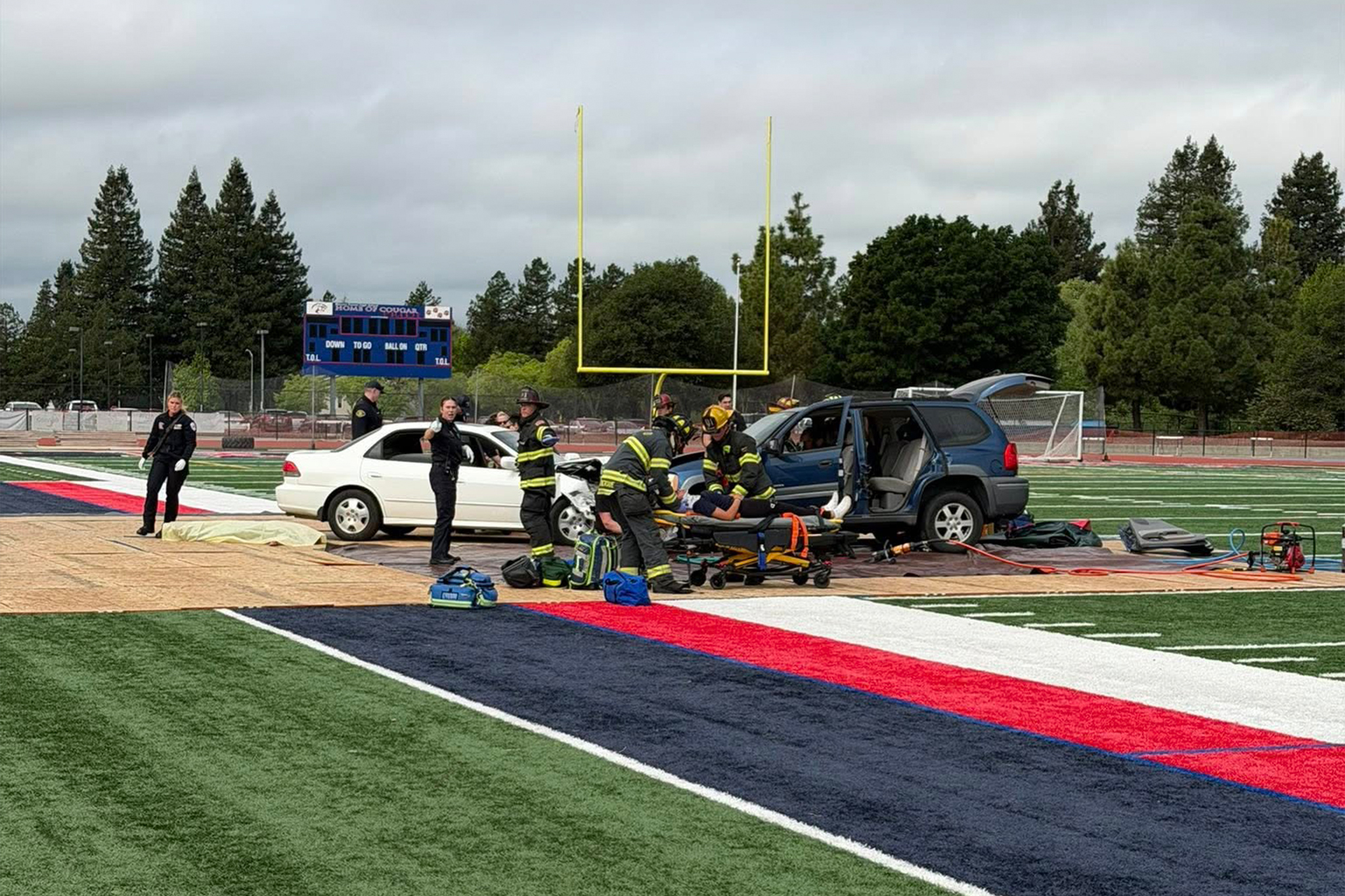
Last month, Tim Mattos delivered a speech on drunk driving to Bay Area high school students that he’s given before. Students lined the bleachers at Rancho Cotate High School while the Rohnert Park police chief urged them to not drive under the influence.
Read more Convicted child predator disappears after judge allows release before sentencing in El Dorado County

“Understand, the difference between a graduation cap and casket is making the right choice,” Mattos told the students.
Hours later, tragedy hit the Sonoma high school. A Toyota Camry struck a utility pole a few towns over in Novato at around 1 a.m. on April 11, killing 17-year-old Rancho Cotate student Niko Vargas-Ortiz and leaving another student in critical condition. The 17-year-old driver was later arrested and charged with driving under the influence.
“The next morning when I woke up and looked at the text, I got a lump in my throat. I literally said this could happen,” Mattos told SFGATE. “It’s a tragedy, there’s no other word for it. It’s so disheartening to know we put that program on and within 12 hours that happened. I couldn’t believe it.”
Mattos’ speech to Rancho Cotate High School was part of the Every 15 Minutes, a two-day program aimed at reducing drunk driving that is held at of California high schools every year. The state provides funding, and the California Highway Patrol and local law enforcement work together to administer the program, which include simulated car crashes designed to instill fear in students about the danger of drunk driving.
It’s a full-throated plea to discourage driving under the influence, but its efficacy has come into question, given that a young person who was a passenger died right after their school participated. Robert G. Lachausse, a psychologist at California Baptist University, wrote in 2018 that there’s no evidence the program works and faulted its approach, saying “it is unlikely that scare tactics or awareness programs will ever be effective.”
Don’t let Google decide who you trust.
After decades of implementation in countless schools and government subsidies, Every 15 Minutes’s effectiveness remains largely unstudied.
One study from 2000 that used surveys before and after Every 15 Minutes sessions found that the program “had a favorable impact on attitudes but not behavior.” No other studies appear to have been done to evaluate the effectiveness of the program, but the state of California continues to fund programs like these, with the California Office of Traffic Safety recently requesting $30 million to support “” for 2024 to 2026.
— Search warrant served at home connected to Kristin Smart’s killer
— Bay Area crash occurred hours after teens took drunk driving education
— Convicted child predator disappears before sentencing in Tahoe
— Alcatraz coyote didn’t swim from San Francisco, officials say
Sign up for daily SFGATE breaking news alerts here.
In 2024, the state for $2.65 million and received $2.5 million from the U.S. Department of Transportation to support Every 15 Minutes and related programs. SFGATE left several messages for representatives of the California Office of Traffic Safety but never received a response.
California Highway Patrol officer David deRutte remembered how Every 15 Minutes faltered for some students at Piner High School in Santa Rosa, who completed it in 2019.
“One of our officers made a speed stop on a student right after the program,” deRutte said. “They were blown away. The student had just watched this program, and now they’re driving way over the limit.”
The intensive youth education program has become a staple of high school education in the state, rotating between schools in a county every few years. Police, first responders and educators collaborate on a highly orchestrated mock car crash to illustrate the aftereffects in heart-wrenching detail across two days. Participating students are assigned roles — including a “driver” who undergoes the full process of an arrest — while several others act as the “living dead” to personify loss in the student community.
Every 15 Minutes is praised for its commitment to accuracy, which led to confusion after the car crash on April 11, with some community members thinking the deadly Novato crash was part of the demonstration after the superintendent of Cotati-Rohnert Park Unified School District emailed parents the following day.
Read more New Amazon facility sparks heavy backlash in small California town
“There was confusion about what is real and what is not real,” Maité Iturri, the superintendent, told SFGATE.
The Press Democrat reported that the five teens, ages 16 to 18, were current students from the Rancho Cotate and El Camino high schools. Iturri could not confirm if the students from Rancho Cotate had attended school during Every 15 Minutes. Mattos said he believes some of the students were in the bleachers that day.
“I don’t blame any of the kids,” he said. “You talk about the fact that you have the living dead, the arrested, the one taken in the body bag. There’s a lot going on there. If you’re watching closely, it has an impact on you.”
Originally from Canada, Every 15 Minutes was first adopted by a California high school in 1995. The name derives from an older statistic that, four times an hour, someone in the U.S. is injured or killed in an alcohol-related crash.
In on highway safety, the state’s Office of Traffic Safety revealed that alcohol-impaired driving accounts for nearly a third of all traffic fatalities. Drunk driving fatalities have fallen in the last three decades, but it’s still an ongoing issue; nationally, in 2021, someone died from an alcohol-impaired driving crash every 39 minutes on average.
Despite funding and education, the state found in 2024 that alcohol-impaired driving fatalities have steadily increased over the years, reaching 1,370 in 2021. The office said its goal is to reduce that number to 912 by the end of 2026.
Nearly a third of the fatal incidents involving alcohol in 2021 — 481 crashes — included drivers under the age of 20.
Mattos and Iturri said they have not personally heard criticisms about Every 15 Minutes since the crash. Both said the incident proves there is still more to do to encourage students not to drink and drive.
“What else can we be doing? We have Every 15 Minutes — now what else can we be doing? I’m never satisfied with one response, we need a multilayered response,” Iturri said. “We just need to be continually improving our systems and how we’re engaging with students.”

Iturri said that after the Rancho Cotate community mourns the loss of one of its own, she would like to “include the students in the conversation” by engaging them on next steps.
Mattos also suggested turning to students for developing more effective measures. He proposed a continuation to Every 15 Minutes that could occur a week after the program, where the students that participated could detail further about what they thought to their peers.
“That wouldn’t have mattered in this situation, since the crash was 12 hours after it was done,” Mattos said. “But we need to keep the conversations going.”
— Illegal cars on Market Street surge after Mayor Lurie welcomes Waymo
— California’s biggest state park expansion in decades spotlights Central Valley
— This Hollywood icon is Cal Poly’s proudest dad
— Hawaiian Airlines is slowly disappearing in front of our eyes
— $2.5 million bridge over Highway 101 planned in Northern California
Read more Long-stalled plan to honor SF sports legends finally gets approval
For more travel news and features, sign up for our TravelSkills newsletter here.