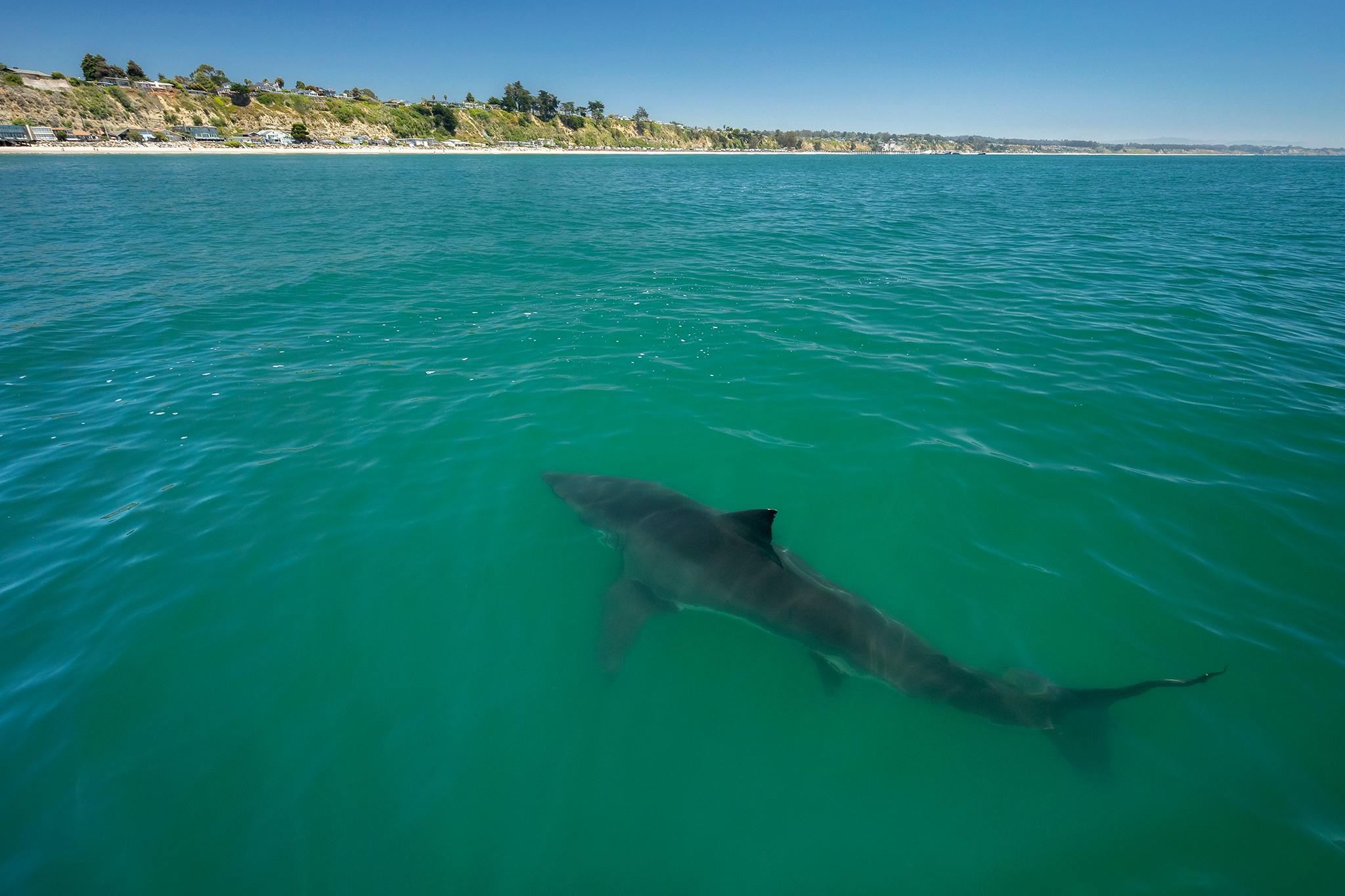
Bay Area scientists see rare shark entourage as El Niño looms
It was Paul Kanive and Scot Anderson’s first day out on the water for the season. The president and vice president of the California White Shark Project were looking for the oceanic apex predators off the coast of Point Reyes as part of their organization’s population monitoring efforts throughout the state. But just before noon on that September morning, the researchers got more than they bargained for.
Read more He poisoned his Berkeley co-worker. Now he wants his conviction cleared.

While the duo would have been thrilled to see at least one shark, they spotted three in the murky blue depths of the sea. One of them, found about 100 yards from land, was accompanied by an entourage of pilotfish — something Kanive and Anderson had “never seen before in over 20 years of research” at that particular aggregation site.
“Every year, you never know what you’re going to get,” Kanive told SFGATE over the phone. “And this year in particular is exciting because of the height behind this super El Niño on an oceanic scale, and the temperature changes in the water. We can’t predict what will happen, but it’s interesting to see those tropical fish this far north this time of year.”
Striped and similarly carnivorous, pilotfish are known for their tendency to swim alongside sharks, rays and sea turtles, with whom they share a mutualistic relationship. In this case, while the sharks get the benefit of the fish picking away at their parasites and dead skin, the fish get an easy food source and are able to take cover from other larger predators that would never attempt to get near a white shark.
Anderson said the only other time their organization observed pilotfish swimming with a white shark was during the last El Niño in 2023, near the Farallones. “It’s surprising to see,” he said, “and would be something you would correlate to warmer waters.”
Back from the shark cafe
White sharks, often called “great white” sharks by the public, are found off the coast of California year-round. But sightings become more frequent between the months of September and November — a period some researchers call “Sharktober” — as the mature animals return from their annual migration to the White Shark Cafe, a meetup point approximately halfway between Baja California and Hawaii.
It’s during this time that the California White Shark Project, which has been compiling data since 1987, heads out to known aggregation sites of the toothy predators, including the Farallones and Año Nuevo Island. Using the combination of a seal decoy — a yoga mat cut out to resemble the silhouette of the animal from below that’s soft enough to prevent damage to their teeth — and salvaged marine mammal blubber they are permitted to deploy, the scientists attempt to lure sharks for documentation and identification.
“When a dorsal fin comes out of the water, that’s how we ID the animal,” Anderson explained. “If it comes closer, we can get underwater footage and determine the sex.”
Advice| My wife is unable to have sex, but I still want it. What can I do?
Local | SF’s bougiest street is an ultrawealthy construction site
Health | How I went from ‘healthy’ to a quadruple bypass in weeks
Sports| Private investigator shakes up a California high school
Read our stories ad-free on the new SFGATE app.
Factors like El Niño years are accounted for to see if there are impacts on survival rates or other trends that may be affecting the population. In some ways, it’s “a double-edged sword,” Kanive said. Warmer temperatures in the water can lead to harmful algal blooms, causing more animals like sea lions and elephant seals to get sickened by domoic acid poisoning, which can make them disoriented and unable to react quickly.
“That’s an easy meal for a shark,” Kanive said. He noted the carnivores are less likely to get sickened by the neurotoxin because they typically prey on one animal for a meal, as opposed to a high concentration of them, like a sea lion eating anchovy would. “They don’t have to think twice.”
Over time, if enough animals died as a result of the marine neurotoxin, the sharks could lose their source of prey. But the researchers find that highly unlikely.
Anderson said they’ve watched humpback whales lunge feeding “all day long” in Half Moon Bay, and recently found one of the animals washed up dead on Point Reyes National Seashore. It was covered in shark bites, with 1,000 to 2,000 pounds of flesh missing, Kanive estimated. They’ve also observed “dramatically high” populations of California sea lions on the Farallones.
Read more Reality TV personality shot and killed in downtown Oakland
“Right now, it looks like they’re going to get as much as they need,” Kanive said.
Counting sharks
Kanive and Anderson estimate that there are about 300 to 350 sharks living in the Red Triangle, an area off the coast of Northern California between Bodega Bay, the Farallones and Big Sur. Typically, they are subadults ranging from just 8 to 12 feet long, though the duo have observed a slight increase in adult males and females, which can grow up to 19 feet long. Identifying individuals over time allows the researchers to learn more about growth and mortality rates, and also estimate abundance and population trends.
“It’s important to realize it’s a small population on the West Coast, and it’s vulnerable,” Anderson said. “If we weren’t counting them, there would be no real numbers. This is a really valuable dataset to speak to what the sharks are doing.”
As far as the ongoing impacts of El Niño, the researchers need to let the season run its course, after which they’ll start crunching the numbers and looking at results. They hope to have a new update on the shark population by the spring or summer of 2027.
“The one thing that will be most notable in this warming water is that white sharks are actually warm-blooded,” Anderson said, making them more likely to survive and maintain their core temperature, as opposed to smaller sharks that may lose heat more quickly.
However, for that reason, Kanive speculated more of the smaller sharks may make their way up north.
“Today, we saw five, and that’s a good day,” he told SFGATE last week. “Going back to 2020, zero to one or two a day was our average.”
That doesn’t mean surfers and other people heading out to the water need to be especially worried, Anderson said, but they should still take precautionary measures as they would during any shark season. Look into whether the spot has a history of white shark encounters with humans, he advised. Go out with a group instead of going alone, and check where you can get medical attention if needed.
“If you’re around seals and sea lions, you’re around prey where there’s probably going to be predators around,” he said. “But if you’re in the waters along the California coast and swimming, recreating, you’ve probably been seen by a white shark and it hasn’t done anything. Those benign interactions don’t get as much news, but they happen several orders of magnitude more than the unfortunate ones.”
Notably, shark bites are rare in California. Between 1950 and 2022, there were fewer than 250 encounters recorded between humans and all species of sharks, and of those run-ins, fewer than 20 were fatal, according to the California Department of Fish and Wildlife.
It’s tough to say what the next few months will have in store for Bay Area wildlife. “But that’s what excites us about being shark researchers,” Kanive said. “You never expect anything and are always surprised by what they tell us.”
— Sea turtle lays eggs in Calif. for first time in recorded history
— Pup boom for endangered gray wolves breaks California records
— After mistaking call as spam, Bay Area resident wins ‘genius grant’
— All eyes are on this new El Niño forecast for California
Read more The last woman executed in California was the mother-in-law from hell
Sign up for daily SFGATE breaking news alerts here.