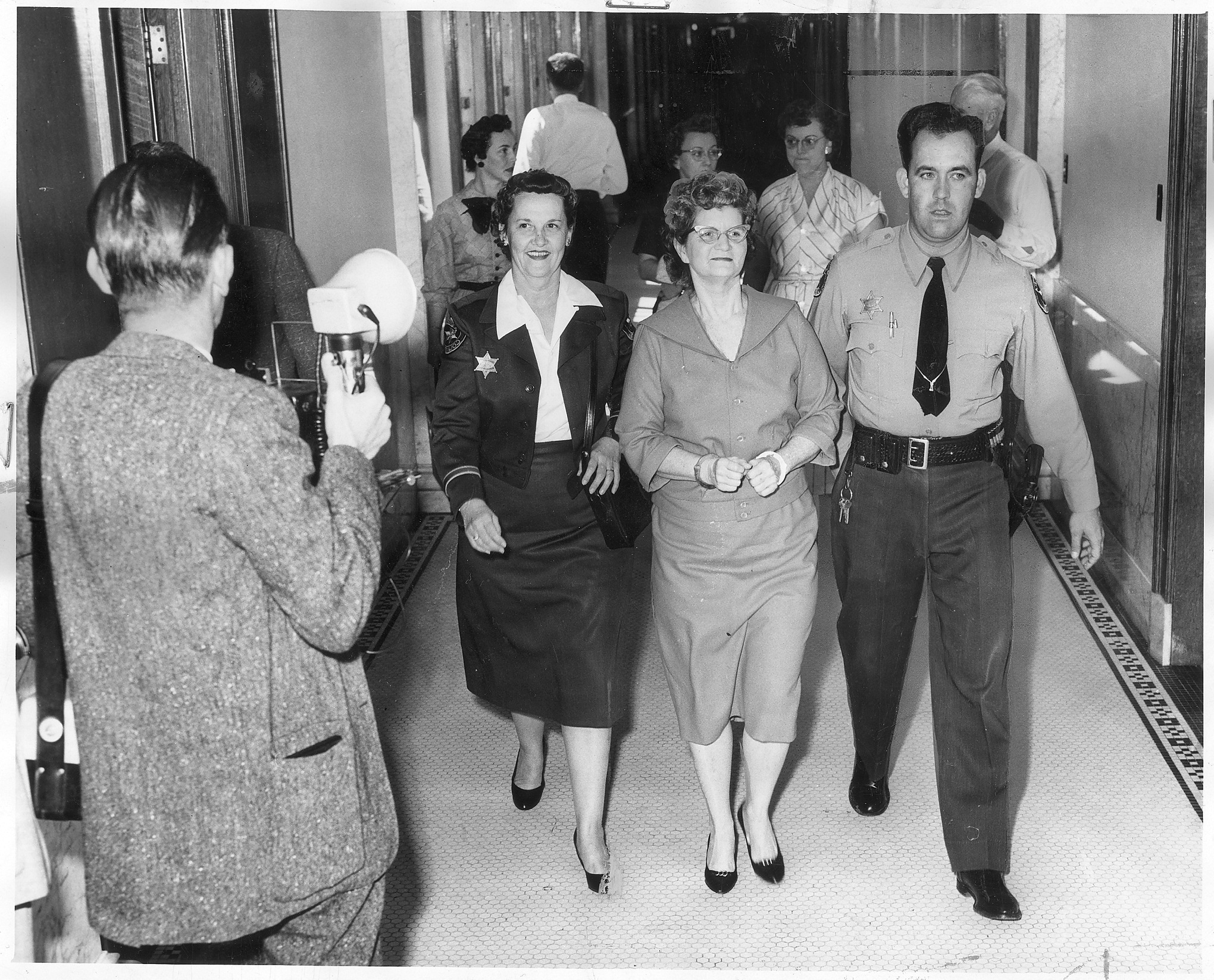
The last woman executed in California was the mother-in-law from hell
The woman in the hospital bed didn’t seem like a threat to nurse Olga Kupczyk.

She’d been admitted in November 1957 for an overdose of sleeping pills, an apparent suicide attempt after her adult son said he was moving out of their Santa Barbara home. The 53-year-old housewife was catatonic over the situation, but if Olga thought it was strange, it didn’t dampen a growing crush on her patient’s son. As Olga cared for the woman, her eyes kept falling on Frank Duncan. After his mother was discharged, Frank asked Olga on a date.
Read more Desert flooding traps 70 ultramarathoners in ‘war zone’ conditions
It wasn’t until later that Olga may have wondered how Elizabeth Ann Duncan viewed those early interactions — and when exactly it was that Elizabeth decided Olga had to die.
‘Your mother tried to get me to kidnap your wife’
Few mothers in the annals of history have been as compulsively, disturbingly obsessed with their sons as Elizabeth Duncan. Born Hazel Nigh, her aliases are impossible to keep up with due to the fact she married at least 10, and possibly up to 20, times. Those marriages produced at least four children, including Frank, born in 1929 in Southern California. Despite the fact Elizabeth had a teen daughter who died tragically of a cerebral hemorrhage, Elizabeth had no problem telling people that Frank, always, was her favorite child.
Wherever Frank went, his mother followed. When he started law school at Hastings in San Francisco, Elizabeth moved in with him. But she wasn’t single: In an eight-year span, she married and divorced five different men. Most were close to Frank’s age: a 24-year-old man who filed for divorce when she refused to leave her son and live with him, a typewriter salesman who was 15 years Elizabeth’s junior and, most unsettlingly, a law school classmate of Frank’s. That marriage was annulled when Elizabeth refused to have sex until Frank graduated. History has not recorded her rationale for that particular demand.
Despite Elizabeth’s full-time employment as a bride-slash-divorcee, she had another part-time gig. In 1953, an undercover San Francisco police officer entered a massage parlor run by Elizabeth at 1008 Sutter St. He was asked, quite unsubtly, if he wanted “a massage or a girl.” Elizabeth, then in her 40s, was charged with running a brothel.
The next year, Frank graduated law school and moved back to Southern California to begin his career. His mother — surprise — went with him. But cracks were starting to show in their co-habitation. Frank was now a full-grown adult, and he was going on regular dates. This, no doubt, introduced tension into the relationship, and he began threatening to leave their shared home.
In response to one such threat in November 1957, Elizabeth took too many sleeping pills, landing her in the Santa Barbara hospital where 29-year-old nurse Olga Kupczyk worked. Olga had recently moved from Canada in search of sunny weather and better job opportunities. And when she met a young attorney named Frank Duncan, it seemed she had found love, too.
Frank had never been this serious with a woman before, and it sent Elizabeth into a tizzy. When Frank told her that he planned to marry Olga, Elizabeth — who had no leg to stand on when it came to quickie weddings — ordered him to tell her before they got married.
“But I saw Olga the next day and we just decided to go ahead,” Frank would later testify in court. There was a reason for their impulsive decision: After just a few months of dating, Olga was pregnant. Knowing that Mommie Dearest was going to lose her proverbial marbles, Frank asked the county clerk to hide their marriage certificate. At the time, all marriage certificates were reported in the local newspaper, so hiding it would give Frank at least a few days to break the news to his mother.
Although the county clerk played ball, it didn’t matter. That night, Frank didn’t come home. Elizabeth immediately rang up the hospital where Olga worked and asked if the nurse was in. A cheerful co-worker told the woman that Olga was off on her honeymoon. Elizabeth saw red. And she started planning.
First, Elizabeth tried being a holy terror. She called Frank’s office and hospital constantly. She showed up at the couple’s home and pounded on the door until they ordered her to leave. She bought a gun and told Frank she intended to kill herself with it.
Two months after the couple got married, Elizabeth offered a man $100 to come with her to the county courthouse to annul a marriage. She said he would play the part of her son Frank Duncan and she’d stand in for Olga Duncan. The man, understandably, asked why the couple couldn’t come themselves. Olga said her important lawyer son was too busy. As for Olga, “To hell with that bitch,” Elizabeth allegedly said.
The ruse worked, and the separation was granted. This, however, only served to piss off Frank even further. He felt like a “human yo-yo,” he said, constantly “going back and forth, trying to keep both happy.” But there was no making Elizabeth happy. With the now visibly pregnant Olga still very much in the picture, she escalated.
Her plan was not a sophisticated one. Frank was then working as a criminal defense attorney, and Elizabeth saw his clients as a stream of possible crooks. She began approaching some of them, asking if they would get rid of a young nurse for cash. At least one of the people she approached tattled to Frank. The woman, working as a carhop at a local restaurant called the Blue Onion, demanded to know if his mother was “crazy.”
“Your mother tried to get me to kidnap your wife!” the outraged carhop told him. If Frank thought it was a serious threat, he didn’t show it.
Although the carhop had turned her down, Elizabeth found two men who didn’t: 25-year-old Augustine Baldonado and 20-year-old Luis Moya. She offered them $6,000 to kill Olga, and they had no scruples about agreeing to the deal.
The last few weeks of Olga’s life must have been terrifying. She was almost seven months pregnant and being harassed relentlessly by her mother-in-law. Her husband was around only sporadically, and seemed more on his mother’s side than hers. At a breaking point, Olga was contemplating divorce.
Read more Retired SFPD officer linked to murder-suicide that left SFPD wife, daughter dead
The last night of Olga’s life, Nov. 17, 1958, she had a few nurse friends over at her apartment on 1114 Garden St. in Santa Barbara. They left around 11 p.m., and the apartment complex went quiet. Not long after, Moya knocked on Olga’s door. He explained to her that her husband was downstairs drunk in a car, and he needed her help to get him inside. Olga went with Moya to the car, where Baldonado was hiding in the backseat. Baldonado struck her on the head with a pistol and Moya sped off into the night, eventually pulling over on the side of Highway 150 near the Casitas Dam.
The men had planned to shoot the pregnant woman dead, but in the struggle, the gun was damaged. So they came up with a horrific backup plan: They took turns strangling her, one man putting her in a headlock while the other dug a shallow grave with his hands. Once Olga stopped breathing, they rolled her into the grave, obscured from the road by a ravine and heavy brush.
The next morning, Olga’s co-workers were alarmed when she didn’t appear for work. They went to her apartment and found the door wide open. Her passport, luggage and purse were all inside.
A search began, and it was obvious to detectives that something very, very strange was going on with Olga’s mother-in-law. Witnesses emerged who’d either been approached directly by Elizabeth or were privy to her offers to kidnap, harm or kill Olga. Police arrested Moya and Baldonado, and the pair pointed fingers at Elizabeth Duncan. Once in custody, Baldonado agreed to lead police to the spot where they’d buried the body. Olga was still in the quilted robe she’d left her home in. “Her knees were drawn up, the way a child sleeps on a cold night,” a Santa Barbara News-Press reporter wrote.
When the case went to trial, the defense made the mistake of allowing Elizabeth to testify. Her demeanor was offputting, swinging between anger and inappropriate cheeriness. She “generally appeared to be enjoying her chance to tell her own story,” the News-Press reported. She admitted she’d been “in hysterics” over the marriage, but insisted she never threatened to harm her daughter-in-law. She did, however, say that she fought with Olga over the fact she had premarital sex with Frank — quite the moral high ground from a woman who once ran a brothel. In front of police, Elizabeth sighed that her favorite son didn’t “know much about women, and that may be my fault.”
The jury took less than five hours to return a guilty verdict. A few days later, Duncan, Moya and Baldonado were all sentenced to death in San Quentin’s gas chamber. Frank, who had stood by his mother’s side the entire time, was outraged. “It was horribly unfair,” he told reporters. “There is no question that political ambition is involved in this.” He accused the lead prosecutor of trying to “climb to a higher position over the body of my mother.”
The body of his deceased wife and unborn child went unmentioned. In fact, despite promises to a funeral home that he would claim Olga’s ashes and pay for the bill, Frank reportedly never did. Months after Olga died, her brother finally came to Ventura to arrange for her ashes to be taken home to Canada.
‘The best mother a son could have’
Whereas now appeals can take decades, in the 1960s, the wheels of justice turned much faster. By August 1962, the trio of killers had exhausted their final appeals. Duncan requested steak for her last meal — although she was thoroughly convinced it was not, in fact, her final dinner. San Quentin’s warden found her unruffled, convinced that Frank would save her. But the hours ticked by and no call for clemency came through on the prison phone line. On the morning of Aug. 8, 1962, the warden escorted Elizabeth Ann Duncan to San Quentin’s gas chamber. Before she went into the green metal hull, she calmly turned to him and said, “I am innocent. Where is Frank?”
She was strapped into a chair; below her was a vat of acid. At 10:04 a.m., cyanide pellets were dropped into the acid, unleashing a fatal cloud of fumes. Eight minutes later, she was dead. Frank, who was still at a San Francisco courthouse, fighting for a last-second appeal, was beside himself. He called her “the best mother a son could have.”
Astonishingly, the work of the San Quentin executioners wasn’t finished. A few hours later, Moya, then 23, and Baldonado, 28, were taken to the gas chamber. After being strapped in, Baldonado joked to a guard, “Be sure to close the door when you leave.” Seated side by side, they were killed simultaneously. Since that day, California has never executed another woman — and they’ve never killed three people in the same day again. California’s death penalty is currently on an indefinite moratorium; it’s been 20 years since the state’s last execution.
A mystery remains regarding the whereabouts of Elizabeth’s body. According to newspaper reports at the time, Frank claimed his mother’s remains, but some genealogy websites have her final resting place as the San Quentin cemetery. San Quentin’s own records, however, don’t list her among its permanent residents. Wherever she lies, Frank Duncan is likely the only person who knows for sure.
Frank went on to marry again; when he was fighting for his mother’s life, he was on his second marriage, this time to a fellow attorney. Their marriage ended in 1966; she cited his hostility toward house guests as one of the reasons for their divorce. She did still retain him as her lawyer in a personal injury suit, though. Frank continued to practice law until 2023, when he was disbarred in his 90s.
Although Elizabeth Ann Duncan was a household name for a time, Olga Kupczyk and her unborn baby have largely been forgotten. From newspaper accounts after her death, it’s clear that in her 30 short years, she made countless friends among the nursing community. Her family, far away in Canada, loved and missed her deeply. And, despite her tumultuous marriage, she was still looking forward to what her future held.
“Life is short,” she wrote to a friend shortly before her murder, “and I want to enjoy the rest of it.”
Advice| My wife is unable to have sex, but I still want it. What can I do?
Local | SF’s bougiest street is an ultrawealthy construction site
Health | How I went from ‘healthy’ to a quadruple bypass in weeks
Sports| Private investigator shakes up a California high school
Read more Calif. family’s dog, let out by campground staff, now roams Yellowstone alone
Read our stories ad-free on the new SFGATE app.