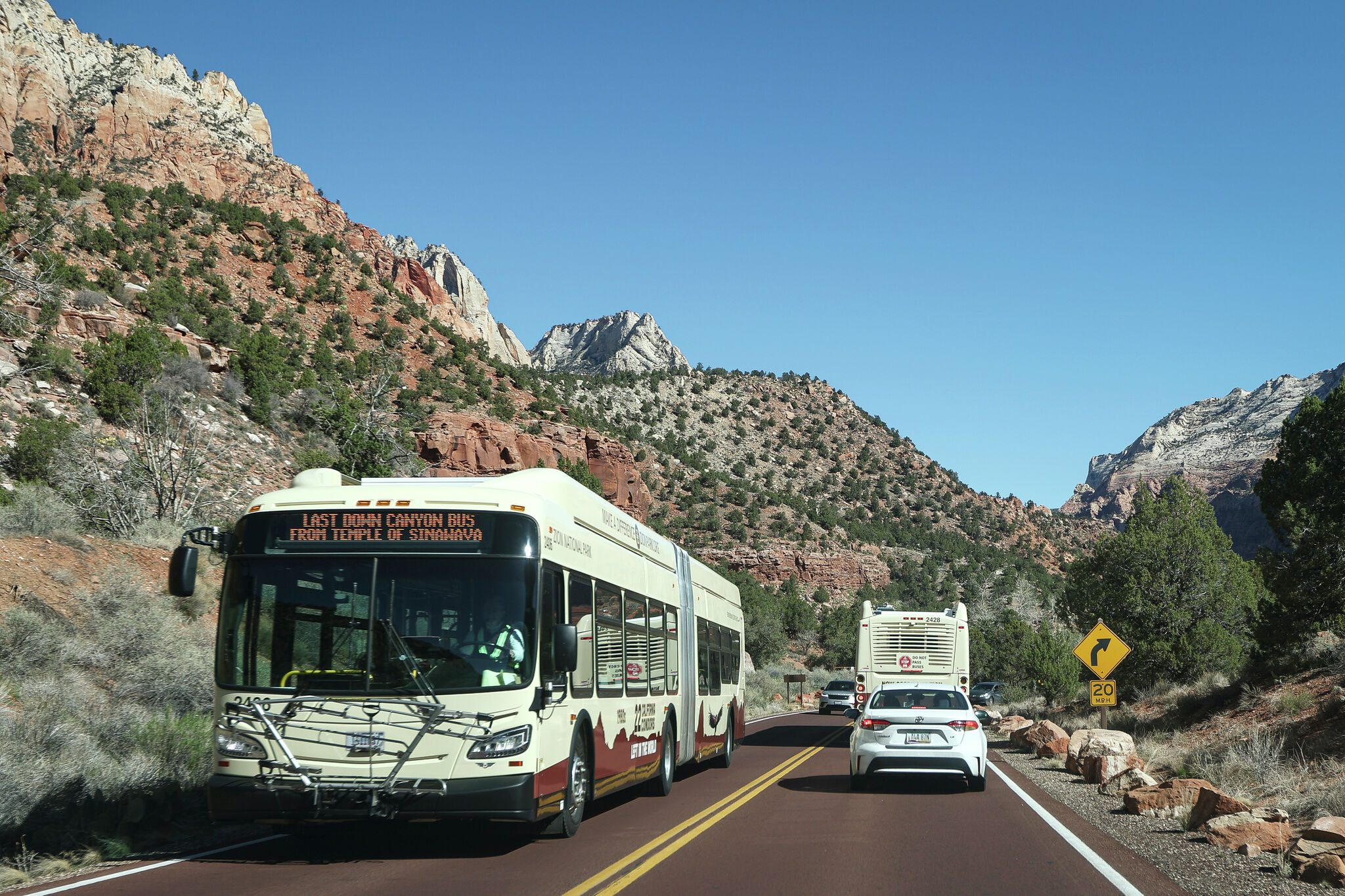
Another dramatic rockfall in Zion National Park begs the question: Why now?
A slew of rockfalls has grabbed headlines at national parks across the West this summer, killing multiple visitors and climbers while closing popular roads and trails.
Read more Dozens remain at Calif. rescue where 138 dogs found dead, 700 missing

Earlier this week, a large rockfall blocked part of Zion National Park’s scenic drive, forcing shuttle buses to turn around and closing the road to pedestrians and cyclists. The incident came two months after a boulder crashed to the ground in the Narrows, landing just feet from a group of hikers.
No one was injured, but visitors hit by rockfall in other national parks across the West this summer haven’t been so lucky. In July at Mount Rainier, a rockfall killed a climber and injured three others, and a falling rock in Glacier National Park crashed through a vehicle and later claimed a visitor’s life.
View this post on InstagramA post shared by Zion Concierge (@zionconcierge)
Rockfalls are a natural and often unpredictable part of national park landscapes, commonly caused by water, freeze-thaw cycles and erosion. Researchers are also studying how repeated heating and cooling — especially during hot summer weather — can weaken rock and trigger collapses.
“We had all these rockfalls that happened in the summertime when it was a blue-sky day. It hadn’t rained for weeks. There was no earthquake. We didn’t know why,” said Brian Collins, a supervisory research civil engineer with the U.S. Geological Survey.
Over a decade ago, Collins and his colleagues began examining whether heat could explain otherwise unexplained rockfalls. A 2016 study, conducted with Yosemite National Park geologist Greg Stock, monitored a thin granite slab on a south-facing cliff in Yosemite Valley for three years. The study found that the slab moved in and out by as much as a centimeter each day as temperatures changed, while also shifting permanently outward by about half a millimeter to a millimeter per year.
“Basically, [slabs] are going in and out because of this,” Collins said, comparing the movement to breathing.
The researchers found that the largest fluctuations did not necessarily occur during the hottest months. In Yosemite, it happened during the shoulder seasons, when cold nights were followed by warm afternoons and temperatures could swing by 30 or 40 degrees. But the slab was farthest out from the cliff during the summer, after months of repeated expansion and contraction. That led the researchers to hypothesize that a rockfall may be more likely to occur during the hottest part of the year, when the rock is already most extended.
The team also examined a database of Yosemite rockfalls and focused on events without an obvious trigger, such as rain, an earthquake or freeze-thaw conditions. Those rockfalls occurred disproportionately during summer afternoons, when solar heating would be expected to peak. Collins described the relationship as a “loose correlation,” but said it was statistically significant enough to suggest that thermal stress could be the final push for some unstable rocks.
Read more California man swindles more than 40 investors in lucrative real estate scheme
In other words, heat may not create the weakness in a cliff, but it could help turn an existing fracture into a collapse.
The research has since expanded beyond Yosemite. In a 2018 study, Collins, Stock and their colleagues examined “spontaneous exfoliation” events at Twain Harte, California, where large granite slabs detached from a dome beside a concrete dam. The researchers found that the rock was breaking apart during the hottest times of the day and year, when temperatures rose to the 99th percentile for the site.
In Yosemite, researchers have tested radar and lidar systems to identify which sections of a cliff face are moving the most, but predicting exactly when or where a rock will fall remains challenging. Still more difficult to predict is whether hotter summers could lead to more rockfalls.

BECOME A FRIEND. GET OUR AD-FREE APP.
“That’s a lot tougher of a question,” Collins said. “We don’t have a lot of good studies on that.”
Rockfalls can be caused by many different processes, and researchers would need to investigate individual events to determine whether temperature extremes played a role. Still, Collins said, daily cycles of heating and cooling affect rocks across the planet and may gradually weaken them, even when heat is not the immediate trigger.
“If they’re not the straw that broke the camel’s back,” Collins said, “they’re certainly leading to the kinds of stresses in rocks that will eventually lead to failure.”
— National park ranger quits, tours visitor centers to fight censorship
— 30-year-old who set El Capitan speed record dies in national park climbing accident
— Near Mount Rainier, mysterious sightings continue to baffle the public
— Calif. marmot researchers turn to OnlyFans as their funding dries up
We love national parks just as much as you do, so we have a newsletter that covers them from top to bottom. Sign up here.
Read more Eugenio Suarez’s grand slam highlights 7-run 9th inning as the Reds rally past Giants 10-9