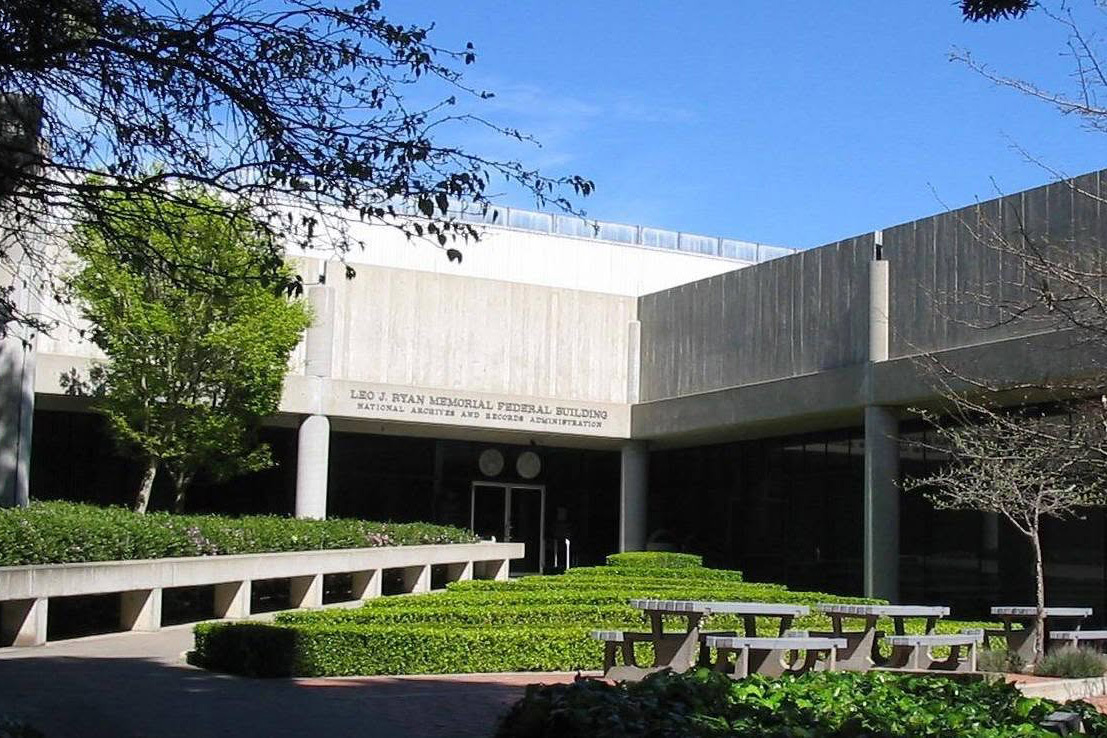
Trump administration targets SF National Archives, home of birthright citizenship records
Trump administration plans to close the Bay Area branch of the National Archives storing vital documents chronicling immigration to the West Coast is spurring widespread concern and resistance among local residents and beyond. Activists say they were caught off guard by the news, which came to light in late June through an internal email first obtained by KQED.
Read more New tire rule raises concerns: ‘California is particularly vulnerable here’

“If it wasn’t for someone leaking an employee’s memo, we would not have known that this was coming, that things were in motion, and that records could be moved as soon as this month or the next couple months,” said Christopher Chow, former chair of the Angel Island Immigration Station Historical Advisory Committee, whose own father’s record is stored there. “We’re still in the dark.”
The National Archives and Records Administration has not released details about its intentions, timeline or justification for closing the National Archives at San Francisco, and the agency did not respond to SFGATE’s requests for comment. A brief message on its website only says that the facility, located in San Bruno, is “closing in the next few years” and “we will share future updates here.”
But if the San Francisco site does shutter and its records are moved, Californians looking for genealogical records, and records involving Japanese American detention camps, Chinese American immigration, and Native and Pacific Islander history, could all risk losing local access.
Chow is also a member of the advocacy group Save Our National Archives, which formed when federal officials previously sought to shut down the San Francisco facility in 1998 and sell the property. But a broad coalition of locals, students, genealogists and historians mobilized at the time to save it, he said.
“It’s disappointing to see that nearly 30 years later, we’ve come back full circle to this situation,” he said. “The difference is, this time there was no public notice prior and there’s been no public discussion.”
What’s at the National Archives
Though the National Archives temporarily hosts various pedestrian documents, like IRS records, its permanent collection, which spans more than 75,000 cubic feet, holds far greater importance for people like Chow. It includes records critical to Northern and Central California history since the 1840s, as well as records from much of Nevada, Hawaii, Guam, American Samoa, dozens of Native American tribes, and U.S. Navy bases in the Pacific and East Asia.
With more than a third of San Franciscans and many other Bay Area residents having Asian American heritage, maintaining a regional National Archives branch is particularly important, said Caitlin Oiye Coon, archives director at Densho, a Seattle nonprofit focused on the World War II incarceration of Japanese Americans.
“There are quite a few records at the San Bruno location that are directly related to the incarceration period,” she said.
There are also Chinese Exclusion Act files, detention records of Japanese Americans held at Hawaii camps, and all sorts of citizenship and immigration files, which are generally not digitized and harder to access, Oiye Coon said. To access those files with the help of an archivist, you only need to have a case number. But if they’re spread to other archive sites in Seattle, Riverside or elsewhere, it will become much more difficult and time-consuming to see them, Oiye Coon said.
According to the email, the federal government also seeks to shutter the National Archives in Chicago. Both moves come six years after Washington state officials sued successfully to block attempts by the first Trump administration to close Seattle’s archives. Whether a similar move could be mounted here remains unclear.
The uncertainty fuels speculation over why the Trump administration is trying to do this. Perhaps one reason, Oiye Coon said, is that the National Archives in San Bruno possesses files for the 1898 case of Wong Kim Ark, a San Franciscan born to Chinese parents, that established birthright citizenship. (In June, the Supreme Court struck down President Donald Trump’s executive order attempting to restrict birthright citizenship.) The archives also hold files involving the 1886 case of Lee Yick, a Chinese laundry owner, which formalized the right to equal protection for noncitizens.
Waverly Lowell, who served as director of the San Bruno facility from 1987 to 1998, played a role in advocating for the Chinese immigration records from Angel Island to be made permanent, she said. The archives have numerous other records, involving California’s role in the Gold Rush and the Civil War, Forest Service wildfire records, Alcatraz prisoner records, records of atomic bomb tests, and records involving the damming of Hetch Hetchy, she said.
She described any closure of the San Bruno archives as “like ripping the heart out of the history of the region.”
Read more Officers spend hours chasing loose bull along Bay Area highway
Lowell speculates that part of the reason for the federal government’s actions is that “it is cutting back on history,” and it has already repeatedly criticized the Smithsonian museums. It may also be partly due to all the records involving Chinese Americans, Japanese Americans, tribes and immigrants.
“Until they start to hurt you, they don’t document you all that well,” Lowell said. The National Archives has a modest budget and a small number of employees, she said, disputing that any notion that closing would align with the Trump administration’s record of slashing federal departments to save money. “It is penny-wise but pound foolish,” Lowell said.
Resisting the closure
Like Oiye Coon, American Historical Association Executive Director Sarah Weicksel expresses concern over the speed at which the Trump administration appears to be attempting this move. Relocating the records at the San Bruno facility requires thorough cataloging and “an extraordinary amount of planning and logistics,” Weicksel said.
The National Archives centers also serve their respective regions of the country, and it’s essential that “the people’s records,” as Weicksel describes them, remain where they are. “What we risk with the removal of these records from their locations is them no longer being accessible in the way that they are, requiring extensive amounts of travel on the part of individual citizens,” she said.
Rep. Kevin Mullin, who represents San Bruno and much of the Peninsula, co-authored a on Aug. 19 with Rep. Judy Chu of Los Angeles County to NARA’s acting head, Ed Forst, and Trump’s nominee, Bradford Wilson, arguing that the facility’s pending closure “will create an undue burden on public access” and questioning what the cost savings might be or whether they’re worth the “significant negative impacts” from the closure.
Along with Reps. Chuy García and Pramila Jayapal from Chicago and Seattle, Mullin and Chu also introduced on Aug. 20 that would prohibit any national archive, including the San Bruno facility, from closing without congressional approval. “We have a responsibility to protect this history and ensure these tangible records are carefully preserved and accessible to the people they represent,” Mullin said in an Aug. 20 news release. “… I strongly oppose the closing of the National Archives facilities in my district and around the country.”
The National Archives building itself may be of historical significance. Caitlin Hibma, a historian who runs a Bay Area consulting firm called Left Coast Architectural History, served on a team in 2022 that evaluated the significance of the building, for the General Services Administration, the agency that manages the National Archives.
She and her colleagues determined that the building is indeed historic and eligible to be included in the National Register, thanks to its architecture and its association with important events, she said. As a result, she’s concerned that the building could be torn down.

BECOME A FRIEND. GET OUR AD-FREE APP.
“I think technically GSA is supposed to then pursue formal designation, but I’m not sure they’ve done that with this building,” Hibma said. “It’s pretty easy to demolish a property that is not designated historic.”
Now a coalition of groups, led by Save Our National Archives, has been organizing. It started an online petition and collected more than 8,000 signatures, and the coalition has been making phone calls to Mullin and Forst.
“We’re talking about people who are not used to being activists, but they’re interested in the history,” Chow said. “This is important.”
— Jan. 6 attendee sells Bay Area cafe, says the money goes to Mamdani
— Foul play suspected in disappearance of woman last seen at CVS
— 3 Bay Area high schools crack California’s top 10 in new ranking
— Blue Apron, once valued at $2B, descends into chaos
Read more San Jose races to remove 32 dangerous palms downtown
Sign up for SFGATE’s breaking news email