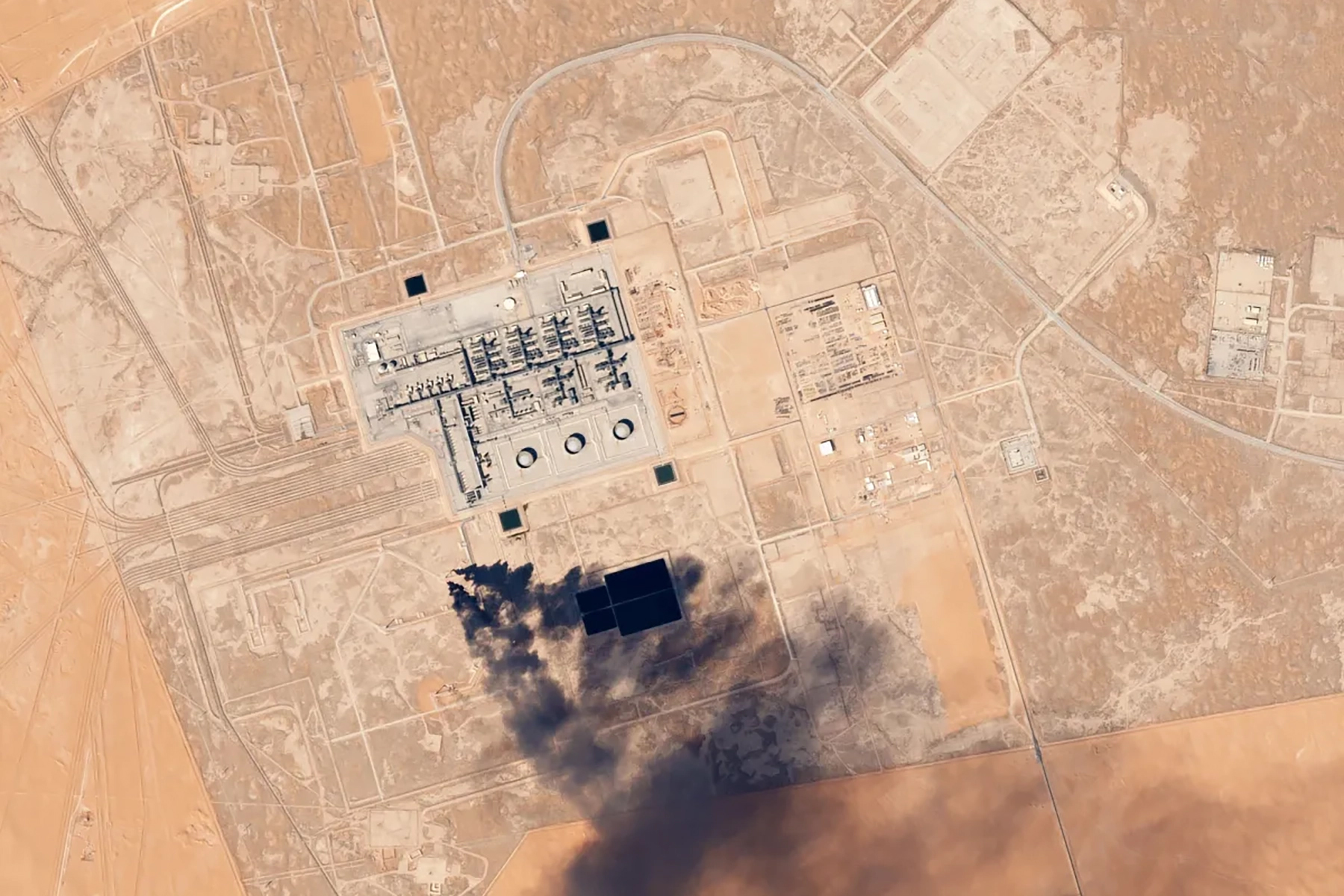
San Francisco company Planet finds itself on the front lines of Trump admin’s war on Iran
When the Trump administration began its bombing of Iran on Feb. 28, San Francisco-headquartered Planet soon made its own unprecedented decision: It began blocking the release of its satellite imagery of the Middle East. The space company had been scanning the globe and making images widely accessible to everything from news outlets to nonprofits for more than a decade, but as the attacks commenced, the company started imposing restrictions.
Read more ‘Massive migratory flight of millions’: Rare butterfly swarm visits Tahoe, Lassen

Planet, formerly known as Planet Labs, did not publicly detail at the time how it came to the decision to restrict its imagery from March 9 to July 1. But in a statement last week to SFGATE, the company said it did so at the request of the U.S. government “in response to concerns of potential misuse” of the images.
“These are extraordinary and dynamic circumstances, and these decisions have been made in an effort to balance national security and personnel safety concerns with our transparency mission,” the statement said. The company said it has now released “nearly all” of the previously restricted imagery into its archive. (Planet provided a statement in lieu of granting SFGATE an interview.)
Then on July 10, after the U.S. bombing campaign resumed following President Donald Trump’s declaration that a ceasefire with Iran was over, Planet acted again by “temporarily reinstating a delay on publishing of images” over Iran, Pakistan, Afghanistan, Turkmenistan, Uzbekistan and Azerbaijan.Both moves have put Planet in a unique and challenging situation: After building its reputation on openness and accessibility, it now finds itself relying on U.S. military contracts while managing the vicissitudes of a militant and mercurial federal government. In 2026, those contracts are where the money is, but by taking them, Planet and other California space companies are finding the Pentagon is both an unpredictable customer and a threat to the transparency it has long espoused.
Jeffrey Lewis, a distinguished research fellow at the Foreign Policy Research Institute, counts the company’s co-founders, who are former NASA scientists, as friends of his. He told SFGATE he frequently used their imagery for his work and believes Planet will eventually release the satellite data.
“I’m speculating that they came under a lot of pressure from the government,” Lewis said. “Historically, they’ve been the most transparent of any other companies; they basically put everything in the catalog.”
How satellite images became important
Formed in 2010, Planet began as a hip startup developing innovative Earth-imaging satellites, some just the size of a loaf of bread. Far cheaper to build and more adaptable than the larger satellites that dominate space, they’re also less vulnerable and they deliver higher-resolution images than those from NASA and European Space Agency satellites that you’ll see on Google Earth.
Within a decade, Planet moved ahead of the curve, operating one of the world’s largest satellite networks before most other competitors and before SpaceX had launched a single Starlink spacecraft. It now has multiple orbiting constellations totaling approximately 200 satellites, providing daily snapshots at wavelengths similar to what our eyes can see. These include crisp images with 50-centimeter resolution, and the company is even exploring the possibility of orbital data centers.
Planet’s ambitions, including aiding climate and environmental monitoring, have long matched the altitudes of its satellites. Always with the motto “Using space to help life on Earth,” the company has promoted global transparency and human rights while providing imagery to news outlets (including SFGATE), nonprofits and nongovernmental organizations.
The company is also no stranger to conflicts. For example, Agence France-Presse and the wartime civilian harm watchdog Airwars used Planet’s images in 2023 to investigate the killing of a journalist in southern Lebanon, possibly due to a targeted Israeli attack. But while it has delayed or restricted its satellite data delivery before, such as during Russia’s invasion of Ukraine in 2022 and the start of Israel’s war in Gaza in 2023, this is the first time Planet has entirely blocked such data over a vast region spanning almost a million square miles.
Some U.S. national security experts believe that, since Planet’s satellite imagers sweep over almost every country every day, Iran’s military could use such images to target American troops in the region. Though Lewis believes such concerns are overstated, he said it “would be a totally freaking nightmare” for a company if it had turned out the Iranians had access to its satellite data prior to any U.S. service members being killed in the conflict. “Even if it was totally unrelated, that would’ve been reputationally catastrophic,” he said.
In addition, the move to limit commercial satellite images probably didn’t matter that much in the conflict, Lewis argues. “I think we have pretty good evidence now that Russia and China are assisting the Iranians with satellite imagery, so I don’t think Planet’s imagery would have been that much of a risk,” he said.
A Planet competitor, Colorado-headquartered Vantor (formerly known as Maxar), also restricted imagery at the same time. The U.S. government is overwhelmingly Vantor’s largest contractor, Lewis said.
Jennifer Rizzo, a Vantor spokesperson, told SFGATE in an emailed statement that it imposed “enhanced access controls” to its imagery over the parts of the Middle East, and that it places such restrictions when there is a risk to “civilians, U.S. Forces, allies, or partners.” Rizzo’s statement continues: “These decisions are made independently by Vantor based on the security environment and potential risk; they are not directed by any government or third party.”
The military space economy grows
Though many customers globally pay for satellite-based imagery, navigation, broadband internet, communications and more, the U.S. military remains a top funder of the space industry. And even as demand rises for commercial space services and companies like Planet can work with more customers than before, the Pentagon still wields the largest budgets.
Read more Why California is rebuilding Santa Clara County’s largest dam
“A lot of us want to see a space economy that’s not dependent on the government or military, but that day is not today or next year,” said Clayton Swope, deputy director of the Aerospace Security Project at the Center for Strategic and International Studies, a Washington, D.C., think tank whose donors include a few aerospace and defense companies. In some ways, he said, Planet and other new space companies face a similar situation as Lockheed Martin and other aerospace industry heavyweights they disrupted: They’re somewhat dependent on the Pentagon as a customer, “and you can’t alienate that customer.”
Military space budgets dwarf those of NASA and other space agencies. The Trump administration proposed in April a whopping $1.5 trillion annual defense budget, compared with about $900 billion the previous year. In contrast, other federal agencies with space needs are facing cuts, including NASA, which has a $24 billion budget, but the White House proposed a budget of less than $19 billion for the next fiscal year. Military space budgets in both the United States and internationally are approximately doubling between 2026 and the next fiscal year, according to a report released on July 21 by Space Foundation, a nonprofit organization that advocates for the space industry.
For its part, Planet has sought to diversify its customer base over the past decade. In addition to the U.S. government, which is one of its major customers, the company has inked even more lucrative international government contracts with Germany, Sweden and Japan. Nevertheless, work for the defense and intelligence worlds has become a growing part of Planet’s business, including previous contracts with the Navy, the National Reconnaissance Office and NATO. And in March, Planet was named as a prime contractor to provide missile-detection data to the Department of Defense’s Missile Defense Agency.
Planet is not alone in its ongoing work for defense and intelligence agencies. California hosts an abundance of space companies, which all depend on Pentagon contracts to some degree. For example, San Francisco’s Capella Space has contracts to provide radar-based imagery and a military communications satellite. Menlo Park’s L3Harris is developing missile-tracking satellites for the Pentagon’s massive Golden Dome missile defense project, and Costa Mesa’s Anduril and a handful of other companies are developing prototypes of missile interceptors that could be deployed in space.
In addition, the U.S. Space Force on July 17 expanded its national security launch contracts and added two Southern California companies, Relativity Space and Impulse Space, to its list of launch providers.
“What’s new is that the Space Force’s budget is growing rapidly and companies are catering part of their business to it,” said Charles Mahoney, a political scientist at CSU Long Beach. The Space Force has a small number of service members, called Guardians, while around two-thirds of its budget goes to contractors, Mahoney points out.
Repercussions
Planet’s and Vantor’s imagery restrictions could have consequences, including for their international customers and for the space economy.
“Instead of limiting Iran’s access to target US bases and forces, I think what it did is it limited the ability to get information about the impact of the war, for outsiders to look at,” said Victoria Samson, chief director of space security and stability at the Secure World Foundation, a nonpartisan Colorado think tank. “It was limiting transparency more than anything else.”
Congress is also taking note. A bill introduced on July 9 in the House of Representatives would block American space companies like Planet from providing “sensitive imagery that could harm national security.” But because satellite imagery is readily accessible from other sources, the legislation would only “limit transparency and harm U.S. Earth observation companies in their competitiveness internationally,” Samson said. Though some European companies have reportedly begun filling the gap left by Planet’s missing imagery, as of mid-July, the European Union imposed a 24-hour delay in releasing European Space Agency satellite imagery over the Gulf of Oman.
Still, Mahoney said the U.S. government has another incentive to encourage companies like Planet and Vantor to limit public access to their images: Any limitations would constrain what news organizations can report about damage to civilian infrastructure from U.S. strikes and the effectiveness of Iran’s military responses.
“By restricting that satellite data, it makes it harder for journalists and the American public to actually see how extensive the damage that Iran’s ballistic missile campaign has inflicted on the US and its partners in the Middle East,” he said.

BECOME A FRIEND. GET OUR AD-FREE APP.
Beyond the loss of transparency that companies have built their reputation on, Samson named another consequence for the commercial space industry that’s emerged over the past couple of years. Even if most of a company’s business is used for civilian purposes, being seen as connected with the U.S. military can make one’s spacecraft legitimate military targets, just as Russia has sought to jam Starlink satellites over Ukraine.
“How do you intend to recover if you’re targeted because of that?” she said. “I don’t know if a lot of companies have thought about that.”
— 6 arrested on suspicion of attacking Calif. family at Maui resort
— Hiker impaled by trekking pole in Montana speaks out about self-rescue
— San Francisco suing to stop allegedly brazen hotel booking scam
— Bay Area wildlife mystery leaves researchers ‘somewhat horrified’
Read more Controversial SF robot startup faces class action lawsuit for allegedly not paying workers
Sign up for SFGATE’s breaking news email