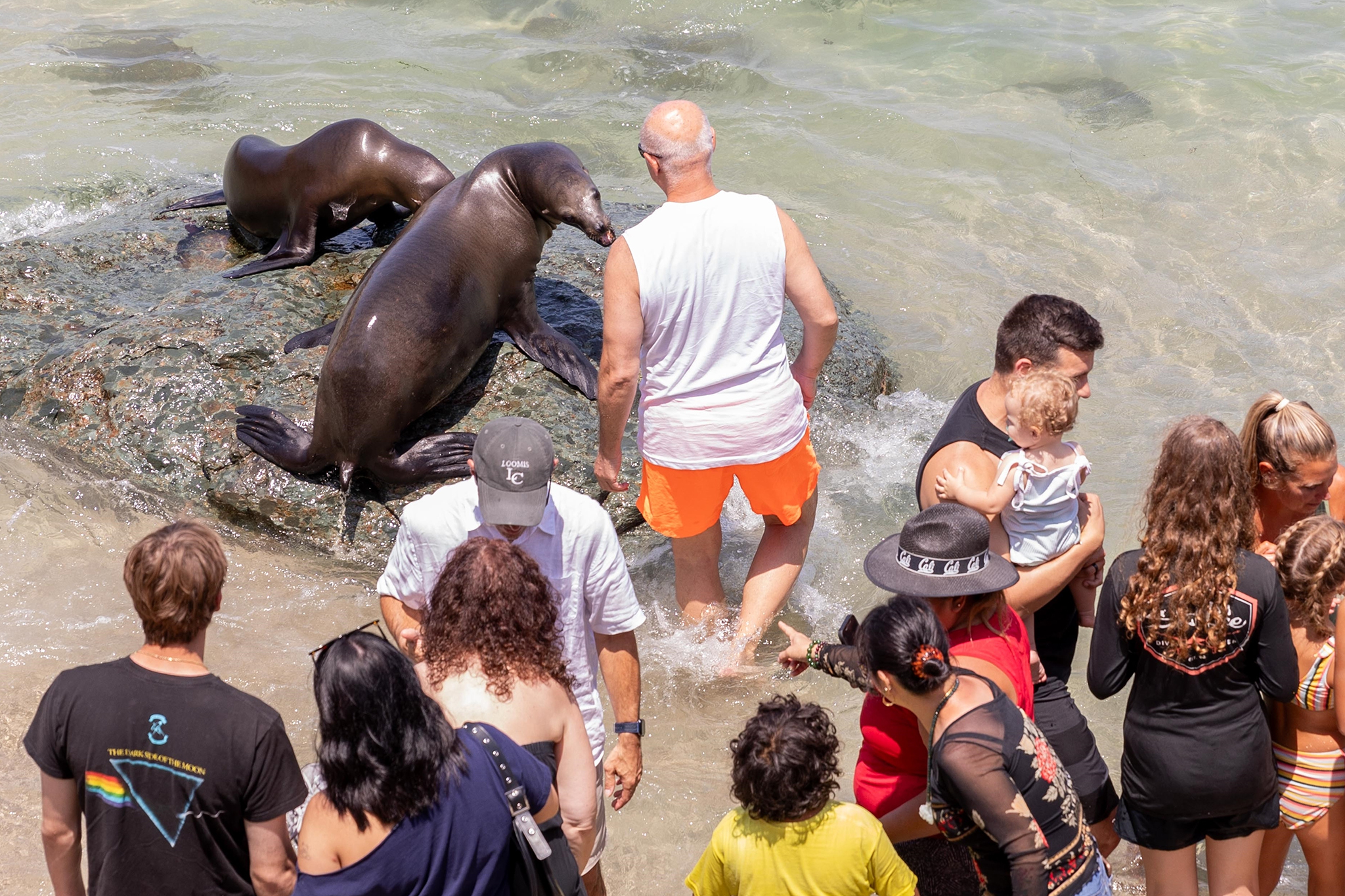
Tourists are still harassing the sea lions at La Jolla Cove
The city of San Diego continues to struggle to find the right balance between keeping a historic beach open to the public and protecting the wildlife on its shores.
Read more Devers, Lee hit 3-run homers, Ray pitches 6 shutout innings as Giants beat Angels 9-2

La Jolla Cove, which attracted 2.3 million visitors in 2024 and was recently voted the best beach in the United States by Tripadvisor, is known for the sea lions that sunbathe on its shores and the permeating smell from the waste they produce. But the interaction of humans and animals on the sands has also become a problem.
Fifty percent of the pups born this season have died, Robyn Davidoff, chair of the Sierra Club Seal Society, told SFGATE. In comparison, only 10% of pups have died in the area not open to human interaction.
Though Davidoff did not name a reason for the greater death rate, beachgoers can get too close to the sea lions as they take photos. When the pups are touched, it changes their scent, making them unrecognizable to their mothers.
“We can’t say that it’s all from humans, but we would have seen the same kind of death rate around the corner,” Davidoff said. “So I think some of it, some of it could be preventable, not all of it. And I believe the natural death rate in the first couple of months is about 25%.”
The sea lions are a protected species under the federal Marine Mammal Protection Act, and guidelines suggest people stay at least 150 feet away. But large crowds can overtake the beach, and some visitors continue to skirt the NOAA guidance to give sea lions ample space. Davidoff said the city’s rules require visitors to stay at least 20 feet away from sea lions.
The city has ramped up its prevention efforts by adding larger signs and recorded announcements in five different languages that warn visitors of the distance they need to keep from the sea lions. Park rangers on the beach and daily volunteers from the Sierra Club Seal Society also help patrol the area and provide education to visitors.
However, city park rangers do not have the authority to enforce the Marine Mammal Protection Act. Instead, violators are reported to the National Oceanic and Atmospheric Administration, which can determine whether to prosecute. Anyone who breaks the law can be fined up to $36,498 or spend up to one year in prison.
Benny Cartwright, spokesperson for the city of San Diego’s Parks and Recreation Department, told SFGATE in an email that the department has referred only a few cases to NOAA, partly due to rangers’ limited capabilities.
“In most cases, individuals refuse to provide identification and walk off. Rangers do not have authority to detain for this, so no referrals are sent in these cases. NOAA then decides whether to open an investigation,” Cartwright said.
Read more Cause of death revealed for hiker found near Big Sur hot spring
In an email to SFGATE, a spokesperson for the NOAA Fisheries Office of Law Enforcement said the agency has “insufficient resources to provide a persistent presence at La Jolla Cove.”
“We have only four Enforcement Officers covering the State of California. Therefore, we rely on our partnerships with local park rangers and the California Department of Fish and Wildlife to provide an enforcement presence in La Jolla Cove,” the email said.
The Sierra Club Seal Society would like the city to add cones and tape off the area where visitors would be too close, saying it would make the rangers’ job easier.
“It would give a visual cue to the people on the beach as to how close they can be to the animals,” Davidoff said. “What we’ve experienced is that people don’t really know what 20 feet is.”
In May, Bob Evans, president of La Jolla Parks and Beaches, argued against adding cones to the beaches. He told the San Diego Union-Tribune that he saw the cones as a gradual step toward a closure like that at Point La Jolla, which the city of San Diego, in partnership with the California Coastal Commission, closed for seven years in 2023 to keep the sea lions in the area safe.

BECOME A FRIEND. GET OUR AD-FREE APP.
Placing cones “creates a psychological barrier that prevents access,” Evans told the outlet. “I call coning off part of The Cove [the same] as closing it.”
There are no plans to close the beach, Davidoff said, and the Sierra Club Seal Society believes the beach should stay open.
“We just want more management and have a share-the-shore kind of situation, Davidoff said. “Which is what NOAA recommends.”
Culture| Iggy Pop caged and whisked offstage at Oakland performance
News | Woman killed herself to fulfill ChatGPT prophecy, lawsuit alleges
Travel | Long-awaited Highway 1 reopening has spelled disaster in Big Sur
News | California nurse, 27, murdered while in Michigan
Read more Visitor dies after being hit by falling rock at Glacier National Park
Read our stories ad-free on the new SFGATE app.